About a quarter million young men on each side were wounded and about 135 thousand died in the appallingly badly planned Gallipoli campaign that was launched by the intellectually retarded military leaders of the 'Allied' forces on April 25, 1915. It is recognized as one of the great military disasters of all time, a fiasco of massive proportions. The 100th anniversary of what henceforth was called Anzac Day, like the 100th anniversary of the Armenian genocide which is commemorated on April 24, is not an occasion for celebration. There is, however, something to celebrate: they fought on opposite sides, but Turks and Australians have been firm friends ever since. When Wendy and I were taken to the Gallipoli battlefields by our Turkish hosts in October 2004, we encountered several groups of young Australians, many of them high school students, and were struck by the obviously affectionate relationship between them and their Turkish hosts who also looked to be about high school age. Friendships forged between opposing sides in 1915 have become firmer in recent generations, reinforced by these visits of young Australians.
My memories of Anzac Day date from my very early childhood, probably 1931 when I was 5, soon after my mother took my brother Peter and me to live with her in a bungalow at Brighton, a seaside village separated in those days from Adelaide by several miles of orchards and vineyards. One morning she woke me very early and dragged me unwillingly to a dawn commemoration service. Peter was too young to come with us and I resented the fact that he stayed home warm in bed, while I had to get up on this cold morning and listen to a series of men making speeches about matters I didn't comprehend. In the years that followed, I came to appreciate Anzac Day as a sacred remembrance ceremony at which we honoured those who died in the 1915 Gallipoli campaign. They included my mother's brother, my Uncle Lidie, QMS Elias Judell, 9th Light Horse Regiment, who died like so many others in an artillery bombardment from the heights above that the ANZAC forces could never conquer. ANZAC is the Australian and New Zealand Army Corps. They were the backbone of the forces at Gallipoli, and were supported by British, Indian, French, and even a tiny company of the Royal Newfoundland Regiment - now proudly but falsely claimed as 'Canadian' by our current bellicose government, which seizes upon every imaginable excuse to proclaim that Canada has always been a warrior nation.
Another of my mother's brothers, Cedric, also served at Gallipoli; so did Wendy's father who was wounded there, and two of my father's uncles. Most families in Australia and New Zealand had members who fought at Gallipoli, and many had family members who died or were maimed there. All are scarred by the experience. It is true to say that the two nations, Australia and New Zealand, were born on the battlefields of Gallipoli.
My impressions of and emotional reaction to the battlefields at Gallipoli, and some photos, are in my post on this blog, on March 10, 2012.
Friday, April 24, 2015

Sunday, April 19, 2015
An early 20th century genocide
In his CBC Radio program The Sunday Edition, Michael Enright reminded us that this year marks the 100th anniversary of the Armenian genocide of 1915. The Turkish military authorities arrested, tortured, and executed the Armenian intellectuals in Constantinople, and local authorities drove the populations out of Armenian villages and urban enclaves all over the nation. Men, women and children were herded on forced marches into arid regions lacking water, food, and shelter. Women and girls were subjected to mass rape, many who fell by the wayside on forced marches because they were too feeble or too ill to continue, were summarily executed - which, it could be argued, was a kinder fate than forcing them to keep walking until they died. An estimated one and a half million Armenians died in the genocide of 1915. Abundant documentary and photographic records confirm that this genocide really happened. Among other more or less impartial observers, the German ambassador and American consular officials reported back to their leaders in Berlin and Washington quite detailed accounts of what was happening. In the protracted discussions in Paris in 1919 to draft a peace treaty after the carnage of the Great War of 1914-1918, the 'allies' who claimed victory were anxious to win over the charismatic Turkish army officer Mustafa Kemal (later to name himself Kemal Attaturk). They therefore refrained from drawing attention to the brutal slaughter, rapes, dispossession, destruction of churches - obliteration of all traces of Armenian culture - in order to get Kemal's signature and support for the peace treaty.
The mass killings, rapes, dispossession, destruction of cultural artifacts, obliteration of an ethnic and cultural minority in Turkey are now recognized almost everywhere as a genocide. The most recent leader to acknowledge publicly what happened is Pope Francis. Almost the only national leaders to deny what happened are in Turkey. American presidents, anxious to retain Turkish friendship, have equivocated and never stated in forthright language that there was a genocide. The US Congress voted a few years ago that there was a genocide.
Why did it happen? The Armenian population in Turkey was a distinct, readily recognizable group. The Armenians are Christian, the oldest or second oldest Christian community in the world. They are mostly well educated, relatively well-to-do, rather influential movers and shakers. These qualities are enough to arouse the envy and suspicion of the majority. A paranoid belief took root that Armenians were traitors, spies, supported the Russians, and sought to bring about the defeat of Turkey, Austria and Germany in the Great War.
One consequence of the genocide was the Armenian diaspora. Gifted writers, artists, actors, musicians, film makers of Armenian heritage have greatly enriched the intellectual life of many Western nations in the 100 years since the genocide. The first to cross my cultural horizon was William Saroyan. His parents had actually left Armenia earlier and he was born in an agricultural community in California in 1903; he and the Armenian community to which he belonged, became hosts to survivors of the genocide, some of whom considerably strengthened the nascent film industry. One consequence of my peripatetic life is that I've been obliged to discard many books as I've moved from one country to another. I acquired William Saroyan's Pulitzer Prize winning novel, The Human Comedy early in my medical student years and kept it, I recall, long enough for it to migrate from Adelaide, Australia to Edinburgh, Scotland. As best as I can recall, Saroyan's allusions to the Armenian genocide in that charming novel are oblique and low-key. His comments in some of his other writing, which I also had and have discarded, were angrier, more demanding from the Turkish authorities an acknowledgement that a genocide occurred in 1915, and suggesting that they should plead for forgiveness. That's all the Armenians want: they don't seek revenge, just recognition by the Turks that they wronged and harmed their Armenian minority, and should ask for forgiveness. Well educated modern Turks are aware of what happened. Some, including the Nobel Laureate Orhan Pamuk, have spoken out courageously. How much longer will the Armenians have to wait?
The mass killings, rapes, dispossession, destruction of cultural artifacts, obliteration of an ethnic and cultural minority in Turkey are now recognized almost everywhere as a genocide. The most recent leader to acknowledge publicly what happened is Pope Francis. Almost the only national leaders to deny what happened are in Turkey. American presidents, anxious to retain Turkish friendship, have equivocated and never stated in forthright language that there was a genocide. The US Congress voted a few years ago that there was a genocide.
Why did it happen? The Armenian population in Turkey was a distinct, readily recognizable group. The Armenians are Christian, the oldest or second oldest Christian community in the world. They are mostly well educated, relatively well-to-do, rather influential movers and shakers. These qualities are enough to arouse the envy and suspicion of the majority. A paranoid belief took root that Armenians were traitors, spies, supported the Russians, and sought to bring about the defeat of Turkey, Austria and Germany in the Great War.
One consequence of the genocide was the Armenian diaspora. Gifted writers, artists, actors, musicians, film makers of Armenian heritage have greatly enriched the intellectual life of many Western nations in the 100 years since the genocide. The first to cross my cultural horizon was William Saroyan. His parents had actually left Armenia earlier and he was born in an agricultural community in California in 1903; he and the Armenian community to which he belonged, became hosts to survivors of the genocide, some of whom considerably strengthened the nascent film industry. One consequence of my peripatetic life is that I've been obliged to discard many books as I've moved from one country to another. I acquired William Saroyan's Pulitzer Prize winning novel, The Human Comedy early in my medical student years and kept it, I recall, long enough for it to migrate from Adelaide, Australia to Edinburgh, Scotland. As best as I can recall, Saroyan's allusions to the Armenian genocide in that charming novel are oblique and low-key. His comments in some of his other writing, which I also had and have discarded, were angrier, more demanding from the Turkish authorities an acknowledgement that a genocide occurred in 1915, and suggesting that they should plead for forgiveness. That's all the Armenians want: they don't seek revenge, just recognition by the Turks that they wronged and harmed their Armenian minority, and should ask for forgiveness. Well educated modern Turks are aware of what happened. Some, including the Nobel Laureate Orhan Pamuk, have spoken out courageously. How much longer will the Armenians have to wait?
Thursday, April 9, 2015
We can't be on both sides! It would be more sensible to be on neither.
The increasingly savage conflict in Yemen seems to be a proxy war between Saudi Arabia and Iran; USA is supporting the Saudis with satellite intelligence and heavy weapons. The Salafist Wahabi faction in Saudi Arabia is the philosophical base of IS or ISIS, and Iran, a Shia Islamic republic, is fighting against ISIS, with covert US (and Canadian) support. Iran supports the Assad regime in Syria, and despite this regime's war crimes, USA (and Canada) are getting closer to overt support for Assad and Iran too. But USA (and Canada) regard Saudi Arabia as a staunch ally in the Middle East, along with Israel, which doesn't get along well with Saudi Arabia and is implacably hostile to Iran. USA (and Canada) seem to be on both sides at once. I'm bewildered. I'd prefer to be aloof, neutral in this melee.
Saturday, April 4, 2015
Wrongly interpreted events
Canada's Harper government has seized on the horrible events in Iraq and Syria, exhorting all Canadians to close ranks against a perceived threat from a barbarous band of unprincipled evil-doers, with the Harper government of course, leading the nation bravely into war against these evil-doers. Meantime a few thousand Km south-east in Kenya, a handful of Al Shabaab fighters (4 or 5 altogether) from Somalia descended on a small undefended private university just across the border in Kenya, separated the Christian and Moslem students as they slept in their dormitories, and slaughtered 147 of the Christians. The Harper government hasn't proposed military action against Al Shabaab. However, its statements imply that a holy war is in progress between genocidal Islamists and the defenders of righteousness (of Judeo-Christian persuasion). A few troubling facts suggest this is at best only partly correct. It may be utterly wrong. Some of it is based on the same fantasy that asserted the Iraqis would welcome as liberators the American forces who invaded their country in 2003. One fact is that aerial bombardment, even with terrible weapons like napalm and cluster bombs, can't defeat a grass roots movement. Another fact is that populations who have been targets for napalm or cluster bombs (or any other form of aerial attack) do not perceive those who bombed them as friends. The bombing campaign the Harper government has so eagerly embraced, which will cost over half a billion dollars in the next year, will not win friends for Canada in Iraq and Syria. The Islamic State - an aspiration, a grass roots movement, not a real state - has committed some appalling atrocities. We have TV evidence from their own skilled propagandists as proof of this. But truth is the first casualty in all wars and I doubt if this is an exception. What reliable evidence is there of genocide? Another fact is that IS, or ISIS, or ISIL, is a Sunni Islamic movement; Shia Islam is its mortal enemy. That's the reason Iran, and the Assad regime in Syria, are aligned against IS - with Canada and USA. This is a Sunni-Shia war. On the basis of the old saying that 'My enemy's enemy is my friend' we have (the Harper government has) become an ally of Iran - where we recently closed our embassy - and of the reviled Assad regime. In the meantime, some 25,000 well educated youngsters from many western nations have made their way to the ruins of Syria and Iraq, eager to join IS. Why? What do they know that the rest of us don't know? It's all very bewildering.
These events suggest to me that getting involved in a war against IS may be the most stupid mistake yet made by the Harper government - a government not noted for evidence-based decisions, noted by some of us at least for some spectacularly stupid policy decisions.
There is another interpretation of the dreadful wars and unconventional forms of conflict in progress in the Middle East and Africa. Rather than being based in disputes about faith and belief, the real underlying cause is a quest for what Hitler and the Nazis called lebensraum - living space and resoures. The most important fact of all may be that the world is overpopulated by at least an order of magnitude. The world would be a better place for all humans if instead of more than 7 billion of us, there were 700 million.
These events suggest to me that getting involved in a war against IS may be the most stupid mistake yet made by the Harper government - a government not noted for evidence-based decisions, noted by some of us at least for some spectacularly stupid policy decisions.
There is another interpretation of the dreadful wars and unconventional forms of conflict in progress in the Middle East and Africa. Rather than being based in disputes about faith and belief, the real underlying cause is a quest for what Hitler and the Nazis called lebensraum - living space and resoures. The most important fact of all may be that the world is overpopulated by at least an order of magnitude. The world would be a better place for all humans if instead of more than 7 billion of us, there were 700 million.
Saturday, March 28, 2015
Dashing and dawdling
A glossy magazine insert in my daily newspaper had a revealing graphic about high speed trains in various countries. The speeds are shown in the obsolete US notation, MPH, rather than KPH, but make the point regardless. The slowest are the Belgian and Italian high speed trains; they reach 190 MPH; the Eurostar (London-Paris via the Channel Tunnel) hits 200 MPH on the sturdy French tracks, noticeably less as it crosses Kent and descends below the English Channel. In France, TGVs travel at 240 MPH. Japanese Shinkansen ("Bullet") trains and the German Transrapid reach 275 MPH. The fastest are the new Chinese high speed trains, which use an innovative propulsion system I learnt about in First Year University physics in 1944; they average just over 300 MPH but theoretically could travel at twice that speed. I've traveled on all except the Chinese high speed trains. They are all very comfortable and most are quiet. The Eurostar scores highest in my experience for comfort and quiet - and serves gourmet meals and very good wines. The Shinkansen can be noisy, but it has an unblemished safety record, no accidents in over 40 years. Indeed, all these high speed trains have excellent safety records, except the Eurostar and the newest entry in the field, the Chinese trains, each of which has had one or two crashes, though none with major loss of life or even injuries.
London to Paris, Geneva to Paris in 3 hours! With trains this fast, there's no contest with air travel: add check-in time and planes in line for an hour or more waiting to take off, and it's time-saving as well as much less stressful to take the train. If you've a mind to, you can get a lot of work done on one of these train journeys.
Intercity trains in Canada aren't included in the graphic. It's embarrassing to reflect how far behind Canada has fallen. Ottawa-Toronto "express" trains go as fast as they can on dubiously secure rail-beds with the antiquated diesel engines that pull them. For several brief periods they achieve 100 MPH, but the average speed is below 75 MPH. There are many level crossings as well as unreliable rails and rolling stock, and most trains make several stops. The Ottawa-Toronto trip typically takes 5 hours for a journey that a TGV or Shinkansen could make in well under 2 hours.
In the early 1970s there was talk about modernizing train service in the Windsor-Quebec City corridor, with a diversion through Ottawa. There's been occasional desultory talk about modernizing train services ever since. Lately there have been subversive murmurs about contracting out to China the work of strengthening the rail-bed, constructing under-passes and bridges to eliminate the level crossings for many of which current trains must slow down, perhaps even allowing China to supply rolling stock. It won't happen in my lifetime. Perhaps my grandchildren will live long enough to travel by train from Ottawa to Toronto in less than 2 hours, but I wouldn't bet on it.
London to Paris, Geneva to Paris in 3 hours! With trains this fast, there's no contest with air travel: add check-in time and planes in line for an hour or more waiting to take off, and it's time-saving as well as much less stressful to take the train. If you've a mind to, you can get a lot of work done on one of these train journeys.
Intercity trains in Canada aren't included in the graphic. It's embarrassing to reflect how far behind Canada has fallen. Ottawa-Toronto "express" trains go as fast as they can on dubiously secure rail-beds with the antiquated diesel engines that pull them. For several brief periods they achieve 100 MPH, but the average speed is below 75 MPH. There are many level crossings as well as unreliable rails and rolling stock, and most trains make several stops. The Ottawa-Toronto trip typically takes 5 hours for a journey that a TGV or Shinkansen could make in well under 2 hours.
In the early 1970s there was talk about modernizing train service in the Windsor-Quebec City corridor, with a diversion through Ottawa. There's been occasional desultory talk about modernizing train services ever since. Lately there have been subversive murmurs about contracting out to China the work of strengthening the rail-bed, constructing under-passes and bridges to eliminate the level crossings for many of which current trains must slow down, perhaps even allowing China to supply rolling stock. It won't happen in my lifetime. Perhaps my grandchildren will live long enough to travel by train from Ottawa to Toronto in less than 2 hours, but I wouldn't bet on it.
Tuesday, March 24, 2015
A Life Like Other People's
In 1961-62, Wendy and I and the two toddlers we had in those days had to survive for a year in London on a stipend meant for a single man without dependents. We rented a furnished part-house in Finsbury Park, 30 Newington Green, from a biochemist at St Mary's Hospital Medical School, who had a sabbatical year in USA. Most days I walked several miles to my office in the Social Medicine Research Unit behind the London Hospital Medical College on Whitechapel Road. Wendy made our financial survival possible by feeding us very well at rock bottom prices, walking two miles each way to Ridley Road street market, pushing David in the stroller, with Rebecca walking beside her. Usually Rebecca's little legs couldn't manage the walk home as well, so Wendy came back from the market balancing both kids on top of the spuds, sprouts, carrots and cheapest cuts of meat in the stroller. It was the nearest we came to living in real poverty. It was a wonderfully happy year, in some ways the best year we ever had, the year in which we discovered all the things you can do in London without having to spend a lot of money, or indeed, any money at all.
We were too poor to take in the rich theatrical offerings available in the West End of London. My father took us to a vaudeville show once. And I took Wendy to see Beyond the Fringe as a special treat for her birthday. We saw it with the original cast and the original skits. It was one of the best things we ever saw on stage. The cast, Peter Cook, Dudley Moore, Jonathan Miller, and Alan Bennett, were four youngsters, fresh out of Oxford, on the threshhold of outstanding, brilliant careers.
Alan Bennett - quiet, lethally witty, a penetrating social critic - was the most thoughtful of the four. He went on to achieve fame as a playwright and man of letters, best known for his TV plays Talking Heads, and for the west end success of his stage play that became an even more successful movie, The Madness of King George.
Recently I've been reading his memoir, A Life Like Other People's. I knew that he, like Peter Cook, came from a working class family in the north of England - his accent reveals this, mellowed though it is by his years at Oxford. I knew nothing about his family or about the circumstances in which he grew up. His quietly understated account of working class family life in the aftermath of the great depression of the 1930s and during the 1939-45 world war describes his mother's recurrent bouts of severe depression, the shadowy family history of suicide, and the emotional ups and downs of his two aunts. One aunt joined the WAAFs and went to exotic foreign parts - India, the Far East - while the other stayed on in a department store. Both had emotional and marital troubles. The story reads to me like a family with the heritable condition, bipolar disorder. It describes also how such families made their way in the world, living hand to mouth, making their own entertainment, finding happiness in simple pleasures. His unhappy Mam laments that theirs is not a life like other people's, but I think Alan Bennett describes a family life very much like that of tens of thousands of other people in England at that time. He is a master of the English language, and this little book, like everything of his that I've read, provides genuine aesthetic pleasure from the prose alone. I picked it up for a dollar in a jumble sale. It's a keeper, that will go into the set of book shelves where I keep my most precious books.
We were too poor to take in the rich theatrical offerings available in the West End of London. My father took us to a vaudeville show once. And I took Wendy to see Beyond the Fringe as a special treat for her birthday. We saw it with the original cast and the original skits. It was one of the best things we ever saw on stage. The cast, Peter Cook, Dudley Moore, Jonathan Miller, and Alan Bennett, were four youngsters, fresh out of Oxford, on the threshhold of outstanding, brilliant careers.
Alan Bennett - quiet, lethally witty, a penetrating social critic - was the most thoughtful of the four. He went on to achieve fame as a playwright and man of letters, best known for his TV plays Talking Heads, and for the west end success of his stage play that became an even more successful movie, The Madness of King George.
Recently I've been reading his memoir, A Life Like Other People's. I knew that he, like Peter Cook, came from a working class family in the north of England - his accent reveals this, mellowed though it is by his years at Oxford. I knew nothing about his family or about the circumstances in which he grew up. His quietly understated account of working class family life in the aftermath of the great depression of the 1930s and during the 1939-45 world war describes his mother's recurrent bouts of severe depression, the shadowy family history of suicide, and the emotional ups and downs of his two aunts. One aunt joined the WAAFs and went to exotic foreign parts - India, the Far East - while the other stayed on in a department store. Both had emotional and marital troubles. The story reads to me like a family with the heritable condition, bipolar disorder. It describes also how such families made their way in the world, living hand to mouth, making their own entertainment, finding happiness in simple pleasures. His unhappy Mam laments that theirs is not a life like other people's, but I think Alan Bennett describes a family life very much like that of tens of thousands of other people in England at that time. He is a master of the English language, and this little book, like everything of his that I've read, provides genuine aesthetic pleasure from the prose alone. I picked it up for a dollar in a jumble sale. It's a keeper, that will go into the set of book shelves where I keep my most precious books.
Monday, March 16, 2015
Alone in the Classroom
I haven't counted heads but I have a strong impression that among talented, successful fiction writers, women outnumber men by a considerable margin - at any rate in Canada. I think it's because empathy is an important quality for a writer to possess, and women tend to have a higher quotient of empathy than men do. I'm not a slow reader, quite the reverse in fact, but I read haphazardly and without reference to best seller lists. Thus I caught up with Alone in the Classroom, Elizabeth Hay's best seller from a few years ago, only last week. It's a story in which her empathy for her characters comes through loud and clear. I've read her previous novels, greatly enjoyed her Giller prize-winning Late Nights on Air. I think this is a better book, a complex story that extends over three or more generations and manages to present three dimensional views of several people whose lives and loves are intertwined. Good and great story-tellers must have several qualities. They must be able to tell a story: narrative skills are important. They must be able to create characters, preferably well-rounded, believable people. They must be able to develop tension, conflict, challenge and response, crisis and resolution, so readers will ask "Then what happened?" -- and will eagerly read on to find the answer. Another quality creative writers require is empathy, the ability to see the world through another person's eyes, and to present that other perspective with credibility and compassion. In much great literature and in most good fiction, this is the most important quality of all. It is a quality Elizabeth Hay possesses in abundance, perhaps particularly in presenting her female characters, although she does pretty well with the two most prominent men in this book too. When I finished Alone in the Classroom, I knew the free-spirited Connie, the twisted, driven Parley, dyslexic, talented philanderer Michael, and half a dozen others with whom their lives collide. I've known real people like each of them. I'm less confident that I can identify among my friendship network a real person who resembles the sometime first-person narrator Anne, perhaps because she is too self effacing. Her personality is clear enough, her appearance less so. The physical appearance, clothing styles, mannerisms, as well as the personalities of the other principal characters are sketched so convincingly I would recognize them if I saw them in my neighbourhood supermarket. Probably every reader of this blog has already read Alone in the Classroom. If there are any who haven't, try it. You'll like it.
Wednesday, March 4, 2015
What is this age we live in?
This is the age of hate and paranoia. Astute (cynical?) political leaders know that nothing binds a nation's people together as firmly as an easily identifiable hate figure. In the early 1930s when I was about 8, I began to read newspapers and listen to the radio. Benito Mussolini, leader of Italy's fascists, attracted our loathing because he was bombing and strafing Abyssinians armed with muskets and spears. The communist ideology made manifest by Stalin's regime in the Soviet Union and by some Australian trade union leaders was the object of paranoid hatred propagated in many print media and the radio stations they sponsored. A curious child increasingly aware of the world around me, I wondered why we should fear and hate a political philosophy that had many features resembling the teachings of Jesus as expressed in the Sermon on the Mount. As I went through puberty and my early teens, my country which was Australia in those days, went to war against Germany, Italy and Japan; we were part of the Free World, in contrast to the totalitarian regimes of Nazi Germany and Soviet Russia. It was easy to see and hear for ourselves if we understood German as I did - I was learning it at school - that Hitler was a very evil man. The USSR was evil too, or its leader Stalin was. He had show trials that led to execution of the intelligentsia, and brutally invaded Finland. Then a problem arose: in 1941 Soviet Russia was invaded by Nazi Germany and overnight became our second-best friend, surpassed only by Great Britain. That didn't last long though. By the late 1940s, many on the extreme right, my father among them, were asserting that we should nuke the Soviet Union before they too, like USA, got the atom bomb. Germany split asunder into good (democratic) West Germany and bad (communist) East Germany. All the countries of eastern Europe and the Baltic states were satellites of the USSR. They were bad. My passport wasn't valid for travel to any of those bad countries.
Meanwhile, bewildering political changes swept over former colonial empires. French Indo-China became Vietnam, the Dutch East Indies became Indonesia, Northern Rhodesia became Zambia, Southern Rhodesia became Zimbabwe. Portuguese East Africa became Mozambique, Belgian Congo became the Central African Republic, French Equatorial Africa fragmented into a dozen countries. Some of the leaders of these former colonies were on our side, therefore good, others weren't, therefore they were bad. Most were and are ruled by violent, bloody dictators, good friends if they grant us mining rights, our evil enemies if they don't. In Latin America, national boundaries remained intact but many countries that had been docile client states of the USA began to assert their autonomy and several had revolutions and civil wars. In Colombia the war between the government and the left wing FARC has been smouldering for 50 years. Some leaders were bad, some not, depending mostly on mining rights and whether they had democratic elections (no matter how dodgy the election may have been). Cuba was a special case. Cuba sloughed off a repulsive criminal dictator, Battista, and for a few weeks the new leader, Fidel Castro, young, handsome, bearded, speaking quaint English that made much sense, was our hero, got a ticker-tape parade in New York. Then he said some things that were labeled communist (or maybe socialist - it's a long time ago, and I forget). So overnight he became bad, and remained bad ever after. In Chile, the bloody military coup that ousted Salvadore Allende was a CIA operation that almost everyone in my personal and professional networks perceived as a profoundly evil example of American imperial excess - the worst until G W Bush's invasion of Iraq, which is having unintended consequences that seem likely to be with us for many years, perhaps until my grandchildren are my age.
In the Far East (Australia's near north) China, which had been our ally in the 1939-45 world war became the People's Republic of China and our enemy. When the PRC flexed its muscles a little bit, very nasty wars broke out in the PRC's neighbouring states, Korea and Vietnam. The Korean war began in 1950 and never ended, or at any rate there's never been a peace treaty. North Korea is the baddest of the bad, the worst of the Evil Empire, and acts accordingly. The war in Vietnam was unequivocally a war of liberation in which the people of Vietnam sought freedom and autonomy from French colonial oppressors. In one of the great political tragedies of my lifetime, American administrations saw Vietnam as another 'domino' that would fall into the evil hands of the leaders of the PRC unless they intervened. They expended untold blood - mostly Vietnamese blood - and American treasure in ultimately futile attempts to keep Vietnam within the orbit of what they chose to call the Free World. Future historians may identify the Vietnam war as the turning point that marked the end of American global hegemony.
Iran, formerly Persia, was our friend when ruled by the benevolent Shah (our leaders said he was benevolent and of course they were honest men). The Shah aspired to have atom bombs, had a large army and air force, and had secret police who pulled out schoolboys' fingernails - one little schoolboy grew up to become a student of mine in Edinburgh 10 years later. When he was 9 or 10, his fingernails had been pulled out by the Shah's police in front of his father, using needle-nosed pliers, in an attempt to persuade his father to confess to subversion of the Shah's regime. His deformed fingers never fully recovered. Then the Shah was replaced by the Ayatollah Khomeini, who was bad. His revolutionary guards were more brutal, more malevolent, than the Shah's secret police. My Iranian friends tell me many are the same people, even wear the same uniforms. My Iranian friends, almost all academics, despair of seeing changes for the better in their lifetimes. Iran is the living residue of one of the oldest organized civil societies in the world. It is sad, indeed tragic, that it is the target of bitter and perhaps paranoid hatred of the Israeli government. As for the Israelis, they seek to maintain a Jewish state in the implacably hostile Middle East. I have lost count of the number of wars they have fought against their neighbours, especially the unfortunate Palestinians. With American support, they have won all these wars. So far. They have nuclear weapons, and no doubt others as terrible. I think it is unlikely that they will go on winning these wars forever in the future. A few of my Israeli friends share my doubts and have left Israel to live in more tranquil countries. The closest I've come to the perpetual hostilities in the Middle East was during a visit to Beirut in 1998. The Lebanese civil war had ended but the scars remained everywhere in central Beirut, for example the top floors of the tower of the Holiday Inn, blackened, burnt out, destroyed by artillery and rocket propelled grenades. At night when the traffic noise quietened, I could hear distant artillery and small arms fire along the line of demarcation between the Israeli Defence Force and the Hezbollah forces in southern Lebanon; this was a constant background noise throughout the weeks I spent in Beirut. My Lebanese colleagues told me they barely recalled a time when distant (and sometimes very close) gunfire could not be heard. No one can honestly say who is good and who is bad in this cauldron of ancient hatreds.
This is a haphazard partial summary based on memories that are bound to be selective. I do my best to stay abreast of these changing political alliances although some make me recall a song about the Vicar of Bray (dating from Restoration England) that a possibly subversive school teacher taught my Grade 3 or 4 class when I was 8 or 9 years old. The Vicar of Bray might be a useful role model for us all in these turbulent times.
Meanwhile, bewildering political changes swept over former colonial empires. French Indo-China became Vietnam, the Dutch East Indies became Indonesia, Northern Rhodesia became Zambia, Southern Rhodesia became Zimbabwe. Portuguese East Africa became Mozambique, Belgian Congo became the Central African Republic, French Equatorial Africa fragmented into a dozen countries. Some of the leaders of these former colonies were on our side, therefore good, others weren't, therefore they were bad. Most were and are ruled by violent, bloody dictators, good friends if they grant us mining rights, our evil enemies if they don't. In Latin America, national boundaries remained intact but many countries that had been docile client states of the USA began to assert their autonomy and several had revolutions and civil wars. In Colombia the war between the government and the left wing FARC has been smouldering for 50 years. Some leaders were bad, some not, depending mostly on mining rights and whether they had democratic elections (no matter how dodgy the election may have been). Cuba was a special case. Cuba sloughed off a repulsive criminal dictator, Battista, and for a few weeks the new leader, Fidel Castro, young, handsome, bearded, speaking quaint English that made much sense, was our hero, got a ticker-tape parade in New York. Then he said some things that were labeled communist (or maybe socialist - it's a long time ago, and I forget). So overnight he became bad, and remained bad ever after. In Chile, the bloody military coup that ousted Salvadore Allende was a CIA operation that almost everyone in my personal and professional networks perceived as a profoundly evil example of American imperial excess - the worst until G W Bush's invasion of Iraq, which is having unintended consequences that seem likely to be with us for many years, perhaps until my grandchildren are my age.
In the Far East (Australia's near north) China, which had been our ally in the 1939-45 world war became the People's Republic of China and our enemy. When the PRC flexed its muscles a little bit, very nasty wars broke out in the PRC's neighbouring states, Korea and Vietnam. The Korean war began in 1950 and never ended, or at any rate there's never been a peace treaty. North Korea is the baddest of the bad, the worst of the Evil Empire, and acts accordingly. The war in Vietnam was unequivocally a war of liberation in which the people of Vietnam sought freedom and autonomy from French colonial oppressors. In one of the great political tragedies of my lifetime, American administrations saw Vietnam as another 'domino' that would fall into the evil hands of the leaders of the PRC unless they intervened. They expended untold blood - mostly Vietnamese blood - and American treasure in ultimately futile attempts to keep Vietnam within the orbit of what they chose to call the Free World. Future historians may identify the Vietnam war as the turning point that marked the end of American global hegemony.
Iran, formerly Persia, was our friend when ruled by the benevolent Shah (our leaders said he was benevolent and of course they were honest men). The Shah aspired to have atom bombs, had a large army and air force, and had secret police who pulled out schoolboys' fingernails - one little schoolboy grew up to become a student of mine in Edinburgh 10 years later. When he was 9 or 10, his fingernails had been pulled out by the Shah's police in front of his father, using needle-nosed pliers, in an attempt to persuade his father to confess to subversion of the Shah's regime. His deformed fingers never fully recovered. Then the Shah was replaced by the Ayatollah Khomeini, who was bad. His revolutionary guards were more brutal, more malevolent, than the Shah's secret police. My Iranian friends tell me many are the same people, even wear the same uniforms. My Iranian friends, almost all academics, despair of seeing changes for the better in their lifetimes. Iran is the living residue of one of the oldest organized civil societies in the world. It is sad, indeed tragic, that it is the target of bitter and perhaps paranoid hatred of the Israeli government. As for the Israelis, they seek to maintain a Jewish state in the implacably hostile Middle East. I have lost count of the number of wars they have fought against their neighbours, especially the unfortunate Palestinians. With American support, they have won all these wars. So far. They have nuclear weapons, and no doubt others as terrible. I think it is unlikely that they will go on winning these wars forever in the future. A few of my Israeli friends share my doubts and have left Israel to live in more tranquil countries. The closest I've come to the perpetual hostilities in the Middle East was during a visit to Beirut in 1998. The Lebanese civil war had ended but the scars remained everywhere in central Beirut, for example the top floors of the tower of the Holiday Inn, blackened, burnt out, destroyed by artillery and rocket propelled grenades. At night when the traffic noise quietened, I could hear distant artillery and small arms fire along the line of demarcation between the Israeli Defence Force and the Hezbollah forces in southern Lebanon; this was a constant background noise throughout the weeks I spent in Beirut. My Lebanese colleagues told me they barely recalled a time when distant (and sometimes very close) gunfire could not be heard. No one can honestly say who is good and who is bad in this cauldron of ancient hatreds.
This is a haphazard partial summary based on memories that are bound to be selective. I do my best to stay abreast of these changing political alliances although some make me recall a song about the Vicar of Bray (dating from Restoration England) that a possibly subversive school teacher taught my Grade 3 or 4 class when I was 8 or 9 years old. The Vicar of Bray might be a useful role model for us all in these turbulent times.
Monday, February 23, 2015
44 Scotland Street, Edinburgh
One of my most refreshing pleasures is to live a while with the occupants of the flats at 44 Scotland Street, Edinburgh, and their friends and acquaintances. The latest instalment is "Bertie's Guide to Life and Mothers" in which Bertie turns 7; his appalling mother Irene wins a prize air trip to Dubai where she is confined in a sheik's harem in the desert and starts a book club for the sheik's wives; Angas Lordie's sleepwalking is cured by a single consultation with Pat's father, the psychiatrist Dr McGregor, who acquires an email-ordered companion from the Czech Republic; Pat falls in love with a handsome furniture-maker; Angas Lordie's wife Domenica is visited by their former neighbour Antonia and Sister Maria-Fiore dei Fiore di Montagna, her aphorism-prone fellow-nun; Matthew and Elspeth and their triplets Rognvald, Tobermory, and Fergus (indistinguishable except for their names, and Matthew has mixed them up at least once so their birth order is now unknowable); their au pair Anna from Denmark and their au pair's Danish au pair Birgitte, relocate from India Street to a manor house in the Pentland Hills, Big Lou takes on a foster child, Finlay, who becomes Bertie's protector; and under Alexander McCall Smith's gentle, occasionally profound plot-weaving, (almost) everyone is happy and content. This partial synopsis is my attempt to explain why the 44 Scotland Street books are my favourites of all the delightfully inventive series by the prodigiously prolific emeritus professor of medical law at the University of Edinburgh.

The 44 Scotland Street series (9 books so far) describe the lives and times of the occupants of the 8 flats at 44 Scotland Street. Wendy and I lived in a comparable commodious flat at 22 Eyre Crescent, just around the corner from Scotland Street, for several months in 2002; there’s no #44. Bertie Pollock, the ‘gifted 6-year-old’ lives with his ultra feminist Mum and his statistician Dad in one of these flats. Other characters live in the 7 other flats in the building, or nearby. “The Sunday Philosophy Club” is the 1st book in the Isabel Dalhousie series, also set in Edinburgh, also 9 books so far; each of the Isabel Dalhousie series comes nearest to containing a ‘cosy mystery’ but that’s not why I read them. McCall Smith is a distinguished bioethicist, and he smuggles ethical conundrums into both series, and into his other books about the Number One Ladies’ Detective Agency (15 so far) set in Botswana. I’m addicted to the two series set in Edinburgh because they massage my nostalgia for that loveliest of cities, because Alexander McCall Smith writes very well, because they are gently humorous - and occasionally hilarious - and because they are about basically decent people, even the appalling Irene Pollock, who means well but is the worst mother ever for a little boy who just wants to be a normal little boy, not a gender-neutral child as his Mum aspires to mould him to be. I’d hoped to meet Alexander McCall Smith when the University of Edinburgh gave me an honorary doctoral degree in 2003, but he attended the convocation for the faculty of law, not the faculty of medicine where I got my robe, hood and parchment. He must be a remarkable man, well into his 80s now, still churning out several very well written, well-plotted, always thought provoking books every year. He types his books rather than using a word-processor, and one of his neighbours told me that on summer evenings when everyone’s windows are open, they hear his typewriter tapping away every night, far into the night. He inserts real people, other Edinburgh writers like Ian Rankin for instance, for minor walk-on parts in his Edinburgh-based stories.
The 44 Scotland Street series (9 books so far) describe the lives and times of the occupants of the 8 flats at 44 Scotland Street. Wendy and I lived in a comparable commodious flat at 22 Eyre Crescent, just around the corner from Scotland Street, for several months in 2002; there’s no #44. Bertie Pollock, the ‘gifted 6-year-old’ lives with his ultra feminist Mum and his statistician Dad in one of these flats. Other characters live in the 7 other flats in the building, or nearby. “The Sunday Philosophy Club” is the 1st book in the Isabel Dalhousie series, also set in Edinburgh, also 9 books so far; each of the Isabel Dalhousie series comes nearest to containing a ‘cosy mystery’ but that’s not why I read them. McCall Smith is a distinguished bioethicist, and he smuggles ethical conundrums into both series, and into his other books about the Number One Ladies’ Detective Agency (15 so far) set in Botswana. I’m addicted to the two series set in Edinburgh because they massage my nostalgia for that loveliest of cities, because Alexander McCall Smith writes very well, because they are gently humorous - and occasionally hilarious - and because they are about basically decent people, even the appalling Irene Pollock, who means well but is the worst mother ever for a little boy who just wants to be a normal little boy, not a gender-neutral child as his Mum aspires to mould him to be. I’d hoped to meet Alexander McCall Smith when the University of Edinburgh gave me an honorary doctoral degree in 2003, but he attended the convocation for the faculty of law, not the faculty of medicine where I got my robe, hood and parchment. He must be a remarkable man, well into his 80s now, still churning out several very well written, well-plotted, always thought provoking books every year. He types his books rather than using a word-processor, and one of his neighbours told me that on summer evenings when everyone’s windows are open, they hear his typewriter tapping away every night, far into the night. He inserts real people, other Edinburgh writers like Ian Rankin for instance, for minor walk-on parts in his Edinburgh-based stories.
Thursday, February 19, 2015
Memories - true or false?
I'm sure Wendy kept a diary in 1957, but my diligent search has failed to find it. She must have destroyed it. That's unfortunate, because I'm sure she would have recorded my encounter with the rifleman in the fig tree. I told her all about it less than an hour after it ended, and she provided much needed comfort in the week or two afterwards when I was still shaking. I have all of Wendy's diaries from 1951 until she became unable to write a few weeks before her death from motor neurone disease (ALS) with the single exception of her diary for 1957. It was a stormy year (see my post of June 28, 2013) so she probably had good reasons to do away with it when tranquility - if that's the word I want - came back into our lives.
My vivid memories of that scary episode include details such as the fact that the man had a bandage on his wrist and the policeman in charge had bad breath. Perhaps there's a police record, if the suburban police in Adelaide keep records for that length of time. I doubt if the event made it into the Adelaide Advertiser or the News (Rupert Murdoch's paper, from which he launched his worldwide media empire). Readers of this blog will just have to take my word for it.
Tuesday, February 10, 2015
Does facing death require courage or bravery?
I was 6 or 7 when our bouncy terrier was hit and fatally injured chasing after one too many cars. We wrapped him in his old blanket which soon got badly stained with his blood. I watched as his breathing became laboured and his obviously painful whining faded into silence. Then the sparkle disappeared from his eyes: they went sightless and without anyone having to tell me, I knew he was dead. It wasn't the first death I was aware of in my family, but it was the first time I observed and understood the difference between living and dead. I was about the average age at which children can grasp this concept, the distinction between life and death. I could comprehend the fact that the transition is irreversible. Once we are dead, there is no way back to life again, at any rate outside the pages of gothic and supernatural fiction.
Paediatric cancer specialists with empathy know that it is cruel and wrong to withhold the truth from children over the age of about 8, when ultimately their cancer is going to kill them - and that this might happen rather soon. Children of that age have enough insight and self awareness to recognize that they are getting worse, not better. They do not like their parents and their doctors to lie to them, and it is harmful and wrong for parents and doctors to deceive children who want to decide for themselves who will get their most treasured possessions. What's more, many children who face this fate are able to do so with courage and good humour. I have not had to care for many children facing inevitable and imminent death, for which I am thankful. In 1952 when I was a paediatric resident at Edgeware General Hospital in North London, a little girl about 9 years old was dying of bone cancer. She was cheerful most of the time, except when the pain of her cancer escaped our best efforts to suppress it. She played happily with her doll and her teddy bear, reading aloud to them. She got sad when her parents came to see her because, she said, her Mum always cried and her Dad looked so unhappy. My chief, Dr Margaret Baber, asked the child if she knew what was going to happen to her. I can't recall her exact words, but she knew her leg had been cut off near her hip because it had got cancer, knew that the cancer had come back, and knew that she would soon die. As far as Dr Baber, the experienced nurses, and I could tell, she accepted her fate calmly, without bitterness or anger. Was she courageous? Perhaps. She may have been in denial. I can't say one way or the other.
I've seen enough deaths to be aware that courage or bravery aren't usually important issues. Wendy and I knew immediately that the neurologist Pierre Bourque gave her a death sentence when he told us his diagnosis of her vaguely defined symptoms and signs was ALS, or motor neurone disease. She accepted it calmly, more calmly than I did, and we lived with the inevitability of her death for 14 months until it became a reality. Previously we had talked several times about the end of our lives and how best to prepare for this. In our mid-80s we were well adjusted to the certainty that death would come to us sooner or later. We were greatly reassured when our palliative care physician Louise Coulomb described how Wendy would die and what we could do to minimize distress. Philosophical acceptance of inevitability describes her attitude, and mine, better than courage or bravery. We were both profoundly grateful for long, useful, well-lived lives that turned out much more interesting, exciting, and fun than we'd have expected if we'd thought about it on the day we decided to join our lives together.
My own first unequivocal close encounter was my departure from Paris in April 1952. I flew, to allow me to have the maximum time in Paris. As we took off from Orly to return to Heathrow, an engine caught fire, the pilot slammed on the brakes and we ended nose down, propellers buckled, in a ditch well beyond the end of the runway. I had a momentary flash of alarm as I looked out the aeroplane window and saw all the flames and smoke pouring from the engine; after that everything happened so quickly there was no time to feel afraid. I had a delayed bout of something like panic as a replacement aeroplane raced along the runway a couple of hours later, and I was shaking all over for a few minutes, but it passed off once we were airborne. In November 1958, Wendy and I and baby Rebecca flew to New Zealand to meet Wendy's family. I was incubating a nasty chest infection as we flew across the Tasman Sea, and a few days after we arrived at Mum and Pop Wendelken's home I was delirious with a high fever. My recollection of the next few days is very hazy and incomplete. I was admitted to a local hospital and put in an oxygen tent with a detergent mist to loosen the sticky mucus that was choking me. For a day or two, in my lucid moments I and the young chest physician caring for me thought I might die. Well, he thought I would die; I was delirious and unaware for much of that time, but as I began to get over the worst, I became obsessed with anxiety about my seemingly imminent death - anxiety about leaving Wendy destitute with baby Rebecca not yet a year old and Wendy heavily pregnant with another one. Since the 1950s I've had several more terrifying experiences in the air or approaching a runway in bad weather. It hasn't helped when the aircraft have been in an obvious state of disrepair. Flying out of Medellin in Colombia between towering mountains, into Hong Kong in a monsoon deluge, in and out of boondock airports in Indonesia, also in monsoon rains, were nail-biting experiences but at the time none felt like my last moments. There've been near misses in traffic a few times too, and once at least when swimming in heavy surf off a North Shore beach in Sydney when I really thought for a few moments that I would drown. My life didn't flash before my eyes but as in the oxygen tent in Blenheim, New Zealand, the thought of leaving Wendy and the kids ill prepared financially made me determined to live. That didn't require courage, just muscle power enough to fight the waves and the tide rip for a few moments longer until I was out of harm's way. Courage or bravery weren't what I needed and found, just determination to survive. My father and his wife possessed it too, when they survived in a lifeboat in the North Atlantic off Iceland after their ship was torpedoed a week before Christmas in 1940. Several others in the lifeboat younger and perhaps fitter than they were didn't survive. 'Will to live' - whatever that is - accounts for it I suppose. When we were young and middle-aged adults Wendy and I had plenty of will to live. Now, not so much.
Battlefield conditions in wartime are far from the only setting in which courage and bravery - and their opposites - are revealed and displayed. The display may be unobtrusive, low-key, or dramatic, flamboyant. The accompanying states of mind likewise vary greatly. Wendy's state of mind throughout her terminal illness can be summed up as philosophical acceptance. Mine was much the same. I had mixed emotions about facing life without her, on one hand, thankful that I was behaving as a gentleman should, letting her go first, sparing her the emotional stress of clearing up after a long, loving marriage ends; and on the other hand, sadness and even despair at the thought of life without her by my side. Four years later, those emotions are unchanged, but I've accepted my fate and am trying as best I can to carry on without her.
Paediatric cancer specialists with empathy know that it is cruel and wrong to withhold the truth from children over the age of about 8, when ultimately their cancer is going to kill them - and that this might happen rather soon. Children of that age have enough insight and self awareness to recognize that they are getting worse, not better. They do not like their parents and their doctors to lie to them, and it is harmful and wrong for parents and doctors to deceive children who want to decide for themselves who will get their most treasured possessions. What's more, many children who face this fate are able to do so with courage and good humour. I have not had to care for many children facing inevitable and imminent death, for which I am thankful. In 1952 when I was a paediatric resident at Edgeware General Hospital in North London, a little girl about 9 years old was dying of bone cancer. She was cheerful most of the time, except when the pain of her cancer escaped our best efforts to suppress it. She played happily with her doll and her teddy bear, reading aloud to them. She got sad when her parents came to see her because, she said, her Mum always cried and her Dad looked so unhappy. My chief, Dr Margaret Baber, asked the child if she knew what was going to happen to her. I can't recall her exact words, but she knew her leg had been cut off near her hip because it had got cancer, knew that the cancer had come back, and knew that she would soon die. As far as Dr Baber, the experienced nurses, and I could tell, she accepted her fate calmly, without bitterness or anger. Was she courageous? Perhaps. She may have been in denial. I can't say one way or the other.
I've seen enough deaths to be aware that courage or bravery aren't usually important issues. Wendy and I knew immediately that the neurologist Pierre Bourque gave her a death sentence when he told us his diagnosis of her vaguely defined symptoms and signs was ALS, or motor neurone disease. She accepted it calmly, more calmly than I did, and we lived with the inevitability of her death for 14 months until it became a reality. Previously we had talked several times about the end of our lives and how best to prepare for this. In our mid-80s we were well adjusted to the certainty that death would come to us sooner or later. We were greatly reassured when our palliative care physician Louise Coulomb described how Wendy would die and what we could do to minimize distress. Philosophical acceptance of inevitability describes her attitude, and mine, better than courage or bravery. We were both profoundly grateful for long, useful, well-lived lives that turned out much more interesting, exciting, and fun than we'd have expected if we'd thought about it on the day we decided to join our lives together.
My own first unequivocal close encounter was my departure from Paris in April 1952. I flew, to allow me to have the maximum time in Paris. As we took off from Orly to return to Heathrow, an engine caught fire, the pilot slammed on the brakes and we ended nose down, propellers buckled, in a ditch well beyond the end of the runway. I had a momentary flash of alarm as I looked out the aeroplane window and saw all the flames and smoke pouring from the engine; after that everything happened so quickly there was no time to feel afraid. I had a delayed bout of something like panic as a replacement aeroplane raced along the runway a couple of hours later, and I was shaking all over for a few minutes, but it passed off once we were airborne. In November 1958, Wendy and I and baby Rebecca flew to New Zealand to meet Wendy's family. I was incubating a nasty chest infection as we flew across the Tasman Sea, and a few days after we arrived at Mum and Pop Wendelken's home I was delirious with a high fever. My recollection of the next few days is very hazy and incomplete. I was admitted to a local hospital and put in an oxygen tent with a detergent mist to loosen the sticky mucus that was choking me. For a day or two, in my lucid moments I and the young chest physician caring for me thought I might die. Well, he thought I would die; I was delirious and unaware for much of that time, but as I began to get over the worst, I became obsessed with anxiety about my seemingly imminent death - anxiety about leaving Wendy destitute with baby Rebecca not yet a year old and Wendy heavily pregnant with another one. Since the 1950s I've had several more terrifying experiences in the air or approaching a runway in bad weather. It hasn't helped when the aircraft have been in an obvious state of disrepair. Flying out of Medellin in Colombia between towering mountains, into Hong Kong in a monsoon deluge, in and out of boondock airports in Indonesia, also in monsoon rains, were nail-biting experiences but at the time none felt like my last moments. There've been near misses in traffic a few times too, and once at least when swimming in heavy surf off a North Shore beach in Sydney when I really thought for a few moments that I would drown. My life didn't flash before my eyes but as in the oxygen tent in Blenheim, New Zealand, the thought of leaving Wendy and the kids ill prepared financially made me determined to live. That didn't require courage, just muscle power enough to fight the waves and the tide rip for a few moments longer until I was out of harm's way. Courage or bravery weren't what I needed and found, just determination to survive. My father and his wife possessed it too, when they survived in a lifeboat in the North Atlantic off Iceland after their ship was torpedoed a week before Christmas in 1940. Several others in the lifeboat younger and perhaps fitter than they were didn't survive. 'Will to live' - whatever that is - accounts for it I suppose. When we were young and middle-aged adults Wendy and I had plenty of will to live. Now, not so much.
Battlefield conditions in wartime are far from the only setting in which courage and bravery - and their opposites - are revealed and displayed. The display may be unobtrusive, low-key, or dramatic, flamboyant. The accompanying states of mind likewise vary greatly. Wendy's state of mind throughout her terminal illness can be summed up as philosophical acceptance. Mine was much the same. I had mixed emotions about facing life without her, on one hand, thankful that I was behaving as a gentleman should, letting her go first, sparing her the emotional stress of clearing up after a long, loving marriage ends; and on the other hand, sadness and even despair at the thought of life without her by my side. Four years later, those emotions are unchanged, but I've accepted my fate and am trying as best I can to carry on without her.
Wednesday, February 4, 2015
Courage, bravery, heroism, valour, et cetera
Robert Fowler’s
talk to the Friday Lunch Discussion Club about courage and bravery on the battlefield,
awakened a long forgotten memory.
It was 1957, not long after Wendy and I were married. I
was on duty at the Western Clinic, which served the suburbs west of the city of Adelaide. The police phoned. A man had climbed into a
large fig tree and was taking potshots at passers-by with a rifle. Could I talk to him, ask him to give up
his gun and come down from the tree? The
policeman who phoned didn’t know whether the man was drunk or deranged, just
that he was a poor marksman - he hadn’t hit anyone yet. Knowing this did nothing for my peace of mind as
I approached the fig tree, waving my stethoscope to identify myself as a
doctor. Somehow I persuaded him to hand
his rifle to me and come down out of the tree.
Inspection later showed that the rifle was harmless: he had already
fired his last bullet. But I didn’t know that at the time. As soon as the
shooter gave me his gun and set foot on the ground, the brave constabulary wrestled him flat on his face. I had to talk loudly to prevent them
from injuring him. They put him in their
paddy wagon and took him to the psychiatric hospital. For several days afterwards I was
shaking so much I had to use both hands to hold my mug of tea. I suppose that
would now be called post traumatic stress disorder. I had forgotten all about that event until Bob Fowler’s
talk reminded me.
Was I courageous? Was I brave? I
don’t think so. Stupid maybe.
In my five years at that clinic, I had several abrasive encounters with the police, and a few with warders at the Adelaide jail, which was in our 'parish,' who were unsympathetic to the notion of mental illness as a cause of bad behaviour. At least on that occasion they recognized that medical help rather than brute force was the best solution to the problem. They manipulated or morally blackmailed me, however: if I had declined their request to talk him out of the fig tree, they said they would have to shoot him.
In my five years at that clinic, I had several abrasive encounters with the police, and a few with warders at the Adelaide jail, which was in our 'parish,' who were unsympathetic to the notion of mental illness as a cause of bad behaviour. At least on that occasion they recognized that medical help rather than brute force was the best solution to the problem. They manipulated or morally blackmailed me, however: if I had declined their request to talk him out of the fig tree, they said they would have to shoot him.
I've had other
experiences requiring more courage than that episode. I'll say more about bravery and courage another time.
Tuesday, January 27, 2015
A sense of belonging
Adrienne Clarkson and her
consort John Ralston Saul, are among the most effective patrons of the arts in Canada. While she was the governor general, this power couple enriched the library at Rideau Hall with Canadian books, graced the walls with Canadian paintings, stocked the cellar with excellent Canadian wines. Moreover Adrienne Clarkson has other concerns
besides the arts. She is an immigrant; with her family, she immigrated to
Canada from Hong Kong as a small child. The social, cultural and emotional
impact of immigration to Canada is a major interest on which she has written
with greater eloquence than anything she has ever said about Canadian literature. In
her 2014 Massey Lectures, Belonging; the
Paradox of Citizenship, she examines the ingredients of citizenship,
including the impact of migration on the Canadian nation, and the impact of
living in Canada on immigrants. She summarizes the substance of her lectures in
a brief paragraph:
In what follows, I will explore how a sense of belonging is a
necessary mediation between an individual and society. And in belonging to
ourselves and to our society, we have the greatest possibility to live full
lives, connected to all other human beings.

People who migrate from
one country and culture to another may experience identity problems. They are
perhaps more at risk for these problems if they are insightful and
introspective. I observed this when I was a family physician
in Adelaide, Australia in the 1950s; about a quarter of my patients were
"New Australians" and some of them had problems associated with their
split identity and loyalty, partly to their homeland, partly to their new
country. I described some of the problems I'd seen in an article in the Medical Journal of Australia in 1960. Then I became a migrant myself, together with my family: we moved to Sydney for a year, on to London,
England for a year, back to Sydney, Australia for 2 years; to Burlington, Vermont,
USA, for a year, then to Edinburgh, Scotland, for 5 years; and finally 45 years
ago, to Ottawa, Canada. Wendy and I and our children all had identity
problems, though only minor ones and no associated health problems
more serious than allergies. Our children’s accents changed from Australian to
London Cockney, back to Australian, then to Vermont Yankee, then to the lovely
Edinburgh lilt that Wendy and I would have liked them to keep forever. But to our sorrow this delightful accent was soon
replaced by Ottawa Valley Canadian. These were outward and audible signs of
their absorption into the prevailing local culture. There were accompanying
outward and visible signs, as they adopted local fashions in children’s
clothes – from grey flannel shorts, long socks and bland shirts to jeans and colorful
shirts, back to shorts, then back to jeans again. In addition to these outwardly
observable changes, Wendy and I were aware of more subtle changes in
behaviour, determined by equally subtle changes in values as all of us immersed in one culture after another. In Vermont, Rebecca and David became a little more 'pushy' (or more assertive) and in Edinburgh, more polite and considerate of others; Jonathan acquired similar behaviours as he grew old enough to have observable behaviour traits. Perhaps all these behaviours were just age-related responses to Wendy's parenting skills, not part of local norms; I'm not sufficiently expert in behavioural science to tell, but I think it was at least partly, probably mostly, related to the local norms. Values and behaviour, like
accent and clothing, are markers of identity. They may have to be modified as
identity is molded, as the sense of belonging is consolidated and becomes more confident.
Wendy and I at first regarded living in Ottawa as a temporary interlude, a staging post on our way home to Australia - or to New Zealand, we didn't care which, so long as it was the homeland of one of us. That was where we belonged, with bright sunshine and blue skies by day, the Southern Cross and the dazzling Milky Way - much brighter than north of the equator - by night. Only after our children became firmly rooted in Canada, acquired a sense of belonging here, and after we, their parents, had taken on multiple Canadian roles and responsibilities and for me, American ones too, did we begin to feel that we too belonged in Canada. That process took us about 15-20 years, longer for me than for Wendy. A German couple, among our closest friends in Australia, described to us an exactly similar slow transfer of their sense of belonging, from Germany to Australia, long after their children had become 'dinkum Aussies' who felt no ties at all to Germany. My German-Australian friend Harald Ziemer marked the transition of his sense of belonging to the summer in which he first began to follow the fortunes of the Australian test cricket team, and to appreciate the artistry and strategy of cricket played at the highest level. I have had no similar growing interest in hockey, to which I remain indifferent. (Perhaps, therefore, I don't yet fully belong in Canada).
Wendy and I at first regarded living in Ottawa as a temporary interlude, a staging post on our way home to Australia - or to New Zealand, we didn't care which, so long as it was the homeland of one of us. That was where we belonged, with bright sunshine and blue skies by day, the Southern Cross and the dazzling Milky Way - much brighter than north of the equator - by night. Only after our children became firmly rooted in Canada, acquired a sense of belonging here, and after we, their parents, had taken on multiple Canadian roles and responsibilities and for me, American ones too, did we begin to feel that we too belonged in Canada. That process took us about 15-20 years, longer for me than for Wendy. A German couple, among our closest friends in Australia, described to us an exactly similar slow transfer of their sense of belonging, from Germany to Australia, long after their children had become 'dinkum Aussies' who felt no ties at all to Germany. My German-Australian friend Harald Ziemer marked the transition of his sense of belonging to the summer in which he first began to follow the fortunes of the Australian test cricket team, and to appreciate the artistry and strategy of cricket played at the highest level. I have had no similar growing interest in hockey, to which I remain indifferent. (Perhaps, therefore, I don't yet fully belong in Canada).
Adrienne Clarkson had minor
identity problems, made more obvious in one way by being a member of a 'visible
minority' and less obvious in another because her migration from Hong Kong to
Canada occurred when she was a small child. The process of taking on Canadian
identity, of acquiring that sense of belonging, was made easier too by being devout
Anglican Christians. The Poy family (Adrienne Clarkson’s family) arrived in
Canada having belonged already for several generations to this intrinsically English
(and by extension, Canadian) institution. She mentions these identity problems and
the way the Anglican Church helped overcome them, in her memoir Heart Matters. She returns to these problems again in Room for All of Us, and in Belonging.
Describing with warm affection the village in Provence where she has lived from time to time,
she mentions a darker side of Christian faith, the vicious sectarian conflicts
which ripped apart mediaeval and Renaissance Christendom with repeated wars, torture and
persecution, when belonging was more narrowly defined and confined within the
boundaries of one sect or another. Sectarian divisions, albeit mostly more muted but
still sometimes bloody, remain part of Christianity, and are more
pronounced, often much more deadly, in Islam.
She describes with
greater affection her school years in Ottawa, the years that gave her a profound sense of belonging:
When I was growing up in Ottawa, I attended public schools that
were named after the streets on which they were located – York Street School,
Elgin Street School, Kent Street School… I would walk twice a day, ten blocks
or so each way, through winter and summer, picking up my friends at their
houses along the way. The neighbourhoods varied: some friends lived in houses,
some in duplexes, and some came from a part of town called LeBreton Flats…
[T]he geography of my public education was my first acquaintanceship with true
democracy, with what it meant to lead a democratic life and belong to a
democracy. The way I grew up assumed equality among us children. We would all
be imparted the same knowledge, along with the same benefits that come with
that knowledge. The fact that we might or might not have meat every night for
dinner, or only on Sundays was not material. We all attended the same school,
we all sang “The Maple Leaf Forever,” we were all examined for head lice, and
we were all Canadians.
Belonging is a meditation on the
complex interaction between individuals and the society of which they are
parts. Adrienne Clarkson does not share the Weltanschauung
of Margaret Thatcher who infamously remarked that there is no such thing as
society. It is integral to the political philosophy of Thatcher and her
soulmate Ronald Reagan that the world is made better by individuals striving to
beat everyone else in a perpetual competitive struggle to acquire wealth,
possessions, larger homes with more land around each, bigger, faster cars, and
other evidence of ‘success’ in an acquisitive world. Adrienne Clarkson salutes
instead a world in which individuals belong to mutually supportive and collaborating groups – to
families, neighbourhoods, associations and clubs, communities, ultimately
nations and the global community of all people everywhere, all respecting a
benevolent system of governance that achieves success by collaboration, by
helping one another, not by repression or ruthless confrontational competition.
Voluntarism is an
integral part of this vision of the ideal society:
… [In] Canada, voluntarism is the ultimate expression of civic
virtue. It is considered a public good, and to be a volunteer is to be a
participant in the creation of that public good… the Caring Canadian Award…
honours people known in their communities for spending time with others for the
benefit of others. The … result is the creation of civic decency and mutual
help that have the intrinsic virtue of being personal, direct and consistent…
The variety of work done by volunteers in Canada is enormous, and it is quite
rightly heralded.
The proudest moment of my life came when Governor General
Adrienne Clarkson presented the Caring Canadian Award to my late beloved wife Wendy,
recognizing her many years of dedicated volunteer community service.
Incidentally that community service did much to give both Wendy and me a
strong sense of belonging to Canada.
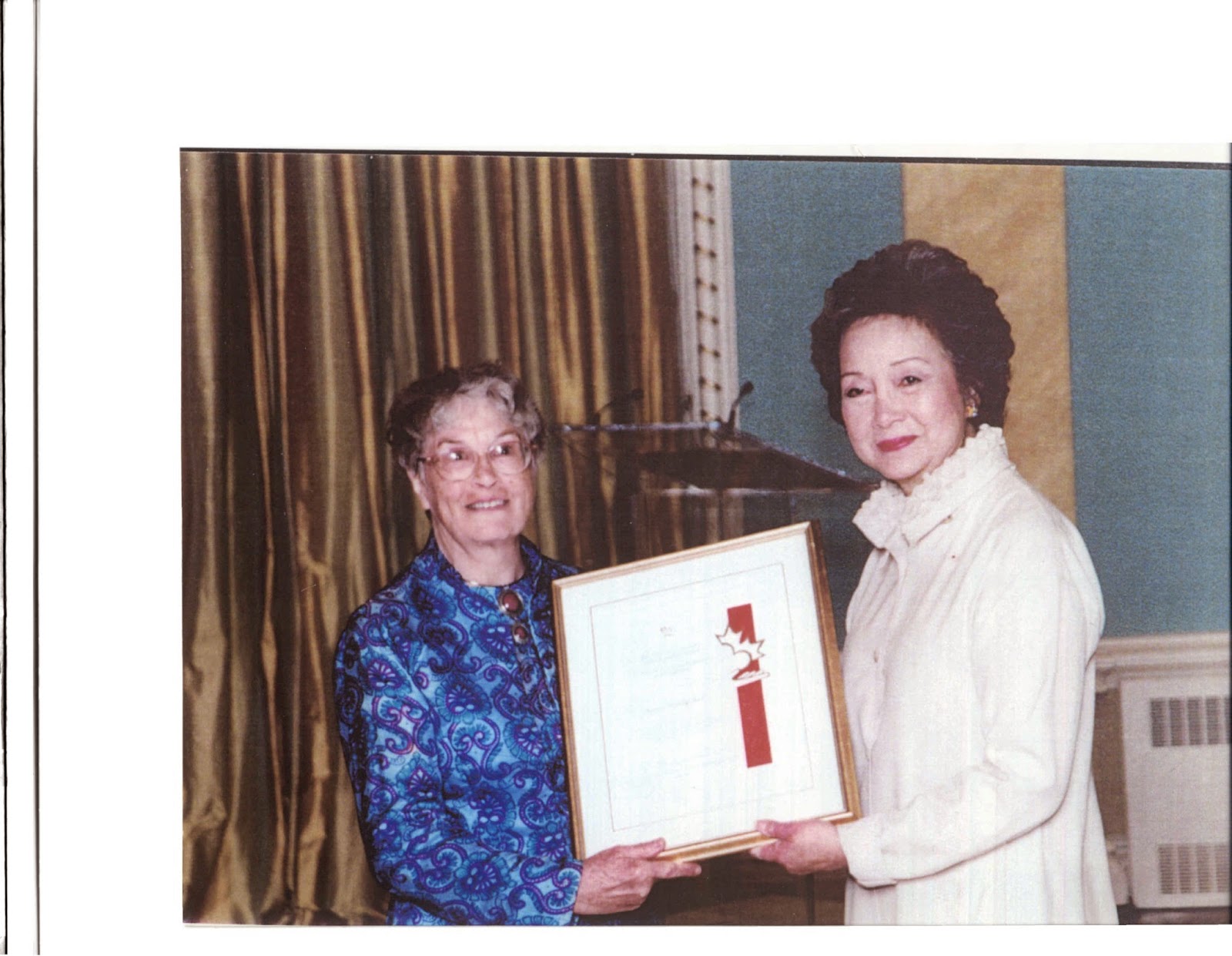 |
| Wendy receiving the Caring Canadian Award from Governor General Adrienne Clarkson, Rideau Hall, June 2003 |
Much more could be said
about ‘belonging’ - cultural identity versus alienation, what’s being
done, what more could be done, to make newcomers feel at home and welcome, the difference between the US ‘melting pot’ concept and the Canadian ‘mosaic’, about multiculturalism and risk of developing ethnic/cultural enclaves that can become ghettos, and sundry
other problems.
There are problems aplenty along the way towards development of
harmonious, fruitful, interactions between individuals, families, and the
society of which they are component parts. Problems arise for instance, in our
multicultural society when immigrants and members of cultural groups fail to
acquire a sense of belonging to the larger society that comprises Canada, or
the even larger society that comprises western civilization. This can happen when adolescent children of
immigrants from certain ethnic and cultural groups rebel against the
traditional values and customs of their parents. I saw this occasionally in
Adelaide in the 1950s when girls from peasant Greek or southern Italian
families, educated in Australian schools, mingling with girls from more enlightened backgrounds picked up some of these enlightened values, rebelled against arranged marriages
that had been customary in their parents’ families. An Australian-born teenaged girl whose parents came from Greece went home from school one day to find a middle-aged man just arrived from Greece, and was confronted with the news that he was to be her husband. She fled to our clinic waiting-room and implored several staff members including me to help her evade this fate. We interceded at the cost of her estrangement from her parents. Today the same problem sometimes occurs among South Asian families in Canada. In its most extreme form it can lead to 'honour killing' - an oxymoronic name for a disgustingly dishonourable custom.
Another problem has taken
on great urgency in light of recent episodes of extreme violence and murder
perpetrated by immigrants or by young men who have adopted the antisocial,
murderous ways of terrorist groups, in recent examples, associated with
perverse interpretations of the teachings of Islam. We had a dramatic
experience of this in the assassination of the young sentry at the National War
Memorial in Ottawa and the assassin’s assault on Parliament. Soon after this
came the blood bath in the offices of the Parisian satirical magazine Charlie Hebdo. Unfortunately the
perpetrators of these and several other terrorist onslaughts have all been
killed. We need to keep them alive so they can be studied by sociologists and
psychologists. We need to find out more about the antecedents of these acts,
how and by whom they were fostered, and what motivates the perpetrators, so
that we can develop strategies and tactics to counteract them and prevent such heinous
acts of violence. About 30-35 years ago I recall reading reports of sociological studies along these lines that had been done on terrorists
associated with the Basque separatist group ETA, and the IRA. Those terrorists, called freedom fighters by their supporters, usually were motivated by ethnic nationalism. Similar studies are
needed on terrorists linked to this perverse variant of Islam. Obviously these
terrorists lack a sense of belonging to the countries and cultures against
which their acts have been aimed. In light of the recent
violent terrorist acts perpetrated by young men who have lacked this sense of
belonging, more in-depth sociological and psychological studies are urgently
needed, to find out more about why these young men (and occasionally women) are
attracted to beliefs that induce them to engage in such violent antisocial conduct.
That is our best hope in searching for ways to put a stop to this kind of behaviour once
and for all.
In Belonging, Adrienne Clarkson has examined the social and cultural
consequences of the tension in personal identity that immigrants may have to
confront. Her Massey Lectures are a very well written, insightful and
sympathetic analysis of this phenomenon. This book is a tribute to all
who make the successful transition from one culture to another. I strongly
recommend it to all who have migrated, and all who are here to greet the
migrants.
(This is an expanded version of a piece I wrote for Ottawa Review of Books)
(This is an expanded version of a piece I wrote for Ottawa Review of Books)
Subscribe to:
Posts (Atom)