Pages

Total Pageviews

Sunday, September 9, 2012

Early memories

Here are the opening paragraphs of my memoirs. Do these grab and hold your interest?  After reading these do you want to read any more?


Dust. Red-brown dust, on the ground, in the sky, inside the house, outside the house, dust everywhere, on everything, in everything. 

It’s my earliest memory, from when I was about three or four years old, in the summer of 1929-30, or perhaps 1930-31. Once when I had been put down for my afternoon sleep I got off my bed, padded across the linoleum leaving footprints in the dust, and climbed on top of the couch under my bedroom window, pulled aside the curtain and looked out over a bare paddock from which wisps of dust whirled slowly, lazily up into the cloudless blue sky. Why, I wondered, did it fly up into the air like this? The back yard of our house was dusty, I kicked it up with every step. Roarey, our red setter, rolled in it and shook himself as if shaking off water after a swim, though he carried a lot of it into his doggy-smelling kennel too and my clothes got covered in it when I crawled in after him. Behind our car as my father drove over bumpy country roads, a brown smoke-screen of dust obscuring everything. It was always hot, dry, dusty. The rare and fleeting moments when it was cool, green, damp, and muddy seemed unnatural.  My fragmentary memories make my early life seem like the biblical myth of human beginnings.  I came from dust. 

South Australia is a scorched, brown country.   Inland, creeks and rivers are rare; many are just meandering traces,  sandy creases on the flat landscape with occasional stagnant or sluggish pools of murky water or nothing but hot sand,  the memory of water marked by sparse lines of scruffy gum trees. When rain falls it is sometimes monsoon-like in ferocity, and can transform these arid remnants into raging flash floods.  In 1955, I was lucky to escape one when I misjudged the depth and force of water as I tried to ford a creek in the mid-north of South Australia near Clare.  I felt my little car being lifted, floating, tilting alarmingly with the water lapping against the door only inches from my elbow.  Then miraculously the car struck land again, righted itself, and using the battery to turn the engine, I managed to get out of harm’s way up on the bank, where, shocked and shaking, I dried out the distributor and got the car started and on its way again. That was one of several early near misses when my life could have ended before it had even become interesting and worth-while.

One long river that never runs dry wanders westward across the south-east corner of the continent from the Snowy Mountains of New South Wales. It forms the border between New South Wales and Victoria before flowing on into South Australia. This is the River Murray. After a few hundred miles it ends its westward wanderings and turns south towards the sea. Rather nearer the end than the beginning of this part of its journey to the salt marsh shallows of Lake Alexandrina that separate it from the Southern Ocean, there are several little twists and turns. In the early days  the settlers came to the river bank here to crutch their sheep - to castrate them and cut off their tails. So this place on the River Murray got its name – Tailem Bend.

Here, in September of 1926, I was born, the son of Raymond Jack Last and Vera Estelle Last, neĆ©  Judell. I’m told I was a sickly child weighing little more than three pounds, born prematurely and saved from an untimely death, my mother said, by the unseasonable heat which sustained me as though I were in an incubator. There is another story passed on to me by an attending nurse many years later, that I was one of twins, the other being stillborn. My mother died before I had heard this story so I couldn’t ask her. My parents were estranged  when I was born, my father absent from the scene, and when I asked him many years later he denied it - but he was not there and the nurse was, so who is to say? If it is true it might explain some unresolved longings I have felt all my life, a curious sense of incompleteness. 

Whatever the facts about this story, I carry a permanent reminder of my birthplace in Tailem Bend on the banks of the River Murray: My mother gave me my middle name, Murray, to commemorate the fact. 

My father graduated from the  University of Adelaide medical school in 1924 and, having completed his year of internship, was working at Tailem Bend as a locum tenens, a relieving doctor.  Soon after I was born, he settled in general practice in Booleroo Centre, a dusty little town in the wheat-growing district about 180 miles north of the city of Adelaide. My mother and I, joined a little over three years later by my younger brother Peter, lived on and off in Booleroo until the early 1930s when my parents'  faltering marriage finally failed altogether, and my mother took us away from Booleroo Centre to return to her parents' home in Adelaide.

Memories of my early childhood at Booleroo Centre are like bubbles that form and burst, isolated from each other in time and place, not forming a coherent pattern of sequentially unfolding events.  Many of my memories are dark and unhappy – tears, shouting, tense silences, parents who ignored me, or used me, I now realize, as a psychological weapon in their domestic conflict of mutual hatred.  That toxic atmosphere left my childhood scarred with wounds that took decades to heal. Perhaps some of those wounds never healed, and the flaws  I can identify in my character are there in whole or in part as a result  There are some happy memories from that time too of course, and puzzling ones, some that lingered for many years until I forgot them or solved the riddles of misunderstood words and phrases.

Here are some of those memory bubbles and some of the puzzles.  


Ray and Vera Last with baby John Last aged about 9 months, 
probably in Booleroo, 1927


My bedroom was decorated with prints from the Gumnut Babies, an original Australian creation, a colour comic-book series that came out in large format with stories beneath a series of comic strips. I don’t remember seeing that book any time after I was able to read. (I saw one like it in an antiquarian book shop in Sydney in the 1980s, at an astronomically high price).  My walls held several large coloured pictures of the Gumnut Babies, chubby little elves with topknots and a stalk sticking up.  The sinister Bad Banksia Man lurked in a corner of one of the pictures on the wall.  I tried not to look at him or catch his evil eye.  The Gumnut babies were probably the inspiration for my imaginary playmates, Bee and Bay, who went everywhere with me.  I had to hold doors open for them to pass through, had to tell grown-ups not to trip over them.  Bee and Bay went away and never came back once I had a baby brother old enough to play with me.
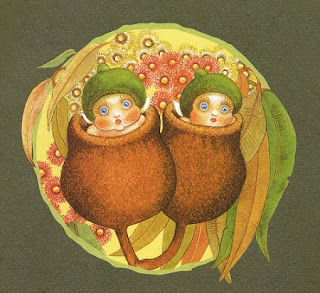


 The Gumnut babies, Snugglepot and Cuddlepie (sic) ensconced in gum nut cups.  They wore no clothes and their  chubby naked bottoms have an erotic quality, whether deliberate or  unintended I know not                                                                                                                                                                                                                  


(Below) The Bad Banksia Man running away with one of the Gumnut Babies whose fate can only be guessed in a nasty nightmare


We traveled in an open car with celluloid side curtains that were taken off on hot days so the air flowed through and ruffled my hair as well as bringing in dust that got in my eyes and up my nose. Driving from the house where we lived on the edge of the town to the main street of Booleroo Centre, to the bank, the post office, the hospital, I jumped up and down on the back seat, and was ordered by my father to sit down. Metal struts held the canvas roof in place, making convenient hand-holds for a little boy's fingers. I think it was a Chevrolet tourer, and that it was dark blue under the dust that I cleared away by tracing patterns with my fingers. 


John Last aged about 2


We drove from Booleroo along the winding Gorge Road to the seaside at Port Germain. Porch a-main. Why was it called a porch, where you went into a house? It wasn't a porch, it was a beach, a wide sandy beach where we sat in the shade of a big red white and blue striped umbrella or under the long jetty, with little pools of water at the base of the wooden pylons supporting the jetty, where the movement of the tides had gouged holes in the sand. These were times to paddle in the warm shallows, dig in the sand, and  recover from the carsickness that always marred those journeys from Booleroo to Port Germain. Why was the sand so white on top and black just below the surface?  My Uncle Lester told me it was rotting seaweed that made it black.  I have a vivid olfactory memory of seaweed drying in the hot sun, a pleasantly acrid antiseptic smell, rather like some of the smells from my father's surgery.

Driving from Adelaide up the Great North Road, another rough road; the heat got more intense as we drove north. Why "Great"? It was a long journey taking all day, on a bumpy narrow highway only intermittently paved, and with many ruts and holes, a far cry from its namesake in England – though that too I remember as winding, and not very smooth in the 1950s, before the expressway was built. Why so many memories of car travel? I suppose there must have been a lot of it, both locally in and around the town where my parents lived, and back and forth between there and Adelaide. I don’t remember many conversations though, and have an impression that often my father and mother were silent, had nothing to say to each other even on the longest journeys.

On a night-time trip back to Booleroo from the Mahood's property, a sheep station at Melrose in the foothills of the Flinders Ranges, I heard the words bush and ranges and thought they had said bush rangers, evil, violent men who robbed coaches and presumably cars too, and I was terrified under a rug on the back seat of the car as it bumped along. How old was I then?  Four? Peter was in a basket on the front seat so I must have been very young. How did I know about bush rangers at that early age?  Someone must have mentioned them in conversation, and this fragment of mis-heard information had stayed with me.

A party of grown-ups went bird-nesting, climbing up the trunks of bare trees – ring-barked, to kill the trees, making it easier to clear the land. Someone took my hand, pushed it into hollows too small for a grown-up’s hand, to feel for nestling budgerigars, rosellas, galahs, and sulphur-crested cockatoos. I was scared that a spider or worse still, a snake, might bite my fingers. We had a galah and a sulphur-crested cockatoo in the yard at Booleroo as well as the red setter, Roarey. The birds had names too, but I have forgotten what they were.

"Garpie" (Grandfather) Last with John and Peter in wheelbarrow, Booleroo, 1930 or early 1931


The limestone track from the road to the garage had mysterious bits of metal that glinted on the surface.  One was shaped like the outline of a large toy soldier on horseback, and I tried unsuccessfully to dig it out, leaving there eventually without ever discovering what it really was, probably a flattened piece of a kerosene drum that may have originally been put there to fill a pot-hole. Until years later, I wanted to go back to find out. I wanted to find out so many things!  That was the time of greatest curiosity in my life, as it is in every small boy’s. How much we would know, if only all those questions could be answered and the answers stored in busy small children’s brains!

John with Roarey our red setter, about 1930


The inside of Roarey's kennel smelt doggy and was as big as Dawdie Mahood’s doll's house. We   went often to the Mahood’s spacious homestead near Melrose. It was from there that one cool day when the grass was green so it must have been late winter or early spring, August perhaps, we went on a snake-killing drive, which I watched in fear with grown-ups from a safe distance while a group of young men and teen-aged boys thrashed at the long grass, driving snakes out to be killed. My father killed a snake in the driveway of our house, blasted its head off with a loud explosion from his shotgun, a great black snake, deadly poisonous, its body writhing and twisting it seemed for hours after it was dead and harmless. The little son of the local Methodist minister, a child about my age at the time of his death a year or so earlier, had died from snakebite. The whole district hated and feared snakes. That little boy’s toy train set, a memorial icon of sorts, was high on a shelf in one of the rooms in their house, but although I could look at it I wasn’t allowed to play with it.

Yabbying was a seasonal country pastime. We caught yabbies, freshwater crayfish, in a little stream somewhere in that part of the world where streams are rare.  Probably that too was on or near the Mahood's palatial property. Something nipped my fingers as I trailed them in the cool creek water and they stung for hours but I didn’t complain. I felt brave keeping my suffering to myself.

Once I awoke at night and the back verandah of the house was alive with big blue crabs, rustling skittering things that crawled across the cement floor of the laundry from a large wet hessian bag, then were gathered unceremoniously but with great hilarity by raucous grown-ups, and dumped into a boiling copper cauldron in the laundry. These crabs came from Port Germain or Port Pirie, the smelting and mining town that also was within driving distance of Booleroo Centre.  That night somebody gave me a glass of beer to sip, a frothy bitter drink that put me off beer until I was in my twenties. The crabs were blue, but their shells were red or pink next day when I saw what remained of a mighty feast attended by who knows how many friends and neighbours. How had that happened? Later I saw the same thing with crayfish. Ah! crayfish!  That's a whole series of other memories from later in childhood when I was old enough to know, or to work out for myself, that cooking induced chemical changes which made the shells change from blue or purple to red.

Family group on Henley Beach, 1929; L-R: Doris Judell, Elsa McRae, Katie Saunders, Vera Last (pregnant with Peter) John in front of her, Olave Judell, Malcolm McRae. The women were 5 of the 6 Judell sisters; 2 never married, probably because potential husbands died in the slaughter of the Great War of 1914-1918


Under my bedroom window was a piece of furniture that remained with us for many years, a set of three wooden crates nailed together, with a hinged lid, the whole covered with bluish paisley patterned linen. This was the box-couch. Later in childhood it was the repository for small boys’ treasures, my Meccano and toy cars, Peter’s train set, lead soldiers, stuffed animals, comics. Dividing the compartments between Peter and me led to quarrels, when Peter complained that I had more than my fair share. Peter often complained that I had more than my fair share, but I don’t think it was so. Anyway, I was older, had been there longer and logic dictated that I was bound to have collected more things in my three and a bit extra years.  At Booleroo when I was a toddler, the box-couch was high enough so that when I climbed on top of it I could look out the window, over wheat paddocks towards distant blue hills..


Ray Last equipped for golf, with John aged 3, Booleroo


There were golf games at Booleroo and at Melrose with Gar Mahood, and garballs - golfballs - that he made disappear behind his ear or mine, then plucked out of my nose. A photo shows that I first held a golf-club in my hands in those days, learnt how to hold it when young enough so that I have always had an easy, fluent swing that made me better at golf than any other sports. (In the late 1950s Gar Mahood , retired by then to a seafront flat at Henley Beach, was my patient during his terminal illness, and was bewitched by my likeness to his friend, my father). 

My father made a huge kite of brown paper. Huge to me anyway as I knelt at one end of it while my father, the only time I remember that he played with me, tinkered with the struts and anchored the paper at the other end, fully six feet away in my memory, perhaps not quite so big in reality, but large enough so that with the string stretched taut it required all an adult’s strength to hold it in check when the kite was flown in a strong wind in the paddock behind our house. We sent messages up the string, pieces of paper cut out and slipped over the string and carried up by the wind. Then the string broke and the kite flew far away out of sight. I tramped with others across a field of stubble in search of it, and we found it, torn and broken, far away beyond a dam at the other end of the paddock. This must have been in winter; it was a drizzly bleak day, there was muddy water in the dam and nobody wanted to get wet. This was when I was 4 or 5 years old.


John, aged about 4,  towing the Express Wagon


There was a four-wheeled trolley, the Express Wagon, made of wood with metal wheels, and the words "Express Wagon" painted in yellow on its shiny red sides. Those words, "Express Wagon" painted on the side of the little trolley, barely big enough for me to sit in and be pulled along, have even now for me after 70 years, the emotional resonance that "Rosebud" had for Citizen Kane. There is a photo of me sitting on a tricycle pulling the Express Wagon in the yard of our house in Booleroo, when I was about 4 years old.. 

I was learning words voraciously then, and wondered about the connection between Express Wagon on my little red trolley and State Express on red tins that had held cigarettes and had the hypnotic tang of tobacco, sometimes also layers of fine silver foil and tissue paper when opened while I inhaled the aroma as somebody taught me to do - preparing for the future time when like everybody else I would be smoking cigarettes instead of merely inhaling the aroma of tobacco. Express and red are permanently linked by these associations. The Express Wagon, or one like it, remained part of childhood for years, through the later years at Brighton where it was certainly a different one, but still called the Express Wagon.

Those were hard times, the "Dirty Thirties," the years of the Great Depression. Years of drought too, with storms of red dust filling the air, the nostrils, making Roarey rust-coloured. My mother tried to seal the house against the dust, but it got in anyway, covering the cream carpet in the living-room, a carpet that followed us to later homes at Brighton and Glenelg. On windy days, the dried leaves of date palm trees rustled. Twigs and dead branches, sometimes bigger than I was, tumbled down from the gum trees at the entrance to the driveway from the road in front of the house.

Men came to the door begging meals, were willing to do any sort of odd job for a crust of bread - chop wood, clean the car, shift heavy loads. Their faces were weather-beaten, lined and dirty, their eyes angry, or, I now realise, sad, defeated. Some carried their belongings in a roll slung over one shoulder, the traditional Australian swagman's style. They smelled stale and sweaty, a different kind of body odour from that of a maid who took me one day when she was off duty to visit her girl friend, and was joined by two men – young men, I suppose, as the two girls were also, but seeming old to me like the swagmen, and more wicked, talking of and doing something I didn’t understand but that seemed a bad thing to do, though I didn’t see clearly what it was.  

There is an association in my mind between swagmen and my father's consulting room ("surgery") and his massive (to my small person) Xray machine, with sparks that shot out of it. Swagmen and that sparking Xray machine are linked memories for some reason. Perhaps there was once a swagman patient whom I accompanied into the surgery for an Xray. I remember chanting "Nux Vomica" - the name of a drug in prescriptions my father dispensed, and I remember handling shiny surgical instruments that had mysterious uses. Eighty years later I have two or three of those instruments, including a pair of small curved surgical scissors, never discarded despite multiple moves around the world, that I use to trim my finger-nails.  

Close by the house at Booleroo was a wheat paddock. One day three of us squatted in the middle in a place where we had flattened a shelter amid the tall wheat sheaves, away from inquisitive adult eyes, and shared secrets. The others were two girls a few years older than I, one called Nancy, the other her friend or perhaps her sister. The secret we shared was as old as children's curiosity. They were very firm with me. I had to take down my pants and show them what I had between my legs; they in turn would show me what was between their legs. This we all three did with great solemnity and so far as I recall, no touching of each other's parts. My pants were attached to my shirt by buttons that held me together, and at this time I was too young to manage buttons so Nancy did it for me. Nancy occasionally took me to school with her when I was about four years old.  I sat on a seat in the back of her classroom; but the seat had no back-rest, and when I leant back, the seat tipped me onto my head on the floor, a frightening and painful experience that made me cry; Nancy had to take me home, sobbing, and she was crying too. Years later when I was a medical student, Nancy was the staff nurse in charge of one of the wards at the Royal Adelaide Hospital; we knew each other politely as grown-ups by then, not having met since I was about 5 and she about 8 or 9. I never reminded her, nor she me, that we had seen each other's private parts long ago. She had become a fine handsome woman, a dedicated nurse. 


Peter and John Last,  Booleroo, 1930


Some varieties of carbonated soft drinks came then in bottles that were sealed with a rubber ring and a clear glass marble stopper; one broke the seal by pushing the marble down a little, then the contents could be poured into a glass, frothing excitingly. I coveted these shiny marbles. In my innocent curiosity, I formed the notion that all bottles contained marbles, and I could collect as many as my heart desired by breaking enough bottles. There were crates of bottles in a shed behind the house, medicine bottles that my father used for the potions that he dispensed for his patients. One day when I was perhaps 5 years old, I had an orgy of bottle-breaking, discovering to my disappointment that none of these bottles contained marbles after all. But I kept on trying to find one that did until a whole crate of bottles lay scattered around the yard in shards of glass. I got a terrible beating for this mistaken attempt to accumulate a collection of marbles. My father didn’t listen to my explanation, instead commanded me to find a suitable stick to be flogged with. I found a thick, heavy one; and he gave me a thrashing such as I have never had again, all the while misunderstanding my motives for breaking the bottles.  Perhaps he believed that it was an episode in the smouldering warfare with my mother. Towards the end of his life I asked him one day if he remembered giving me that beating, or the time I ‘helped’ him make a kite. But he remembered neither of these events that loom large in my memories of early childhood.

His anger at me for breaking his medicine bottles seemed to persist for a long time, erupting periodically when I did other clever things. I discovered that I could use the length of a picture book held in my hand to extend my reach far enough to turn off the light switch and plunge his den into darkness. He cuffed my ears for that, and perhaps swore at me. My mother seized me and ran out of the room, crying, clutching me to her breast. There must have been many other episodes of tension, for that entire period of my life is shrouded in feelings of anger, rage, tears, unhappiness. Some memories of that period date back to before I was toilet-trained.  I remember soiling myself one day at the hospital, walking bandy-legged, uncomfortable, smelling of shit and feeling horribly embarrassed when my father shouted angrily at me from where he was slouched on a sofa, sharing a cigarette with a woman not my mother – perhaps I had  caught them in flagrante. But all those unhappy memories are blurred, jumbled and mostly incoherent.

I have no recollections of the final breakup of my parents' marriage. For a while we lived at my maternal grandparents' home, a gracious old place on Northgate Street, Unley Park. We had been there earlier to stay when I was only three, before Peter was born. That was in the Unley Park Private Hospital, where I was taken to visit my mother. I remember walking along Unley Road, just around the corner from Northgate Street, with two women, one my Auntie Elsa, on the way to see my mother in hospital, though I don’t know whether that was  when she was there with toxemia of pregnancy and high blood pressure, or after Peter was born. I was sent away about then to stay with the Methodist minister's family who had moved from Booleroo to Clarendon in the hills south of Adelaide. At that time I was not yet reliably continent, or had become incontinent because of the emotional stresses, and I suffered acute embarrassment when I wet the bed.  

The large garden of the Northgate Street house was overgrown with weeds. A horse-trough of stagnant water contained many wrigglers – mosquito larvae – and close by was a small pond with tadpoles. There was a tennis court, but I think perhaps not in use at that time though it had been earlier when my parents were courting. My grandfather Leopold Judell had died in 1927, and my grandmother Rebecca died in 1931 when I was about 4 ½ years old. I remember her as a tiny lady clad in black who once gave me a very hot peppermint that I spat out as soon as I could. There were frequent large family gatherings at the Northgate Street house, though I seldom knew who was who. They all seemed very old to me, like Auntie Rae, my grandmother’s sister, who wore a black ribbon around her neck to disguise her wrinkles, and I seemed to be in their company much of the time, except for rare occasions when I mingled with  pre-adolescent cousins like Betsy and Ross Ragless, and Barbie Saunders and her sister Peggy, who was already sick and soon died of Hodgkin's disease. 


John and Peter Last with grandmother Rebecca Judell, Northgate Street, Unley Park, 1930


At Northgate Street the grown-ups sometimes read aloud to me: Peter Pan, and a childhood abbreviation of Robinson Crusoe which I still have today, illustrated with colour plates that prompted my cousin Betsy Ragless to dress, or undress, as one of the pirates with her pink bloomers puffed out to resemble the buccaneer's pantaloons in one of the pictures in the book. I hadn't started school then, but knew the alphabet and puzzled out the meaning of words under the plates in Peter Pan. This was when I was about five years old.  I had begun to read for myself before I was six, and another pair of books from that period, the two volumes of poems by A. A. Milne, When we were very young and Now we are six were a precious part of my childhood, still safely stored in the bookshelves reserved for my most valuable books.  Who read them to me?  I don’t remember my mother ever reading aloud to me, but several aunts and cousins did, and soon I was puzzling and sweating my way through the verses on my own. I was always asking questions that often the grown-ups didn’t or couldn’t answer. Except for Uncle Lester, who was not often there but when he was, always bent down to my level and patiently replied to my eager inquiries – why did the dust rise in the air, how did a magnet, a motor-car work. He more than anyone else recognized my hunger for knowledge and understanding. I am forever in his debt. 


John Last and Janet McRae, 1929 or 1930


I had quite a lot to do with several cousins then, most of all with the cousin closest to me in age, Janet McRae, who was just three months older than I (her birthday was the same day as then little Princess, now Queen Elizabeth). Janet and I went together to a kindergarten in a church hall at the end of Northgate Street, run by two sisters, the Misses Fleming (I recall the name after all these years!). Others who attended that kindergarten included three boys who like me later went on to St Peter's College and the Adelaide Medical School, so our lives were intertwined from early childhood. The most fun at kindergarten was playing in a sand tray, or cutting out paper shapes with scissors that had rounded ends so we couldn't stab ourselves or each other, or making plasticine models, a pastime that I got quite good at later, copying another cousin, Alan Saunders, whose models seemed to us to be magnificent. 

The interlude at Northgate Street was early in the Great Depression, a time of desperate hardship and an ominous time with rumblings of political troubles and threats of war. The conversations of the grown-ups in this partly Jewish household were full of foreboding, and some of their fears and dread unspoken thoughts communicated themselves to me. From a very early age I had a haunted sense of bad times coming, a feeling that has remained with me all my life – and sadly has been proved only too true on several occasions as the world entered on successive downward spirals of tension, confrontation, hostility and warfare. The household, like all others with sons old enough to fight in the Great War, was still in mourning in the early 1930s for "Lidie", Elias Judell, the favorite son who had not come back. He had been killed at Gallipoli in 1915. The youngest son, Ceddie (Cedric) had come back, bringing with him a wife, Dorise, a foreigner in ways, values, religion, disrupting the cohesion of this otherwise close-knit family. None of these nuances were comprehensible to me then (some still aren't) but they coloured the atmosphere of the Northgate Street house.

I don’t remember our final departure from the Judell family home and the sale of it and most of its contents at sacrifice prices in the depths of the depression early in the 1930s, after my grandmother Rebecca died. The house sold then for about £1300. It changed hands again in 1991 for over three quarters of a million dollars - a reflection of inflation as well as of rising land values as Adelaide turned from a small town into a city.

The stressful events of that time, a time of bereavement and mourning, and of financial crisis for the entire family, like other painful experiences of early childhood, are at least partly suppressed. There were tears, hushed voices, whispers. Something bad was happening.
Then, rather suddenly it seems to me now (or maybe I had been sent away again to stay with friends), my mother had left there and taken my brother Peter and me to live near the sea at Brighton, a seaside village some distance in those days from the suburban fringes of the small city of Adelaide. It was the beginning of a new and happier life.

Saturday, September 8, 2012

Another driver's test

Earlier this week I had my 3rd periodic driver's test, a ritual I've had to undergo every two years since I reached 80 years of age. I was in a group of about 14-15 seniors, most taking the test for the first time, I and one other for our third time. It consisted of a group discussion lasting about an hour and a quarter in which the woman conducting the class walked among us, standing directly in front of each of us in turn and observing us closely - our demeanour, grooming, speech, how we reacted to her questions. Later she took one old lady aside and I heard her telling this old lady tactfully that she would be required to take a road test. Then there was a multiple choice set of 50 questions, half of these on rules of the road, the others on road signs - their shape, colour, what they say (which wasn't shown on the signs in the test). Pattern recognition and colour sense are important components of this skill.  I'm happy to say that I aced it, got 100% and completed the test before anybody else. I was pleased to have this evidence that the part of my brain involved in performing this test functions as well as ever.  It was reassuring after my observations lately that my short-term memory is deteriorating, a common neuropsychological finding among old people.  I went straight from the test centre to the licence bureau to renew my driver's licence for another 2 years.  However, I doubt whether I will continue to drive for another two years.  Although it's good to be able to pop out to a neighbourhood shop on the spur of the moment I don't enjoy driving nowadays. It probably makes sense to quit while I'm ahead, rather than wait for a more dramatic episode like a traffic crash to send me a signal that it's time for me to stop driving. I'm aware of a risk that if I stop driving I might tend to become more reclusive and solitary than I already am but I'm also aware that it's very easy to call a taxi; and that I'll probably save money.  Allowing for depreciation, insurance, etc, it costs about $4500 annually to maintain a car and it's unlikely that I'd spend that much a year on taxis.  The loss of autonomy is the hardest part of this life change to get used to. At least by thinking about it before it actually happens I might soften the impact.

Saturday, September 1, 2012

Labour Day weekend

For more than 40 years the Labour Day weekend has been the most significant punctuation in my life, marking the steady progression of the seasons. It's usually excellent weather, late summer fullness of foliage, blowsiness almost, as fruit has ripened, local produce is plentiful, a feeling that life is worth living and there is abundant tangible evidence of this. it's a time of transition in the academic year, when teachers buff up their material, parents prepare their offspring for the new school year. For me, it's been the weekend when I take stock of what I've accomplished in the past 12 months and prepare myself to face the next 12 months, usually with a formidable list of things I have to do. During my active academic life I prepared a list of essential tasks, arranged if possible in some sort of priority with dates by which each task had to be completed: teaching assignments, research grant proposals, committee meetings, reports, papers, book chapters, lectures and seminars I had to get ready by specified dates - an intimidating list that always filled the whole of a long sheet of paper pinned to the bulletin board above my desk. For more than the first 30 years of that 40 year period, some time during the weekend, I wrote a sort of stock-taking letter to my family in Adelaide. This year instead of mailing it, I'll post it on my blog.

The list of 'Things to do' is shorter now, only a handful of assignments. I've been invited to reflect on the paper I still regard as my very best - "The Iceberg; Completing the Clinical Picture in General Practice"- which was published in Lancet in July 1963, fifty years ago next year. It is very gratifying that the concept I described and discussed in this paper has become part of the culture of epidemiology, and is still cited fifty years later. I can take a little credit for this, but the idea originated with my mentor Jerry Morris, and the title of the paper, the metaphor of the iceberg, was suggested by the eminent Lancet editor, Sir Theodore ("Robbie") Fox. His hand-written letter to me, accepting the paper with just one modification, making "The Iceberg" the title and my title a subtitle, is in the National Archives of Canada. I am in debt to Jerry Morris and Robbie Fox. The "Iceberg" established my reputation in epidemiology. I'm happy to have an opportunity to reflect on its significance fifty years after it was first published, happy to acknowledge again my two sources of inspiration, Jerry Morris and Robbie Fox, and happy that my reflections will be published in the International Journal of Epidemiology.

That's the first item on my list of "Things to do," followed in second place by a few lectures and seminars. The fire in my belly nowadays has subsided to glowing embers, but to judge from feedback at Waterloo 2 weeks ago, I can still catch and hold the attention of a room full of 80 or more master's students in this year's MPH class. I hope I can perform as well here in Ottawa later this month.

The third item on my "To do" list has been there for well over a year.  2012-2013 is the year I mean to lick my memoirs into shape and finally publish them, or rather distribute electronic copies to family members and friends.  Over the past 12 months or thereabouts I have posted excerpts on this blog, mostly abridged but otherwise unedited excerpts and free-standing "Traveller's Tales" describing places, people, and some of the experiences of my long, interesting, and thoroughly enjoyable life. Sometimes I've been able to illustrate these with my own photographs. Almost all the excerpts posted on my blog are rough and raw, need editing.  I began to write a first draft of memoirs about 25 years ago when my first grand-child Chris was about a year old and my daughter-in-law Dorothyanne gave Wendy and me a scrapbook, My Grandparents' Recollections  with spaces for photos and some very good questions for us to answer about our parents, grandparents, siblings, what life had been like when we were children, etc. Answering those questions prompted me to enlarge on what I wrote in the scrapbook.  The original plan had been for Wendy and me to wrote our collective memoirs, and a great sadness in my life is that she fell ill and died before that joint enterprise got off the ground. She had such a lovely, lively writing style that would have made our joint memoirs entertaining and irresistibly readable. The slabs of bad prose I've written without her input are too much like a textbook or a learned  article in a scientific journal, not enough like the story of a wonderful and thoroughly enjoyable life.  Be that as it may, the third item on my "To do" list - to bring these memoirs to closure - is highest priority.  I am beginning my final push on it this very weekend.

Friday, August 31, 2012

We didn't have the green thing back then

Wendy's nephew Ivon Hurst has a farm at Pleasant Point, South Canterbury, New Zealand.  He sent me this, which evokes many memories.  I resonate to the older lady's sentiments!


Checking out at the store, the young cashier
suggested to the older  woman that she should
bring her own shopping bags  because plastic
bags weren't good for the  environment. The
woman apologized and  explained,"We  didn't
have this green thing back in my earlier  days."

The cashier responded, "That's our  problem
today. Your generation did not care enough  to
save our environment for future  generations."

She was right -- our generation  didn't have the
green thing in its day. Back then,  we returned
milk bottles, pop bottles and beer  bottles to the
store. The store sent them back to  the plant to
be washed and sterilized and refilled,  so it could use the same bottles over and over. So  they really were recycled. We refilled writing pens  with ink instead of buying a new pen, and we  replaced the razor blades in a razor instead of  throwing away the whole razor just because the blade  got dull.  

But we didn't have  the green thing back in our day.

We  walked up stairs, because we didn't have an escalator in every shop and office building. We walked to the grocery store and didn't climb into a 300-horsepower machine every time we had to go  two blocks. But she was right.
We didn't have the green thing in our day.
Back then, we washed the baby's  nappies because we didn't have the throw-away kind.  We dried clothes on a line, not in an energy  gobbling machine burning up 220 volts -- wind and  solar power really did dry our clothes back in our  early days. Kids got hand-me-down clothes from their  brothers or sisters, not always brand-new clothing.  But that young lady is right.
We didn't have the green thing  back in our day.
Back then, we had one TV, or radio, in the house -- not a TV in every  room. And the TV had a small screen the size of a  handkerchief (remember handkerchiefs?) not a screen the size of Yorkshire. In the kitchen, we  blended and stirred by hand because we didn't have  electric machines to do everything for us. When we  packaged a fragile item to send in the post, we used  wadded up old newspapers to cushion it, not  Styrofoam or plastic bubble wrap. Back then, we  didn't fire up an engine and burn petrol just to cut  the lawn. We used a push
mower that ran on human  power. We exercised by working so we didn't need to  go to a health club to run on treadmills that  operate on electricity. But she's right. 
We didn't have the green thing back  then.

We drank water from the tap when we were thirsty, instead  of so-called pure spring water from a plastic bottle. A lot of food was seasonal and we didn't expect fresh fruit all year round flown in from thousands of air miles away. We cooked food that didn't come out of a tin, a packet, or plastic wrap. We even washed our own vegetables and chopped our own salad.
But we didn't have the green thing back then.
Back then, people  took the tram or a bus, and kids rode their bikes to  school or walked instead of turning their mothers  into a 24-hour taxi service. We had one electrical  outlet in a room, not a bank of sockets to  power a dozen appliances. And we didn't need a computerized phone to receive a signal from  satellites 2,000 miles out in space in order to find  the nearest pizza joint.

But isn't it sad that the  current generation

laments how wasteful we old  folks were just
because we didn't have the green  thing back then?

Please forward this to  another selfish old

person who needs a lesson in  conservation from
a young person.


Remember: Don't  make old people mad. We don't
 like being old in the first  place, so it doesn't take much to piss us  off; and there are lots and lots of us, more every day.      


Sunday, August 26, 2012

Popular music

I have the radio on most of the time.  Talk radio, the CBC, which despite the vicious cuts the current government has made - clearly intended to kill the public broadcasting network - carries enough intellectually stimulating material aimed at grown-ups to satisfy me for much of the time. It's intelligent company and it helps to keep my brain functioning. Some time last week I heard a discussion about the music of the early 20th century that sparked a train of thought about the importance of music in my life - in anybody's life for that matter, but it's the role of music in my own life that I want to talk about today.

My earliest memories include snatches of ballads from late Victorian and Edwardian times and the rousing but often sad songs of the Great War of 1914-18, all of this of course written as much as several decades before I was born, but still popular when I was a small child. I heard these songs on wind-up gramophones that were part of the furniture in many homes in those years.  By the middle 1930s, music on the radio, another rather large piece of furniture, removed to a distance the silences between snatches of music as the record was changed and the clockwork motor rewound. Sometimes the radio could broadcast a live orchestral concert with a whole symphony uninterrupted, but most music came on vinyl records with a diameter proportional to playing time so the music played in rationed chunks of 3 to 5 minutes, the physical limits of 78 rpm vinyl records. In that way I heard a great deal of the popular music of a time that is on average around 100 years in the past. That merged and mingled with the popular music of the 1930s and 1940s, the years of the world war that I experienced as a child and adolescent youth.

That music had substance. It wasn't timeless classical music, just ephemeral popular music, but it had two qualities that have vanished altogether from the the cacophonous noise that contemporary radio announcers describe as music. That music had recognizable tunes and sometimes had words that were mellifluously arranged and worth hearing. Rarely, the words - lyrics - were poetry. Not very good poetry perhaps, but genuine poetry nonetheless with verses, rhyming couplets, stanzas. Some composers of that golden age worked in partnerships with versifiers, as Arthur Sullivan did with William S Gilbert. A few, like Noel Coward and Cole Porter, combined both roles with wit and panache.  It puzzles - and frustrates - me that they have no modern successors. If I listen carefully, I can very rarely discern sense in the words that are chanted as accompaniment to one of the contemporary barbarities, rap or hip-hop, but only so rarely that it's not worth enduring in the almost always vain hope that it will be worth hearing.

Why has this happened?  Why don't modern youngsters have tastes like the young people of 50, 75 or 100 years ago, eager to listen to, and appreciative of, tuneful ballads and songs worth hearing?  It's one of the great mysteries of modern life to me, and it has blighted my old age that I so rarely hear the songs I once loved, and that nothing has come along to replace or reinforce them.

Monday, August 20, 2012

Tolerance of ambiguity

I'd have labeled this post "Multiple shades of grey"but a title close to this has been used in a best selling raunchy novel recently, so that phrase is off limits, temporarily at least. I believe I have always had a high degree of tolerance of ambiguity. Should I leap into this current topic of discussion to demonstrate my tolerance? Probably not, but I'll do it anyway. An anatomically and physiologically female person who is psychologically male had gender reassignment surgery; then he and his partner decided to have a child.  The only feasible way for this to happen was for the gender reassigned male to stop taking testosterone and become pregnant. After a normal pregnancy and birth, the psychologically male "mother" has successfully breastfed his son for 18 months, and has been providing emotional support and practical advice to other mothers at the MCH clinic he attends. He had breast reduction surgery but fortunately at least some breast tissue and mammary glands were left in situ, apparently enabling him to produce copious amounts of breast milk. Now he wants to volunteer as a counsellor to mothers who are having difficulty breast feeding.  He has run into road blocks from La Leche League, the voluntary organization that promotes breast feeding.  La Leche League is quite a progressive organization in many ways. When I used to set up a range of community services, agencies, organizations, etc, to which I could send medical students, La Leche league was among them, and in my experience they seldom advocated positions that I'd have vetoed as reactionary. However, they evidently can't accept the notion of a trans-gender person who is now reassigned as male but is successfully breast-feeding his 18 month old infant son who is thriving on his father's breast milk. Admittedly it's a hard notion to assimilate. But in the increasingly tolerant, laid-back nation that is Canada in 2012, I think they ought to get used to the notion.

Gender identity was explored on CBC radio several times today, in news reports and discussions on talk radio about the breast-feeding "father," then in the Ideas program, which reran a program about gender identity in infancy - and attempts by well meaning parents to avoid what they regard as gender stereotyping. I was reminded of the appalling Irene in Alexander McCall Smith's perceptive tales about the occupants of the flats at 44 Scotland Street in Edinburgh. Irene made her 6 year old son Bertie wear pink dungarees as one of many actions aimed at avoiding gender stereotyping.  A new book in the 44 Scotland Street series awaits my attention on my bedside table; it's probably too much to hope that Irene gets her comeuppance in this new book, but I hope Bertie has a chance to escape Irene's relentless attempts to prevent him becoming a small boy. Well-meaning but I think misguided parents in Toronto have named their children Storm, Jazz, and Kio, in an attempt to avoid labeling them with names that identify their sex.  When David was about 9 months old, he dismantled his pram, managed somehow to unscrew every nut and bolt that was unscrewable. Was this a typically small boy or small girl action? Would he have refrained from this and other boyish acts like climbing ladders, trees and the rotary clothes hoist if he had a gender-neutral name? What about the father who wouldn't allow his toddler son to play with a pink soccer ball, insisted that he kick only the blue ball? That sort of  parental behaviour is just absurd.

Ambiguous gender identity in adolescence and early adult life is a very heavy burden to carry. I wish I could do more to help a young person I know who is coping with this burden - coping rather well now I believe, but other than some counselling I don't think anything much is being provided or offered to help my friend, who at least knows I'm ready, willing and I hope able to help whenever I'm asked.

Saturday, August 18, 2012

A Day Trip in Bengal


This story begins over breakfast at Chateau Montebello, half way between Ottawa and Montreal, on a February day in 1982. There was a conference on medical education, attended by eminent overseas authorities, including Sir Douglas Black, president of the Royal College of Physicians, He was the principal author of the Black Report, on Inequalities in Health.  I'd known him for many years; we have mutual friends whom I wanted to ask about, notably Jerry Morris, my mentor at the MRC Social Medicine Research Unit in 1961-62. On the last morning of the conference, I joined him for breakfast.  He and Jerry were life-long friends, he a son of the manse, Jerry the son of a rabbi, both reared in Gorbals, the Glasgow slums, both with the permanent reminder of this in their thick Glasgow accents. As I sipped my tea, I popped a Chloroquin tablet into my mouth and swallowed it, but not quickly enough to avoid the bitter taste. It made me grimace, and, noticing, he raised his eyebrows. I murmured, "Chloroquin."  He remarked drily, looking at the hard frozen snow outside, that this was hardly the time or place to be taking antimalarials. I told him that the next time I sat down to breakfast, I would be in Calcutta.

That statement proved to be close, but not quite accurate. That afternoon, I hitched a ride to Mirabel Airport for my long flights to Calcutta via Heathrow and Dubai.  I arrived at Dum Dum, the airport outside Calcutta in late afternoon of a pleasant sunny day; Professor N.S. Deodhar met the flight. He was another old friend. We drove into Calcutta in a VW van escorted by soldiers on motor cycles, carrying rifles. Bandits were active in the area around the airport, so this was a sensible precaution. Deodhar said on the way to my hotel that he would leave me to get a good night's rest, and would collect me at 5 am sharp next morning, to take me to see a new rural health centre. At first I thought he said 9 am, but after he had repeated it a few times, it sank in - he really was planning to collect me at 5 am. I had been travelling for about seventeen hours in the air and several more on the ground, across ten time zones; I knew I wanted nothing so badly as a good night's sleep, and wanted nothing less than to get up at 5 am. But it sounded like an interesting day in store, if I could survive it.

The Oberoi Calcutta is a rambling old colonial bungalow style hotel, set behind high stone walls. My suite of rooms was at the back, far from the noise of the busy shopping street in front. My windows, ten feet above a narrow lane, were barred and covered by mosquito-proof wire mesh screens. Before I went to bed, I looked out on this microcosm of Calcutta street life. Two girls about 10-12 years old paraded shamelessly and cheerfully back and forth trying to attract hotel guests, holding the hems of their short skirts up under their armpits whenever they thought someone was looking at them, rolling their naked hips lasciviously, flashing white teeth through scarlet, heavily made up lips. They were the youngest prostitutes I had ever seen. Further along the lane were cooking fires and mats where people lived, a few of the half million or so citizens of Calcutta who have no other home but the street. A few days later when I was coming back from a shopping expedition, I came up the two steps at the gate in front of the Oberoi Calcutta, and had to step over a dead baby, that probably had been alive when somebody left it there half an hour or so before. Calcutta is a good place to see life and death in the raw.

True to his word, Professor Deodhar collected me, more dead than alive, at 5 am. It was still dark, and I had been woken by the room-boy half an hour before, at 4.30 am, seemingly just moments after I had fallen asleep. I had had time only for a long shower and a cup of scalding hot tea, hadn't felt able to face the fried eggs that came with it. A pleasant surprise awaited me in the VW van: as well as Professor Deodhar and one of his colleagues, there was another old friend, Zbigniew Brzeziński, escaping from a Warsaw winter. I often seem to run into him in tropical parts of the world when it is winter in Poland. We had some fine and civilized conversation that morning as we drove across the plains of Bengal. I was working then on the first edition of the Dictionary of Epidemiology. Zbigniew challenged me about the definition of "epidemiology" that I had circulated not long before this to about 30 eminent epidemiologists around the world including his colleague in Warsaw, the former IEA president Jan Kostrzewski. The final clause in the definition of epidemiology,  "... and the application of this study to the control of health problems," is there because Zbigniew persuaded me that morning as we sat in the back of the VW bus: as an abstract study, an end it itself, epidemiology is sterile - its purpose is to control health problems, and this must be spelt out in the definition. Later I successfully defended this argument in debates with some academicians who said epidemiology is a pure science. So the wording of that definition is a permanent reminder of what turned out to be a memorable day. 

We stopped for breakfast about 8 am, at a rather shabby but graceful government rest house, one of the many relics of colonial India to be seen in those parts. So my remark to Douglas Black about sitting down to my next breakfast in Calcutta was only out by about 120 Km, though a world away in tranquillity and, of course, empty of bustling throngs of people.  And a very good, nourishing breakfast it was too, fresh hot buttered toast, eggs and bacon (for us two meat-eaters) and tasty, spicy Bengali rice patties.  

Much of the remainder of the outbound journey is blurred: jet-lag caught up with me, and I fell asleep several times, despite Zbigniew Brzezeński's diligent efforts to keep me awake and talking. He believed, correctly, that it's best to stay awake when the sun is up, to get over jet-lag as rapidly as possible. I awoke around 11 am, just before we reached our destination, the health centre that Professor Deodhar was planning to show us.  

I think Zbigniew, who had been in Calcutta a few weeks already, was almost as surprised as I was, to discover that we weren't there to see a new rural community health centre, but rather to see where it would be when it had been built. We were part of the official party that would preside over the opening ceremonies before the first spade was turned for the foundations to be laid.

It was quite a large official party: representatives from the national government in Delhi, the state government and the local government of that part of Bengal, the national and local health departments, and Professor N.S. Deodhar, in his capacity as Director of the All-India Institute for Hygiene and Public Health, in Calcutta... and Professor Deodhar's two distinguished overseas visitors, who had come all the way from Canada and Poland, just for this occasion. I didn't know this at the time, though I heard Zbigniew's name and mine as one of  the introductory speeches was made in Hindi or Bengali. We were all seated on a specially erected open-air stage, in front of a great sea of brown faces of dignitaries and local citizens, several hundred who had assembled for the occasion (or for the free meal that came after it). I was seated near the end of the front row on the stage, nodding off from time to time despite the fact that I seemed to be the focus of so much attention, as was Zbigniew - our pale faces in sharp contrast to the prevailing browns.

Suddenly Professor Deodhar jogged my elbow, having crept along behind the row of seats from his place near the middle, to whisper in my ear, that it was my turn now to make a speech. Make a speech? Me? On what, why, for how long??? My recollections of the next few minutes are confused. I recall standing (swaying a little from side to side as though drunk) at the microphone. I must have said something. Perhaps I said how intimately entwined primary care and public health must always be, especially in rural community health centres. I wished the new health centre success and its staff happiness... something like that. It felt like a very long time, or like a few seconds, it's hard to say which, before honour was satisfied and I slunk back to my seat, shuddering. Zbigniew was better prepared than I; no doubt he had been awake when Deodhar told him a speech would be expected of him, and he had had time to prepare something. He spoke, however, in Polish! He told me later that as nobody would understand he could say anything; anyway, there had already been speeches in Hindi, Bengali, perhaps Urdu, and of course English (and my Australian) maybe other languages for all we knew. He has a fine sense of humour and he enjoyed the Polish joke he told, even if nobody else did. 

Then there was a large lunch, with lots of those tasty and spicy Indian dishes, which I gobbled hungrily. I don't know what my stomach was expecting to get or what time zone it thought it was in, but it certainly got a pleasant surprise, and set to work digesting it all, fortunately successfully and without mishap. Having slept part of the way out, I hadn't realized how far we had travelled; it was actually about a five-hour drive from Calcutta to the village where the new community health centre was to be built. Now we had to turn about and go back to Calcutta. My heart sank when I realized towards the end of the long lunch that we faced a five hour drive. As soon as I knew this, I was eager to get on the way. My bed was calling me, and I knew that ProfessorDeodhar expected me to give a lecture and a seminar at the All India Institute the next day. Finally we set off on the return journey about 4 pm. So I would be in bed by about 10 or soon after, if all went smoothly. But all didn't go smoothly. 

Although I was wide awake now, it being according to my internal clock about getting-up time, we were all rather quiet. I was enjoying the scenery, the teeming life in the villages through which we passed, the open, slightly undulating countryside with trees, ponds here and there, many rivers, water buffalo, and the ubiquitous cows, scraggy greyish white nondescript animals sacred to Hindus, that wander everywhere in India, even in the bustling heart of huge cities like Calcutta. Soon, too soon, it got dark. Sunsets are spectacular, but twilights are short in that equatorial part of the world; now all we saw were occasional trees close to the road, flashing by in the rather dim headlights; and villages in many of which there seemed to be no electricity, just oil lamps and open fires. I was finding the ride increasingly bumpy, the seats over the back wheels of the VW bus increasingly uncomfortable. 

The driver too became aware of the bumpiness, and stopped the car. We had a very flat tire, on which he had been driving for some time - indeed, we were driving on the rim, no wonder it felt so bumpy. We all got out while the driver set about changing the wheel, which was fairly soon accomplished with the aid of a reasonably efficient flashlight. So far so good. But as soon as he let the weight of the car subside on to the spare wheel, it too proved to be flat. We all could see the great rent in it - perhaps it also had been driven too long after it went flat. 

We had stopped between villages, out in the open countryside. There had been no electric lights in any of the last few villages we had passed through. Would there be any, and more important, any auto repair works, in the next village on our way? Professor Deodhar and his colleague conferred with the driver in whatever language they had in common, Bengali I suppose. No cars had gone by since we had stopped. Zbigniew and I were dismayed by this turn of events, Deodhar clearly  was embarrassed and discomforted by our predicament. Anyway, he and his colleague (whose name I have forgotten) and the driver reached a decision. The driver set off on foot, trundling the less badly afflicted of the two wheels, hoping to hitch a ride as soon as possible, to get to the first town along our way where the tire could be repaired. Professor Deodhar, his colleague, Zbigniew and I, got back into the VW van, where at least we could sit down, to wait, for what I gloomily thought would be many hours if not all night long. There was very little conversation. Zbigniew asked whether we would be likely to get back to Calcutta that night, and how could he tell his wife, whom I knew to be a worrier, what was happening. Deodhar answered that he didn't know. 

I became increasingly conscious of two things. The first and more important was that I was very, very thirsty. I had had several cups of tea at lunch time, as well as some fluid when we stopped for breakfast on the outward journey. I felt very parched and dehydrated, so much so that my voice sounded odd when I asked plaintively if we had anything to drink in the car. "Of course," said Professor Deodhar or his colleague - but we hadn't, someone had forgotten to refill the thermos flasks we had brought from Calcutta; all but one were empty, and that one provided no more than a mouthful each for those who wanted it, of nearly cold, very strong tea. I gulped down my ration gratefully, but it hardly touched the sides. The other thing I became conscious of were many whining mosquitoes, and the fact that quite a lot of them were biting me. Were they anopheline or culex? I asked Deodhar, who reassured me that we were in a malaria-free region. I doubted this, and was thankful that I had started Chloroquin a couple of weeks before. But suppose they were culex? Was dengue, or Japanese B encephalitis prevalent in the area? Zbigniew had worked a good deal in malarial areas for WHO in earlier years. Professor Deodhar is a world authority on tropical diseases. I was diffident about exposing my ignorance in front of these experts, so I didn't ask the questions that were bubbling into my mind. I pulled down my sleeves, made sure no flesh was exposed between my shoes and my trousers, minimizing the target the mosquitoes could strike, and settled into a sulky silence.

It felt like an eternity, but perhaps was no more than an hour, before the driver was back, driven back in a truck, with the wheel repaired. Sometimes things get done surprisingly rapidly in India. He soon had it back on the car, and we were on our way. The next town along our road back to Calcutta was quite large, as we saw when we came to it; there had been no difficulty at all getting the tire mended there; and when we came to it, Professor Deodhar and the driver agreed that the other wheel should be made road-worthy too. We parked at the garage for this to be done. 

Across the street, festooned with little fairy lights, was a stall selling bottled soda water. Oh Joy! My terrible thirst could be satisfied. We began to walk towards it. Perhaps the others were better dark-adapted than I, certainly they were not jet-lagged. They saw, I didn't, the deep ditch, an open sewer, about a foot across and a foot deep, that lay between us and the soda-pop stall. Suddenly, there was no solid ground under one of my feet, and I splashed up to mid-calf in this stinking mess of raw sewage. I was lucky not to break any bones, not even the skin surface, which could have been serious enough - who knows what lethal pathogens may have lurked in that putrid stuff? There was a stand-pipe and tap beside the soft drink stall, and there we washed off the worst of the foul-smelling ordure that had filled my shoe, soaked my sock, and the bottom six inches or so of my trouser leg. I was past caring anyway. But the others weren't, when we got back into the car. Even with all the windows down to let the air circulate freely, I did not smell very nice. Zbigniew sat as far away as he could for the rest of the journey back to Calcutta, which took another two hours or more...  I was in bed soon after midnight and had perhaps the best sleep of my life.

The rest of the story is more cheerful.  Hotels like the Oberoi Calcutta offer a wide range of services, shoe-cleaning of course, and dry-cleaning. Next morning in my shining clean shoes, my other trousers, clean socks, shirt and tie, I felt decidedly better when Professor Deodhar's driver collected me around mid-morning. My lecture had been moved to a more civilized time slot just before lunch, my seminar postponed to the following day. All was forgiven. But sometimes when colleagues in the comfort of Ottawa speak enviously about glamorous international travel, I wonder how they would have reacted to that memorable day trip in Bengal.

Friday, August 10, 2012

Games

The Games of the XXX Olympiad of the modern era are almost over.  I've enjoyed watching some of the spectacle very much. I saw enough of the opening ceremony to make me feel that I want to see the entire ceremony, and dropped a hint to my kids that if they are stuck for ideas for a birthday present, a DVD of this would be welcome. The parts of the opening ceremony that I saw showed the Brits at their self-deprecating best. No other nation seems to have the same comfortable enjoyment of poking fun at themselves, as the Brits clearly do; and this self-mockery was skillfully interwoven with scenes of British triumphs, Shakespeare, the industrial revolution, the National Health Service, and capping it all, Tim Berners-Lee giving his creation, the world wide web, freely, to the world - no copyright, no royalties every time it's used, just a free gift to all humankind.  It's almost impossible to imagine anybody from any other nation giving away such immense potential wealth. Alexander Fleming's gift of penicillin to the world was another example of the British at their altruistic best, although I didn't see any commemoration of this great discovery during the opening ceremony.  Perhaps it was there, like Harry Potter, and Dr Who and the Daleks, while I wasn't watching. I missed the first hour or so of the televised performance. As for the games, there was Usain Bolt from Jamaica, a superb sprinter and a great showman, Michael Phelps, a magnificent swimmer, David Rudesha winning the 800 meters in record time, and the highlight for me, the Canadian women's football (soccer) team who outplayed the Americans and would have won convincingly were it not for several appalling decisions by the referee, who penalized the Canadians several times and was blind to worse violations by the Americans. One especially egregious and erroneous decision by the referee ultimately determined the outcome of the match. My admittedly partisan opinion about this was unanimously shared by the commentators, even the American ones. Another referee showed similar bias in the match for the gold medal which the Americans won only because the referee failed to penalize them for blatant violations against the technically superior Japanese side. But enough already of my whining. Another impressive aspect that I've noted before has been the fact that many of these superb athletes are obviously also intelligent and articulate, able to communicate clearly in well-chosen words, even in a language that isn't their mother tongue. Like many other people, I'm perplexed that some events are regarded as olympic sports, sports of any kind if it come to that, for example synchronized swimming, beach volleyball, trampoline (although a Canadian girl got Canada's only gold medal in this event).  And many times I longed for the advertising-free BBC, rather than the ad-infested TV that is the only kind available here. I didn't time it, but advertising must have occupied at least an order of magnitude more time than the broadcasting of the sporting events themselves. It's ironic too that the greater part of the advertising time was taken up with ads for MacDonald's fast foods and cola cola.  It would be hard to imagine two kinds of foodstuffs less healthful than these! It's churlish to be critical, however.  The spectacle has been well worth seeing, even if I had to endure such a plethora of advertising breaks.

An afterthought: Sometime during the games there was a news item about condoms, specifically, about the prodigious number provided and presumably used at each of the past few Olympic Games.  I was reminded of this by several vignettes at these games. There were the teams of women sprinters joyfully embracing each other after the women's sprint relay, each team exuding sexuality that almost made the pheromones perceptible through the TV screen. I had a momentary vision of the revelry and romping that I imagine went on that night in the Olympic Village...  At the TV presentation of the Closing Ceremony the emphasis was on the spectacle but from time to time the camera zoomed in on the athletes, all relaxed and thoroughly enjoying themselves, their competitions over and done, but the assortative mating beginning in earnest.  What a superb selection of the best of the human race was at play here! The sight set me wondering what the world might be like nine months from now if there really was a night of assortative mating without condoms when this celebration ended.  I think the world might be a better place, because so often athletic superiority is matched by intellectual superiority.  The sum total might be a significant increase in the proportion of excellent humans in the world.   It's an  attractive dream.