Friday, August 26, 2011
Millions like us
The subtitle of Millions like us, by Virginia Nicholson, is "Women's lives in war and peace 1939-1949." I was 12, about 3 weeks short of 13, when World War II began on September 3, 1939, and an 18-year old second year medical student when it ended in 1945. I grew up in Australia of course, far away from the air raids, blitzkrieg, invasions, occupations, Nazi oppression, subjugation, the Holocaust; it all came closer after December 7 1941 and the lightning fast advance of the Japanese as far as Papua-New Guinea, the bombing of Darwin, midget submarines in Sydney Harbour. I grew up among women because most of the men were in uniform fighting in war zones far away. Some of my cousins and other close female relations had experiences very like those described in this excellent book. It is social history of a high order, a beautifully constructed synthesis of Virginia Nicholson's own writing and excerpts and quotations from the diaries, letters, memoirs, jottings of large numbers of women in all walks of life, all classes of the conspicuously stratified British society, all of it evoking the dramatic dislocation of the lives of women and girls by the total war between the aggressive forces of the Nazis, fascists of Germany and Italy, later Japan too, and those opposing aggression, Poland, France and Britain to begin with, Britain alone for about 18 months from May 1940 until December 1941, when the reluctant US forces joined the fight, tipped the balance, and with the insane Nazi assault on the USSR bringing the Soviet Union into the war on our side, the tide slowly turned in favour of the Allied forces. No other history of that tumultuous period focuses on what happened to the millions of British women whose lives were turned upside down by the 1939-45 world war and its aftermath. I think this is an excellent book, first class social history, very readable, sufficiently scholarly to be taken seriously. I've read Virginia Nicholson's social history of the subset of people she calls Bohemians who lived on the margins of respectable society in France, Germany, Britain in the early 20th century. She has written another book of social history called Singled Out, which is about the 2 million British women left unmarried because of the slaughter of their husbands, sweethearts, potential husbands, in the suicidal war of 1914-1918. After Millions Like Us, this has moved up to second place on my list of books to read. If you haven't read Millions Like Us, add it immediately to your reading list. I recommend it without reservations.

Thursday, August 25, 2011
Afterthoughts about Edinburgh and Epidemiology
Tangible reminders of my brief interlude in Edinburgh are a definite dip in my bank balance (I didn't stint on expenses, traveled in comfort); a 2012 calendar with fine photos of Edinburgh; firm handshakes, likely for the last time, with old friends from many countries; and a few stimulating and memorable talks. It's unfair to compare this IEA/WCE with any of the previous meetings because I was absent without leave from enough to count as a part-timer. On balance, I thought it was probably the best organized IEA congress I've ever attended, and a few plenary talks were outstanding. Passing judgement from Australia without having attended, Colin Butler criticized lack of vision about the future, but I think several talks I heard were all about future implications, notably the two opening plenary lectures by George Davey Smith on how we can cope with implacable limitations of epidemiological science and Raj Bhopal on the consequences of the ethnic transformations produced by the massive migrations of recent generations of humans. Very few epidemiologists seem even to be aware of this dramatic demographic, social, and economic phenomenon, but its reverberations are likely to shape the course of human affairs for many generations. I'd like to be beginning my career now rather than ending it: I can see limitless scope for research along frontiers of several disparate disciplines and branches of scholarly activity. I think it's fascinating, for instance, that so much of the greatest literature in English being written at present emanates from writers whose roots are in the Indian Subcontinent (although most are part of the diaspora). Why is this? I notice too that leading scientists, scholars, surgeons, engineers, have names that reveal their ethnic origin in that same region, or in SE or East Asia, although they may have grown up and been educated in UK, USA, Sweden or Germany. I'd like to be a population geneticist 100 years from now as the genes mix and mingle more, and try to trace genetic traits that have contributed to this flourishing of excellence. I'm sure it comes back to the fact that human progress, like the origin of species, thrives on diversity. There will be wonderful opportunities to observe and study this in the next 100 years. That's a grand prospect, some compensation for all the troubles facing humans and other living creatures in our over-populated and polluted planet. I hope the young comers were listening carefully, and heed what Raj Bhopal was saying at the Edinburgh World Congress of Epidemiology.
Wednesday, August 17, 2011
"I'll go no more a-roving..."
Well, not until next time anyway. This afternoon as I climbed out of the tiny ten-seater Saab airplane that brought me back from Waterloo, that tune popped into my head as I realized that for the first time I can remember in many years I have no future travel whatsoever in the file folder in my desk drawer that I reserve for travel plans. I should have: at first I accepted a wedding invitation to fly out to St Andrews-by-the-Sea in New Brunswick where my friends Pat Huston and Bob Clark will marry the day after tomorrow. Then Pat gave me an opportunity to back out when I told her it would be my third flight out of Ottawa in 2 weeks, so I gratefully made my excuses and won't fly to St John New Brunswick tomorrow. It would have been one trip too many. As it was, I flew to Waterloo yesterday afternoon, took grandson Peter Last and his lady friend Sylvie Spraakman out to a rather costly but excellent dinner last night, had a sleepless night because my jet lag finally caught up with me, spoke for almost 2 hours to the new intake of MPH students at Waterloo this morning, and flew back to Ottawa this afternoon. While I was in Waterloo last night, I had an email from Gilles Paradis, inviting me to perform for his class at McGill next month, but the dates he wants me coincide with the visit to Ottawa of my friends Jeff House and Fiona Stevens, so I turned Gilles down too. Everyone says my interactive chat to the new MPH intake this morning was a success, and I felt pretty good about it too, but I was glad when it was over. Now I can focus on the report Raj Bhopal asked me to write about the RCPE online collection of historically important works on epidemiology and public health, and on licking into final shape the chapters I must write for Public Health and Ecology, which is a lineal descendant of Public Health and Human Ecology, the book I am most pleased and proud about among all I've written and edited. Back to that MPH Class: It's worth the trip to Waterloo for my annual dose of optimism about people and the future. This year, like others in the past, the class of about 70-80 is predominantly female and predominantly made up of experienced public health workers aiming to upgrade their skills, perhaps to leap over a salary bar too. I made enough provocative remarks to stimulate a vigorous interactive discussion that led seamlessly into the theme for the second half of the morning, 'The future of public health' -- of which unfortunately I missed the first half because I was kidnapped by a TV interviewer, and asked among other things for my opinions about the future. I'd have preferred to listen to the views of others, especially the two very bright and capable women (both public health physicians) who conducted that session. I understand that my interview is to be posted on the Waterloo MPH website so I'll post the URL on this blog when I get it.
Tuesday, August 16, 2011
Greenland Ice-melt
My flight home to Canada had one worth-while bonus, making up for the problem that cut out the electronics of the in-flight movie system, which deprived us of the chance to watch any of the 120 or more movies on the menu. We flew over Greenland, well north of the southern tip of the island. The clouds had lifted so I had an unobstructed view from 10 Km above as our plane crossed the island. I have two views of Greenland in a deck of slides on "Human Health in our Changing World", a satellite image showing the extent of summer ice-melt in 1992 and 2002, and a photo from a passenger plane window in September 2005 of small islands off the southern tip, all just bare black rock with a few skiffs of snow on high tops of some of them. What I saw was even more dramatic evidence of global warming. There was much bare black rock where years ago I remember snow at this time of year. I saw many very large lakes of melt-water,which I know from articles I've read, are draining into the sea; and all along the coast were glaciers with their noses in the sea, which was flecked with innumerable icebergs scattering far to the south and west, all adding water to the sea from well above present sea levels. Greenland ice-melt is one of the main contributors to sea level rise which is happening at an increasing rate, will raise the sea level by at least a meter before 2100 (the most conservative estimate) and by a great deal more, 5-7 meters if worst-case scenarios occur. Those who deny climate change and global warming should be made to observe Greenland late in the summer. I was seeing it earlier than late summer. The evidence and the effects of melting ice will be more obvious in 6-10 weeks from now. And this hasn't even been a hot summer in Greenland.
Saturday, August 13, 2011
The promise of youth
In an earlier post about my impressions of Edinburgh, I boasted about feeling like the Eiffel Tower because so many people wanted to have their photo taken with me. An extremely well known IEA member, a past president, said to me, rather enviously I thought, that no one at this meeting had asked to be photographed with him. I spoke to most of these photographers, asked them why they wanted my photo now that I'm so far over the hill, no longer the editor of the Dictionary of Epidemiology or of major textbooks of public health. Without exception, all I spoke to had used the Dictionary (or one of the 14 or 15 translations); several said it was their most essential educational tool, not only used by them, but one they urged their students to use too. Some of my editorial comments on definitions struck responsive chords too. Remarks like this make all the effort worth while. I hope all the collaborators and contributors to the Dictionary read this: they share in the praise: I could never have done this alone. My lasting impression of talking with all these photographers is of enthusiasm for epidemiology, and for public health sciences in general. This makes me feel very good. All the hard work, enjoyable for sure, has been worth it.
Somewhere, perhaps in the Royal Scottish Museum, I saw a print of that wartime poster, "Is your journey really necessary?" I think my journey was well worth while, even if strictly speaking, not necessary. Conversing with enthusiastic young comers and those of my old friends who had made it to the Congress was rewarding and enjoyable; seeing the little bits of Edinburgh that were all I could manage in my debilitated state made it worth while too. So did the visit to the Royal College of Physicians of Edinburgh and its library, and the little gathering there of people who love books, especially old books. Most of all, the worldwide collegiality, mingling for a few days with this gathering of like-minded people, made all the stresses and strains of the journey very well worth while. I'm sure I'll have more thoughts about the XIXth World Congress of Epidemiology, so don't be surprised if I post more on this experience.
Somewhere, perhaps in the Royal Scottish Museum, I saw a print of that wartime poster, "Is your journey really necessary?" I think my journey was well worth while, even if strictly speaking, not necessary. Conversing with enthusiastic young comers and those of my old friends who had made it to the Congress was rewarding and enjoyable; seeing the little bits of Edinburgh that were all I could manage in my debilitated state made it worth while too. So did the visit to the Royal College of Physicians of Edinburgh and its library, and the little gathering there of people who love books, especially old books. Most of all, the worldwide collegiality, mingling for a few days with this gathering of like-minded people, made all the stresses and strains of the journey very well worth while. I'm sure I'll have more thoughts about the XIXth World Congress of Epidemiology, so don't be surprised if I post more on this experience.
Farewell to Edinburgh


Three iconic images head this final report on Edinburgh, written in the tranquility of my home office after I got back safely last night. They are in reverse order from top to bottom but no matter. I photographed the Castle and Grassmarket from the broad deck outside my room on a lovely warm sunny afternoon a few minutes after I checked in on Friday August 5, opportunistically snapped Greyfriars' Bobby between rain squalls on a morning stroll up the steep hill from Grassmarket a few days later. From then on it got too windy, wet and cold for me to take photos, and I got too busy fulfilling my promise to my host Raj Bhopal, to write a report on a project of the Royal College of Physicians of Edinburgh, "The People's Library of Epidemiology" which he wants to publish in a journal later this year. When we lived in Edinburgh in the 1960s, summers were always wet and windy, calm, warm sunny days were rare. But the wetness and coldness of these few days in August broke previous records. On Wednesday the maximum was 10 C, on Thursday it was 9 C, with drenching, monsoon-like - but cold - rain, driving incessantly down in squalls of unprecedented severity. Fortunately the World Congress of Epidemiology provided more than enough incentive to stay indoors and take part on some extremely stimulating scientific sessions. I think this may have been the best IEA meeting I have ever attended in the 50 years that I have belonged to and played a part in the affairs of this prestigious organization. I confess I played hookey and did a little walking about old favourite haunts instead of staying indoors all day every day -- protected from the elements by Wendy's splendid L L Bean plastic raincoat and hood, congratulating myself for my prescience in taking it instead of my shabby old raincoat. So each morning I climbed the steep, curly road from Grassmarket to George 1V Bridge, along Chambers Street to The Royal Scottish Museum, or past it to what used to be James thin & Co book shop, is now a branch of Blackwell's. But I saw, heard, even had my 2-cents' worth in discussions, at several outstanding scientific sessions. One of the highlights for me was undoubtedly Raj Bhopal's talk in the opening session, where
he stepped nobly into the breach to replace Michael Marmot who inconsiderately and I think arrogantly withdrew at very short notice. George Davey Smith gave a brilliant, exciting blend of sometimes obscure public health history and life course epidemiology, a very hard act to follow. But Raj Followed it brilliantly with a superb summary of some aspects of the turbulent movements of people about the world that may be the most important social, cultural, demographic, economic and political phenomena of the past century. Talking it over later, Raj and I agreed also that its effects on population genetics, which it is too soon to observe and measure, are more likely to be beneficial than adverse. The impact on health of migration was my first research interest when I was a family doctor in the 1950s and saw what was happening in my own practice, wrote about it, decided I wanted to study it more, and left general practice for epidemiology. I got side-tracked into other kinds of epidemiological research, but I've often wondered how things would have turned out if I'd stuck with that first interest. Certainly it's become a far more fruitful field of study now. (The riots and looting in English cities last week almost certainly had no direct connection to racial or ethnic tensions, but were a spontaneous upwelling of discontent and sheer wickedness rather than mere naughtiness, mainly by "have-not" kids who seized the opportunity of a peaceful protest to assault the better-off stores and little shops in their neighbourhoods, loot them and carry off whatever they could, burn and destroy what they couldn't carry, and otherwise wreak as much havoc as they could). There were many other interesting sessions, including one on the Supercourse, in which its founder and leader, Ron Laporte, insists I played a major role, though I can't see what role this could have been, unless what I'd written prophetically was what got him going. But now I'm beginning to ramble. Let's call this Part 1 of the final blog about Edinburgh and I'll carry on later with another installment.
Wednesday, August 10, 2011
I feel like the Eiffel Tower
At IEA meetings, more than any others, I feel like the Eiffel Tower: everybody wants to be photographed standing next to me. At coffee breaks I'm sometimes so dazzled by flashlights my eyes have permanent after-images. It's all good for my ego of course, but I wonder what I've done to deserve all this adulation. As so often, I'm very sad that Wendy isn't here to bask in reflected glory. Today is the second-last day of the Congress, which surely has been a resounding success. Typically for Edinburgh,there's a mix of sunny,windy days and very wet days, today being one of the latter. South of here in London and several provincial English cities there have been terrible riots, looting, burning, mob violence sparked it seems by social unrest arising from resentment among the "have-nots" at the material wealth of the well off majority among whom they are admixed in crowded cities where not even the well to do have very much breathing space.. Meantime in our ivory tower we debate philosophical arcana. As so often when I think about the human condition, these wide -- and widening -- gaps trouble me. I would not want a society of absolute uniformity, but I do find the absence of talk about this dramatic evidence of social inequality quite alarming. I hope today's drenching rain, which affects the entire British Isles, will help to cool the rage of the hot-heads. Selfishly, I also hope it doesn't disrupt my travel plans -- which, I discovered today, have been badly mismanaged by the incompetent travel agent at CAA.
Monday, August 8, 2011
Edinburgh -- why did we ever leave?


Every time I come back to this beautiful, craggy old city, I wonder why we ever left. Well, I know why of course: ambition and the recognition that there were fewer prospects for our children here than in an expanding "newer" nation such as Canada. This time my range is limited by my weakening muscles, but even within this range there is much to admire and love. Even such mundane matters as the superiority of Scottish bread and British TV (especially the BBC) are cause for delight; and the skillful blending of the new architecture with the old is very pleasing to behold. I won't be able to walk to the summit of Salisbury Crags or Arthur's seat this time but I saw both and much else, even I fancy our old home on Greenbank Crescent and Braidburn Park, as my plane came down on a sunny afternoon last Friday. The World Congress of Epidemiology got off to an excellent start last night with a mind expanding and provocative John Snow lecture by George Davey Smith. I'm about to take time off for more exploring of old haunts this Monday morning; I'll return to duty this afternoon. So I'm back after a splendid walk up from Grassmarket to Chambers Street, Blackwell's book shop (which was formerly James Thin &Co) and the Royal Scottish Museum. I wish I had taken my camera! It was one of those perfect photogenic days, with sunlight streaming into the galleries, all packed with people attracted into the warmth and enticed by free access. I saw that incredible mechanical clock with all its moving parts, 10 meters high, with bizarre cartoon figures that revolved to tinkling tintinabulating bells, performing monkeys and donkeys and goodness knows what all else, just as it began its 1 o'clock performance, I watching from the top level, perhaps 150 little children seated in orderly rows on the floor below. Now, back to work. This evening, after the IEA business meeting, there is a Civic Reception for VIP guests at the City Chambers on the High Street (I wonder how will it compare with the corresponding event in Florence in1999). More in my next post. The topmost photo is the gallery of the museum; the other three photos are attempts to capture a tiny fragment of the whimsical clock that is one of the most popular exhibits in the Royal Scottish Museum. (I went back with my camera next day to take these photos).
Saturday, August 6, 2011
Revellers, drunken revellers:"Fall together by the ears!"
Edinburgh, Saturday August 6, 10.40 am. As I tap out this news update the sun is shining brightly on the castle battlements just across Grassmarket, but if the forecast is right (and they usually are here) it will soon begin to rain steadily for the next few days. So I shall be able to test Wendy's raincoat which is not as shabby and disreputable as my 35-year old one. Edinburgh is vibrating to the beat of hundreds of Fringe performances here below my deck and windows overlooking Grassmarket, and of course many more on the High Street and other segments of the Royal Mile. My jet lag or a full bladder or drunken revelers woke me at 3.30 am, and until I realized they might not understand an Elizabethan curse in a bleary Australian accent, I was tempted to open the door on to my deck, and shout "Fall together by the ears!" or a more full-blooded curse. But I'd have woken up other guests staying here and at the 2 or 3 other new hotels that have displaced the tenements that used to be here, along with some interesting old shops. I remember once getting an antique 16th century pair of globe maps of the world as presents for Peter and Jenny many years ago when we lived here, to take as house presents when we were going to stay with them in 1968. That old map shop has long gone... But gentrification has mostly been tastefully done in Edinburgh. The old buildings in the Old Town that were stained black as tar by centuries of coal smoke have almost all been sand-blasted clean, restoring the honey-blonde colour of Midlothian stone, and no black smoke emissions emerge from the rows of chimney pots on every roof top because now all are heated by North Sea gas. Only the Scott Monument on Princes Street remains black as pitch, to contrast with the pure white marble of Sir Walter Scott's statue. I've just come back from a 1 Km walk, along Grassmarket, up the steep winding West Bow to George IV Bridge, along to the small bronze statue of the faithful terrier, Greyfriars Bobby who sat beside his master's grave in Greyfriar's churchyard for 10 years after his master died. I took a photo of Greyfriar's Bobby, and will download and add it to this post later.
Thursday, August 4, 2011
en route
So here I am in the Maple Leaf Lounge at Ottawa International Airport, heavily laden with a carry on bag and another bag holding my laptop, e-book, camera, headphones, and miscellaneous other stuff. I'm definitely getting too old for this capering about and hope all goes well. I discovered yesterday that the CAA agent who booked my flight didn't get medical insurance or trip-change/cancellation insurance so I'll have to just hope nothing goes wrong...Edinburgh, here I come. I hope.
To be continued ...
To be continued ...
Sunday, July 31, 2011
our mobile world
My first research interest was how health can be affected by moving from one country and culture to another. I got seriously interested in this when I was a family doctor in Adelaide in the late 1950s, and saw many patients who came from cultural backgrounds very different from mine. Among the scientific domains I became acquainted with at that time was demography, including its offshoot, social demography. I suppose that includes cultural demography, although I don't recall seeing this identified as a distinct discipline. Nonetheless, many published works under the librarians' rubric of social demography deal with the influence of cultural factors like language,customs, traditions, religious beliefs, on health and illness. My brother recently described the peregrinations of a family he calls Cossacks -- a word that to me means ethnic Slavs in the region of the lower Dnieper and Don Rivers that embraces parts of modern Ukraine, Poland and Russia. The one to two million Canadians with this heritage describe themselves as Ukrainian. I don't recall ever hearing one confess to being Cossack - the Cossacks were the brutal, bullying oppressors who rode horses, used whips and swords to suppress the aspirations of the first generation of Ukrainian Canadians who migrated to Canada to escape persecution akin to the pogroms to which Jews were subjected. Ukrainian Canadians were technically citizens of the Austro-Hungarian Empire and often spoke German as a second or third language, so a great many of them were interned as enemy aliens in Canada in the Great War of 1914-1918. Then many more Ukrainians came to Canada after the ascendancy of the Bolsheviks and the formation of the Soviet Union. I haven't seen recent census data but last time I looked there were about 1.5 million Canadians who identified their heritage as Ukrainian. Most are Eastern Orthodox Christians, some are Mennonites, some are Jews. My Ukrainian Canadian friends use the word 'Cossack' pejoratively, sometimes with a shudder, recalling familial memories of rape, murder, slaughter of precious cattle, burning of villages, in stories transmitted by their grandparents. Canada is populated by many ethnic and cultural groups such as Ukrainians, Armenians, Lebanese, Bosnians, Chileans, Bangladeshis, Palestinians, Sikhs, Tamils, Cambodians, Vietnamese, Somalis, Afghanis, and many others. Happily, they all or almost all have shed their fears and hatreds and get along with other ethnic groups that once were their bitterest enemies. The restless, turbulent movements continue. Canada is a fruitful population laboratory. I'd like sometimes to be starting my research career, not ending it, so I could devote another professional lifetime to studying and answering some of the important questions raised by these turbulent movements. In the world of the early 21st century, this mass movement of people about the world continues at an unprecedented pace, raising many questions for research workers in sociology, demography, epidemiology,national and international security, economics, and much else. A good reason for wishing my research career was just beginning, not fizzling out, would be to find the answers to some of these questions.
Wednesday, July 27, 2011
U of O Brain and Mind Research Institute
A few weeks ago I got an invitation from the Dean's office to a reception and guided tour of the new Brain and Mind Research Institute. I ignored it at first but got several persuasive follow-up phone calls from the Dean's PA, so I agreed to show up and see for myself what goes on in the new building that recently budded off like an amoeba's pseudopod, on the north face of the Health Sciences Centre. Looking around the Faculty board room where we forgathered I realized that I was in the company of high rollers, lavish donors with whom I'd gotten mixed up, presumably because I'd made a modest donation to the Faculty of Medicine a few months ago in memory of Wendy (my donation was actually to our department and is specifically aimed to bring a visiting professor to stimulate our students). The Brain and Mind Research Institute through part of which our small party was soon guided, is not on that wavelength at all. I was suitably impressed by all the fancy hardware that was demonstrated in action by several graduate students (PhD candidates and a post-doc). The cheapest piece of equipment we were shown was a laser electron microscope (you can have your very own for &1.5 million); in the next room we saw one of two side by side that go a stage further, are used to dissect and manipulate dendrites, the extensions that communicate from one nerve cell to another at a junction called a synapse; we saw this in action, on TV screens arranged alongside the dissecting electron microscope; the probe or needle used to carry out the dissection is slightly less than 1 micron in diameter. You can have your own, complete with a vibration-free table on which the equipment stands, for $2 million and change. As I said to a companion alongside me, "No home is complete without one!" I don't think he appreciated my humour. The whole experience was very interesting, but I don't think I will be making any donation large enough to buy two or three more of these costly items. However, I was encouraged to hear that the research they are doing is not confined to a narrow focus on Alzheimer's Disease, but is exploring other unsolved neurological conundrums (including motor neuron disease or ALS); and that there are good linkages to clinical and epidemiological research. The youngsters at the coal-face -- actually doing the research work -- are very impressive, clearly extremely bright, enthusiastic and dedicated. That was the most encouraging aspect of the afternoon's entertainment. I wish them and their research every success.
Saturday, July 23, 2011
Deluxe Assisted Care Living
A few days ago I had the roots of a troublesome long-dead tooth extracted. I half-expected this to be a traumatic procedure, but it turned out to be very simple and quite painless. However, I used it as an excuse to check myself into one of the 40 or more places in Ottawa that provide 'assisted care' for elderly and ambulant infirm people. I expected to be feeling a little delicate and in need of some pampering for a few days. As it turned out, I really didn't need much but it has been very pleasant to sit at a dining table and be waited on, and to be fed gourmet meals prepared by a qualified chef. The residence I chose for this experience is top of the line with really excellent food; it has a salt-water heated swimming pool, exercise room, a well-stocked library, 4 or 5 computers (mostly used to play solitaire as far as I could tell, though I used it only to check email) and backs onto a park beside the Ottawa River. And it's only about 2 Km from R&R's home. Its only shortcoming is that although there are nurses and nursing aides on the staff and a visiting physician, it does not provide long-term care: if I were to move in and develop one of the illnesses of old age that require long-term care I would have to move to another establishment. All the same, I think I will consider this my first choice if I find that I can't cope with activities of daily living in my apartment. The alternative of personal care workers and staying here might turn out better; but "Amica" has other advantages, notably congenial other occupants with whom I have found it easy to converse on interesting topics. I do get lonely in my apartment, though not so desperately so as to be tempted to move just for that reason. But it's something to think about if a time comes when I can't put my socks on unaided.
Monday, July 18, 2011
Different premises
When James Boswell brought Samuel Johnson to Edinburgh, he proudly showed his city to the distinguished man of letters. As they strolled into a close off the High Street, they saw two women shouting and shaking their fists at each other from windows on upper floors of tenements facing each other across the close. "They will never agree," said Dr. Johnson to Boswell, "They are arguing from different premises." So it is with my brother and me from time to time, recently in discussing the biases of Rupert Murdoch's "quality" newspapers. Despite hearing on CBC Radio an eminent professor of journalism at Columbia University echoing my opinions and citing similar facts, I've exercised my editorial prerogative and closed that correspondence thread.
* * *
Last night just after Rebecca & Richard, and Jonathan, had left here after a pleasant dinner, we had another sudden very violent wind storm. I watched from my picture windows with a mixture of fascination and alarm as debris flew past in the 'gulley' between this tower block and the low-rise building next door. Along with all the other bits and pieces, a sheet of corrugated metal roofing tumbled past, fortunately not hitting my windows. It's hard to judge speed but my guess that gusts exceeded 100 Km/hour was confirmed in this morning's news. I saw at ground level not far away some brilliant electric flashes as downed power lines short-circuited; one of these spectacular electrical short circuits that I watched took place when the outdoor stage for summer music festivals was demolished, injuring three people, one seriously. Unsurprisingly, there are widespread power outages today. This was, I think, the third sudden violent wind storm this summer. I don't recall any that came even close in violent severity in all my previous years in Ottawa. I suppose this was another manifestation of climate change. I wonder how many more such violent weather events will be required to persuade those who continue to deny that climate change is real and is happening, happening right now, not at some remote future time when we are all safely dead.
* * *
Last night just after Rebecca & Richard, and Jonathan, had left here after a pleasant dinner, we had another sudden very violent wind storm. I watched from my picture windows with a mixture of fascination and alarm as debris flew past in the 'gulley' between this tower block and the low-rise building next door. Along with all the other bits and pieces, a sheet of corrugated metal roofing tumbled past, fortunately not hitting my windows. It's hard to judge speed but my guess that gusts exceeded 100 Km/hour was confirmed in this morning's news. I saw at ground level not far away some brilliant electric flashes as downed power lines short-circuited; one of these spectacular electrical short circuits that I watched took place when the outdoor stage for summer music festivals was demolished, injuring three people, one seriously. Unsurprisingly, there are widespread power outages today. This was, I think, the third sudden violent wind storm this summer. I don't recall any that came even close in violent severity in all my previous years in Ottawa. I suppose this was another manifestation of climate change. I wonder how many more such violent weather events will be required to persuade those who continue to deny that climate change is real and is happening, happening right now, not at some remote future time when we are all safely dead.
Sunday, July 17, 2011
Cardiac perfusion scan
My family physician Jennifer Chew (daughter of my fellow-Adelaide MD, Ken Chew) and my cardiologist Andy Wielgosz discussed my status a couple of weeks ago, in response to my doubts about having enough stamina to fly to Edinburgh for the World Congress of Epidemiology. Probably more to reassure me than for sound clinical reasons, Andy asked for a cardiac perfusion scan. This test was done last Tuesday and Wednesday. I stopped all cardiovascular medication and gave up caffiene - tea, coffee, chocolate - and got up very early to be at the diagnostic imaging department by 7 am. A technician gave me an IV injection of a radioactive dye, then a second technician positioned me under a very costly-looking piece of equipment that revolved over my chest for about an hour, taking movie pictures of my heart muscle as it absorbed the radioactive dye. On the second day, all this was repeated, and a cardiovascular stress test was added. I'd have preferred to be stressed by brisk walking on a treadmill, but an IV injection was used to simulate vigorous exercise. At least one and often two nurse-technicians watched over me, one operating the equipment, joined from time to time by a resident (trainee physician) in cardiology. I wonder how much all this cost the taxpayers, and I'm quite sure I'm not worth this much expense. I know Andy is cost-conscious, so I'll ask him whether he thinks I'm worth it, when I see him next. Canada's per capita health care costs, and costs as a proportion of national income are substantially lower than those of the USA (and outcomes are significantly better in virtually all categories); excessive use of tests like the one I had last week could influence these statistics, but it's possible only to do a limited number of tests daily because the test is so time-consuming and I think there may be only one or two sets of the necessary equipment in Ottawa, which obviously limits the number of tests that can be done.
Friday, July 15, 2011
Schadenfreude plus plus
David's sketch of Wendy's personality in his eulogy included a phrase about bad guys getting their comeuppance, and this seems to sum up the way a great many people in Britain and the USA are feeling today about Rupert Murdoch. His grovelling apology to the parents of a murdered girl did nothing to dispel the outrage at his reporters' irresponsible, indeed criminal conduct. The girl's cell phone was hacked and messages deleted by a reporter to leave room for more in case these might be useful to the reporters. They cared nothing for the fact that this gave the parents and the police the false impression that the girl was still alive. In his up-market "quality" newspapers, the news, editorials, op-ed commentaries and correspondence columns are very subtly - and sometimes not so subtly - biased by selective emphases and omissions of specific facts. This has been done in the London Times, the Wall Street Journal, and The Australian, on stories about conflicts between Israel and its neighbours, global environmental change, resource depletion, doubtless other important topics It is always unhealthy for a nation when a single person owns a disproportionately large share of the nation's media, as Murdoch does in the UK and to some extent in USA. It's even worse in Australia where Murdoch owns about 80% of the newspapers, and a radio and TV network - not quite as bad, perhaps, as Berlesconi's hold over the Italian media, but close. Murdoch has been very effective in shaping Australian public opinion, and via the Fox news network in the USA, he has had a pernicious influence on American public opinion, and thus on the way they vote. His current troubles in the UK have prompted both the US Senate and the FBI to examine closely for the first time the extent to which he has used dishonest and shoddy journalistic tactics to gather scandal, innuendo, half-truths, in order to promote his interests and try to destroy his adversaries. His influence over successive British governments has begun to come to light. He may well be responsible for Tony Blair's decision to join Bush in the insane invasion and destruction of Iraq, by his pernicious influence over Blair. British prime ministers did his bidding because they feared the consequences if their governments acted in ways contrary to those he advocated; not only would his media support be lost, there are suggestions that he obtained personal and private information that if disclosed could be politically damaging. Blackmail may not be too strong a word to apply to this behaviour. I join with people of good will everywhere in hoping that this is the beginning of the end of Murdoch's evil empire.
Saturday, July 9, 2011
More dots to connect
Some dots come from memories 50 or more years old, others from more recent events. Collectively they make a sad, grim picture. In the late 60s a wise and thoughtful Arab from the Emirates expressed outrage at the way Americans were squandering oil from his region: burning many tons night after night to propel B52 bombers half way across the world to destroy phantom "communist" enemies, actually rural subsistence farmers in Laos and Cambodia; he was as outraged by this as by the way "his" oil was helping to generate electricity used to illuminate enormous advertising signs in Las Vegas. Speaking on the BBC he foretold the collapse of the American economy because actions like these were unsustainable. (I met him when he recruited me to write for his Encyclopedia of Life Support Systems, a brilliant engineer and polymath). My next dot is the cost of all the wars the USA has fought since the end of the world war in 1945. I heard a respected economist offer the estimate that the unnecessary wars in Iraq and Afghanistan alone have cost $86billion and counting (as well as 5-6 thousand American lives, 10-20 times as many lives of the local people, 50-60 times as many permanently maimed). All the money is borrowed too. Big wars like the war in Vietnam probably cost more, "little" wars and covert wars in several Central American countries (Honduras, Nicuagua, Grenada) and non-wars just confrontations and interference in local affairs, don't come cheap either. Most of the bribes, slippery deals and shady tricks were paid with borrowed money. Meantime, the industrial and intellectual base of the USA were under attack by naked greed. Stockholders, investors, demanded profits and higher dividends every quarter, and the easiest way to achieve this was to outsource American industries to countries without irritating labour and environmental laws, let the plants at home rust away, and American workers take lower paying part-time jobs flipping hamburgers or working in call centres. Investors were happy, for a while anyway. Then investment advisers, investment banks, real estate speculators, and dishonest brokers got even greedier. Bernard Madoff, a revered investment counselor couldn't possibly be dishonest, but he was, and many fortunes were wiped out when his Ponzi scheme collapsed. Then the housing bubble burst, and several million people were not just bankrupt, they were homeless too. Greed elected to public office anyone who promised lower taxes, no matter how that was achieved. One easy target was schools and school teachers; so the incubators of the future leaders and innovators were smashed too. Greed and indolence (watching others work and play rather than working and playing) led to a nation of obese people. There's more, much more. More Americans believe the creation myths in the bible than believe the scientific evidence of evolutionary biology. More believe the government they elect is their enemy than believe it is elected to do their bidding (the evidence that elected officials answer to lobbyists and special interests rather than to the people who elected them supports this cynical view of government and governance). A little of this litany of wrong-doing and mindless nation-destruction was apparent to Wendy and me when we lived in Vermont in 1964-65 and it's gotten much worse since then. We wanted no part of it, so we went to live in Scotland instead. But the Brits, even the Scots, have their own problems, living on borrowed money and rapidly shrinking capital from the vanished Empire. Greed became rampant there too in Thatcher's time. The nation's network of rail and road and telecommunications were "sold" to friends of the governing party who looted them and invested nothing in infrastructure or maintenance. What distresses me most about all this is the abject failure of any national leader anywhere to show evidence of thinking and planning further ahead than the beginning of the next election campaign, and in this respect, the present government in Canada may be among the worst offenders in the world. Be sure their sins will find them out.
Friday, July 1, 2011
Canada Day
Today, July 1st, is Canada Day, a perfect summer day embellished by the presence of the Duke and Duchess of Cambridge (a.k.a. Will and Kate). The national day of celebration shows every sign of being the biggest and best ever. After 41 1/2 years residence in Canada and 35 years as a Canadian citizen, I still feel partly Australian, so to celebrate the day I'm wearing my lapel pin with the Australian and Canadian flags upon it. Already before midday more than 100,000 people have congregated on Parliament Hill where Prince William, Duke of Cambridge is addressing the crowd, kicking off an afternoon and evening of entertainment.
Now I'm finishing off this post on Monday evening, July 4, the lavish American counterpart of Canada's national birthday. Ultimately over 300,000 gathered on Parliament Hill for this year's birthday celebrations, which culminated in a splendid display of fireworks (our tax dollars at work). David drove up from Kingston, Desre flew in from Toronto and we three went out to Rebecca and Richard's for a barbecue supper, after which David and Desre came back to my pad. I thought they might watch the fireworks from my balcony but they walked up to Parliament Hill to mingle with the throng and saw the fireworks from there. I watched quite a lot of the day's festivities on TV and comparing it with past Canada Days when Wendy and I biked to the Hill, mingled with the crowd, and watched the festivities close up, I thought this year's celebrations were almost as good as those we saw way back then in the days of Pierre Trudeau. One year we rubbed shoulders with him - literally - and I took close up photos of him air-borne when he was on a trampoline. That year the celebrations were the most spectacular in my experience, mainly because of the emphasis on the mosaic of multiculturalism, with wonderful displays of traditional dancing and singing by groups from about 20 of the ethnic and cultural communities that make up the aptly named Mosaic of Canadian Multiculturalism. That must have been 30 years ago, and multiculturalism still flourishes despite the pessimists and nay-sayers who said it wouldn't last. Far from it. Now they are mixing and mingling in multicultural marriages that are producing wonderful rainbows of children in the next generation. I look at them all playing happily together in the playground at First Avenue school (a French immersion school) a couple hundred meters from my condo, and it gives me hope for the future to see how irrelevant skin colour, facial features and hair texture are to these youngsters. They are all Canadian, no matter what they look like on the outside, chattering away mostly in English in the playground, or in Hindi, or Mandarin; then they go into the classroom where all the education is conducted in French. And that seems to me to be one or two or more of the things that make Canada such a wonderful place to live.
Now I'm finishing off this post on Monday evening, July 4, the lavish American counterpart of Canada's national birthday. Ultimately over 300,000 gathered on Parliament Hill for this year's birthday celebrations, which culminated in a splendid display of fireworks (our tax dollars at work). David drove up from Kingston, Desre flew in from Toronto and we three went out to Rebecca and Richard's for a barbecue supper, after which David and Desre came back to my pad. I thought they might watch the fireworks from my balcony but they walked up to Parliament Hill to mingle with the throng and saw the fireworks from there. I watched quite a lot of the day's festivities on TV and comparing it with past Canada Days when Wendy and I biked to the Hill, mingled with the crowd, and watched the festivities close up, I thought this year's celebrations were almost as good as those we saw way back then in the days of Pierre Trudeau. One year we rubbed shoulders with him - literally - and I took close up photos of him air-borne when he was on a trampoline. That year the celebrations were the most spectacular in my experience, mainly because of the emphasis on the mosaic of multiculturalism, with wonderful displays of traditional dancing and singing by groups from about 20 of the ethnic and cultural communities that make up the aptly named Mosaic of Canadian Multiculturalism. That must have been 30 years ago, and multiculturalism still flourishes despite the pessimists and nay-sayers who said it wouldn't last. Far from it. Now they are mixing and mingling in multicultural marriages that are producing wonderful rainbows of children in the next generation. I look at them all playing happily together in the playground at First Avenue school (a French immersion school) a couple hundred meters from my condo, and it gives me hope for the future to see how irrelevant skin colour, facial features and hair texture are to these youngsters. They are all Canadian, no matter what they look like on the outside, chattering away mostly in English in the playground, or in Hindi, or Mandarin; then they go into the classroom where all the education is conducted in French. And that seems to me to be one or two or more of the things that make Canada such a wonderful place to live.
Monday, June 27, 2011
Life is precious
Writing about life and death recently in an essay, I asserted that life is precious to all of us. My friend Jeff House commented that life isn't precious to murderous kids in ghetto gangs, or people who commit suicide. I added child soldiers to that list, and doubtless there are other groups too. I don't think many suicides belong there though: a large proportion are suffering from the accursed affliction of depression or some other mental illness which so warps their perception that sometimes their life no longer seems precious to them - and occasionally when in this diseased state they take not only their own life but the lives of their spouse and children. Leaving aside these diseased states and forms of social pathology, I maintain that life is precious to all (the rest) of us. I said to Jeff House that I could make a list of reasons why my life has been precious to me, reduce that list to a short list, and even narrow it down to a single reason, the mutual love that Wendy and I had for each other. In this post, I'll try to list some of the other reasons life is precious to me. The most obvious is the one Peter Medawar gave: considering the alternative to life, i.e. death, he expressed a very decided preference for life. I agree one hundred percent. What are some of the other reasons that life is precious? There is the love I have for my children and grandchildren, and most definitely the love I still feel for my beloved Wendy, even though she isn't here to reciprocate. Then there is the affection I have, reciprocated I am confident in most if not in all cases, for friends, even a diminishing small handful of friends whose bond with me dates from childhood or university, more than sixty years ago. What else? Many particular experiences have made my life precious to me. Very high, indeed top of the list, I must put the experience of being present at the birth of all three of my children. I actually delivered Jonathan, the youngest of the three, because the nurse-midwife, the only other person present in the labour room, was on the phone trying to call our doctor, and Jonathan's birth was very quick, almost precipitate. By then I had delivered many babies and that birth was easy for Wendy too, and so quick there was no time to worry about any of many things that could have gone wrong. Next on my list of reasons life is precious is curiosity that can only be satisfied by the pleasure of finding things out, Richard Feynman's phrase for scientific curiosity which I will broaden to a wider, richer curiosity about what's become of people I know, how has their life unfolded since last I had word of them, what's become of whole nations. Now, in my mid-80s, my main reason for wanting to remain alive is curiosity about what my grandchildren and a few others I know of the same age, will do with their lives. The many pleasures of travel are another thing that makes life precious. Sad to say, these pleasures have diminished perceptibly in the past 20-30 years, not because of increased age and reduced vigour but because of the increasing annoyances of air travel and the decline of sea travel (cruise ships don't provide sea travel, merely a way to commute between allegedly interesting ports at which they stay too briefly for the cruising passengers to gain any insights). Only train travel remains relatively pleasurable, and only in Europe, not in Canada or the USA, and I can't really include it among things that make life precious. Next come an array of aesthetic pleasures: listening to several kinds of music, contemplating art in galleries, especially galleries in Europe that I will never see again - and watching the other people contemplating art, often as richly satisfying as the art itself. Admiring buildings designed by great architects fits in this class too, and above all other forms of creative endeavour, reading great works of literature - and lesser works too - is so rewarding it is high on my list of reasons why life is precious. Throughout my life I've had immense pleasure from reading, sometimes I feel from reading just about anything, even the back of cereal packets. Reading is most pleasurable of course when I'm reading something worth while. Worth while reading includes the literary canon from Homer through Dante and Shakespeare to Proust and Joyce, some living and recently dead writers who seem very likely to join that company; it includes literate works about physical, biological, social and medical sciences; it includes classical and some contemporary works on history, literary and a few political biographies; and for me it also includes enough less eminent writers for this subject to receive further attention in another post on this blog some time.
Thursday, June 23, 2011
Wendy at work
Here is Wendy's diary for 2 weeks in August 1976,illustrating how hard she worked.
Monday August 16: Three loads wash. A wet, dark day. Put basement carpet out to air; washed kitchen floor. Wrote 4 letters.
Aug 17: A lovely day. Played tennis. Started scratching off paint on window ledges downstairs. Took Jonathan to NAC Theatre to hear & see the Huggetts. A most enjoyable evening.
Aug 18: A perfect day. Scraped rest of downstairs windows and got undercoat on. Cleaned both bathrooms. Up early to have car serviced. Spaghetti for tea. Worked after tea to finish undercoat.
Aug 19: Another perfect day to play tennis with Jonathan 8.30-9.15 then gardened till 11.15. Did one load washing. Biked to bank. Bought chicken for tea. Second coat enamel on all downstairs window sills. Played piano.
Aug 20: Played tennis. Finished painting kitchen window sills but paint very gucky. Painted tops of heater covers. To Davies for buffet dinner. Awfully boring. Home late & broke toe and toenail when heater cover dropped on it.
Aug 21: To Emergency to have toe X-rayed (broken) & dressed. Home to rest up. Lamb chops for tea. Rebecca to work. DP [her friend] here but no bother, went out with Suzy & Carol.
Aug 22: David home 3 am & slept all day. DP & Rebecca to Lac Phillippe. Rebecca to work, DP off. Early bed.
Aug 23: A perfect day. Did 5 loads washing very quietly & put foot up as much as I could. Billy [Watt; next-door neighbour]brought in a cup of tea for me in afternoon.
Aug 24: A gorgeous day. Out to Richmond by car with Billy to pick tomatoes. Very pretty out there. Made up 2 lots chutney. Rode bicycle to Dr Patten for toe dressing. Waited some time. Wrote 2 letters.
Aug 25: Another bonza [NZ slang for very good] day. Cut up tomatoes & onions in sun all day. Did a load washing. Made up 22 lb tomatoes into relish. Dropped place mats on to nail bed: agony!!! Roast pork for dinner.
Aug 26: Cool & a little cloudy, just my sort of weather! Finished making chutney & cutting up tomatoes & onions in sun.
Aug 27: Hot & muggy. Shopped all a.m., Bank, Carlingwood, Lincoln Fields. Put food away, made pate & cleaned kitchen. Up to Dr Patten for foot dressing. Home to roast chicken. Out to film Bad News Bears.
Aug 28: Rebecca off to Hull disco till 4 am. Could not sleep for worrying about her. Up at 10 am washing & house cleaning. Toe sore.
Aug 29: Cold but sunny. Away at 10 am w. D & J to Lanark, Carleton Place, Balderson Cheese Factory.
Aug 30: Under 10 C, v cold, started washing early, soaked toe & wrote letters. A bad night with burning toe.
Aug 31: Started painting middle wall in stair well & plastering cracks. Bought wall paper. Had watch fixed.
Sep 1: Washed & carried on w. sanding & scraping doors.
Sep 2: Busy with painting wall, washing, sanding & plastering cracks in stair well. Hired ladder from Rentalex & worked on high walls till 11 pm. Very tired.
Sep 3: Returned ladder. All a.m. shopping for food & putting it away. In afternoon undercoated doors. Bought $1 navy striped dress at Fairweather's.
Sep 4: Painted doors & west wall & architrave of upstairs hall. Put on wall paper. Watched TV.
Sep 5: To church. Fine but cold. Second coated 4 doors upstairs & now finished!
All above is vertbatim from her diary for the last two weeks of August 1976, except for an occasional word I couldn't read. I was away much of those two weeks, doing a series of site visits for the NIH Epidemiology Study Section. As Richard says, she was like the Energizer Bunny. It took more than a broken toe to slow her down!
Monday August 16: Three loads wash. A wet, dark day. Put basement carpet out to air; washed kitchen floor. Wrote 4 letters.
Aug 17: A lovely day. Played tennis. Started scratching off paint on window ledges downstairs. Took Jonathan to NAC Theatre to hear & see the Huggetts. A most enjoyable evening.
Aug 18: A perfect day. Scraped rest of downstairs windows and got undercoat on. Cleaned both bathrooms. Up early to have car serviced. Spaghetti for tea. Worked after tea to finish undercoat.
Aug 19: Another perfect day to play tennis with Jonathan 8.30-9.15 then gardened till 11.15. Did one load washing. Biked to bank. Bought chicken for tea. Second coat enamel on all downstairs window sills. Played piano.
Aug 20: Played tennis. Finished painting kitchen window sills but paint very gucky. Painted tops of heater covers. To Davies for buffet dinner. Awfully boring. Home late & broke toe and toenail when heater cover dropped on it.
Aug 21: To Emergency to have toe X-rayed (broken) & dressed. Home to rest up. Lamb chops for tea. Rebecca to work. DP [her friend] here but no bother, went out with Suzy & Carol.
Aug 22: David home 3 am & slept all day. DP & Rebecca to Lac Phillippe. Rebecca to work, DP off. Early bed.
Aug 23: A perfect day. Did 5 loads washing very quietly & put foot up as much as I could. Billy [Watt; next-door neighbour]brought in a cup of tea for me in afternoon.
Aug 24: A gorgeous day. Out to Richmond by car with Billy to pick tomatoes. Very pretty out there. Made up 2 lots chutney. Rode bicycle to Dr Patten for toe dressing. Waited some time. Wrote 2 letters.
Aug 25: Another bonza [NZ slang for very good] day. Cut up tomatoes & onions in sun all day. Did a load washing. Made up 22 lb tomatoes into relish. Dropped place mats on to nail bed: agony!!! Roast pork for dinner.
Aug 26: Cool & a little cloudy, just my sort of weather! Finished making chutney & cutting up tomatoes & onions in sun.
Aug 27: Hot & muggy. Shopped all a.m., Bank, Carlingwood, Lincoln Fields. Put food away, made pate & cleaned kitchen. Up to Dr Patten for foot dressing. Home to roast chicken. Out to film Bad News Bears.
Aug 28: Rebecca off to Hull disco till 4 am. Could not sleep for worrying about her. Up at 10 am washing & house cleaning. Toe sore.
Aug 29: Cold but sunny. Away at 10 am w. D & J to Lanark, Carleton Place, Balderson Cheese Factory.
Aug 30: Under 10 C, v cold, started washing early, soaked toe & wrote letters. A bad night with burning toe.
Aug 31: Started painting middle wall in stair well & plastering cracks. Bought wall paper. Had watch fixed.
Sep 1: Washed & carried on w. sanding & scraping doors.
Sep 2: Busy with painting wall, washing, sanding & plastering cracks in stair well. Hired ladder from Rentalex & worked on high walls till 11 pm. Very tired.
Sep 3: Returned ladder. All a.m. shopping for food & putting it away. In afternoon undercoated doors. Bought $1 navy striped dress at Fairweather's.
Sep 4: Painted doors & west wall & architrave of upstairs hall. Put on wall paper. Watched TV.
Sep 5: To church. Fine but cold. Second coated 4 doors upstairs & now finished!
All above is vertbatim from her diary for the last two weeks of August 1976, except for an occasional word I couldn't read. I was away much of those two weeks, doing a series of site visits for the NIH Epidemiology Study Section. As Richard says, she was like the Energizer Bunny. It took more than a broken toe to slow her down!
Tuesday, June 21, 2011
A post-script on diaries
Reading Wendy's diaries is vicariously exhausting: just reading her catalogue of a day's activities tires me out. Then I came to Friday 16 April, 1976 (Good Friday). She wrote: "A beautiful day. Up at 8 am, ate breakfast, read paper till 9 am. Washed (i.e., did the washing). Just seemed to mess about all day. What a lot of time I waste!" Earlier that year she flew from Ottawa to Los Angeles, then on to Auckland, Christchurch, Timaru, then Melbourne, Adelaide, Perth, Colombo, where I met her flight - I was working for WHO. We had several fascinating weeks in Sri Lanka, flew on to Madras, Agra where we stayed, saw the Taj Mahal by full moon from our hotel room and at length with a guide all to ourselves next day, Delhi with more sightseeing, then flew to London, rented a car, toured the Cotswolds, visited my classmate Lou Opit, then a consultant surgeon living in Warwick about to become professor of surgery at Monash University in Melbourne; then flew home to shovel snow, ferry kids to and fro, paint window screens, prepare and deliver meals to a sick friend, take part in PTA meetings, consult school teachers about problems with our two sons. All these travels, all the people we met and the sights we saw are catalogued in her diary (1975 and early 1976 are particularly interesting and fun to read). I'll take that entry for Good Friday 1976 with a very large grain of salt. I promise myself and readers of this blog that I'll post more excerpts from her diaries soon.
Monday, June 20, 2011
Diaries again


I've spent many of my waking hours lately reading Wendy's diaries. I began at the beginning (1954) and today I started on 1975, 20 years after I came into Wendy's life. As I've mentioned, there's a gap, no diaries for 1957 or 1958, unless they are squirrelled away in some unlikely place I haven't yet explored. What an eventful period it was for us! We started our married lives in early 1957 in suburban general practice in Adelaide, moved to Sydney in 1960 for me to begin training in public health, had a year in London in 1961-62 where I was a research fellow in the MRC Social Medicine Research Unit; then back to Sydney for 18 months until I accepted an invitation to work at the University of Vermont; in early 1965 we moved on to the University of Edinburgh where I had five wonderfully productive years, and then at the end of 1969 we came to Ottawa. I have relished reliving our experiences from Wendy's viewpoint. In 1961 we traveled from Adelaide to Liverpool via the Suez Canal on a freighter carrying 12 passengers, plus our two toddlers; I had a lightning tour of British medical school departments of Social Medicine then rejoined Wendy, Rebecca and David in a lovely old ramshackle house, Cromwell Lodge, 30 Newington Green, inner north London, where we lived for a year in dire but happy poverty. She describes our struggle for existence cheerfully, skimming over the worries and dwelling on the joy we got from life that year. A cryptic word that crops up once or twice reminded me of our very satisfying sex lives, a form of entertainment that cost almost nothing. (She didn't describe an occasion I vividly remember, a summer Sunday morning when our version of a Kama Sutra position was interrupted by 3 1/2 year-old Rebecca's question in a horrifed, querulous tone, "What's Mummy doing to Daddy?!" We hastily withdrew under the bedclothes, turned and saw Rebecca and David who had woken unusually early, holding hands as they often did, wide-eyed with wonder at the foot of our bed. We didn't explain and they were too young to remember so we don't think their psyches were forever warped). She does record many energetic, sometimes exhausting trips to the Ridley Road street market about a mile and a half away, where a week's provisions could be stacked on the stroller, one or both kids perched atop of it all, and safely brought back to our front door. In our Burlington, Vermont and Edinburgh, Scotland years, she recorded our very active social lives, and the names of many among the large numbers we entertained, or who entertained us. She describes our trips to old ruined castles in Scotland, Boomer, our undisciplined golden Labrador farting in our VW camper van with all the windows closed against the drenching Scottish rain; our wonderful European camping holidays; and our sorrowful but ultimately triumphant relocation from Edinburgh to Ottawa. I was preoccupied building a large new academic department and traveled widely and often in our early years in Ottawa, and until I read her diaries I had not appreciated how rapidly or how well she adjusted to her new life in Canada, formed a large new friendship network, and immersed herself in community activities including PTA, head-start kindergarten, and local activist politics. She sometimes kept separate and more detailed diaries of our important travels, for example to Australia in 1968 (conferences in Canberra and Sydney for me; Wendy helped my mother wind up her little row house and move into assisted care living); and to New Zealand in 1970. We left Rebecca and David in Katamavik summer camp while Wendy accompanied Jonathan to Auckland for open-heart surgery to repair his life-endangering congenital heart defect, I attended a conference in Dunedin and gave talks in various major centres in the USA on my way home. I had not appreciated until I read her diary how stressful this time was for her. It may be a challenge but I will do my best to incorporate excerpts from Wendy's diaries in my memoirs. And I still have over 30 more years of her life with me to read about. The four photos above were taken in Sydney in 1960 (Left); Trafalgar Square, London in 1961 (Middle Right); and Adelaide, December 1963, just before we sailed away across the Pacific to the Panama Canal, and on to the USA (Bottom Right), and about to fly out of Adelaide to Sydney (Top Right).
Tuesday, June 14, 2011
Certainty and doubt
Not long ago I spent an evening looking at and listening to the man I believe to be the greatest scientist of my lifetime, Richard Feynman. I lent one of his books, the collection called "The pleasure of finding things out" to R&R's nephew Martin, who is a physics student at Ottawa U, and will pass it on to Raman Kumar when Martin returns it. Meantime Raman and his Mum, Karen Trollope Kumar found many U-tube clips and the BBC Panorama interview with Feynman on line, and sent me the URL coordinates (some are familiar, others I'd not seen). It's hard to think of a better way to pass the time than learning from or in my case refreshing my memory of Feynman's thoughts - profound thoughts, always expressed in plain language. I've seen that BBC Panorama program several times before, and enjoy it more each time I look at it. I can very highly recommend it to everyone who reads this blog. The last clip I looked at on that evening spent with Feynman was a montage of Feynman's sayings and writings spoken by someone else, on the dichotomy between science and religion, between doubt and certainty, skepticism and unquestioning faith. The fundamental point is that a true scientist questions everything, accepts no absolute certainties. There are obvious exceptions: it is absolutely certain that I could not swim across the Atlantic Ocean, it is absolutely certain that I will die. Feynman's point was that scientific certainties are certain only until or unless refuted by valid scientific observations, often investigations designed to refute previously accepted truths. Thus, for instance, prayer has been demonstrated in numerous trials to be without efficacy. Miracles, required for canonization of saints, vanish under objective, impartial scrutiny. It is impossible to prove or disprove the existence of god, or a supernatural power responsive (or not) to human entreaty. There are scientists who believe in god; those I have heard discussing their belief seem to do so on the basis of a sense of wonder at the working of nature: no human could make a flower, or a flea, or a radish, so there must be a higher power than humans. This commonly used but hackneyed argument misses the point (and ignores the facts of evolutionary biology). The point is simply this: there are believers and there are skeptics. I am a skeptic; my brother, to whom I sent the URL of Feynman on religion, is a believer. He needs no evidence, no proof: god exists, prayer works. My brother and I have a great deal in common. But we differ on this matter. I don't seek to convert him to my viewpoint, but I do enjoy a discussion, a debate, an argument. I suspect that what I've said in this post may provoke some, and I look forward to it.
Sunday, June 12, 2011
Sturm und drang
One calm sunny morning last week as I walked to the shops two blocks away, the summer time leitmotiv of songbirds was drowned by the ugly snarl of chainsaws, cutting up fallen trees and hundreds of stout tree limbs, victims of a violent thunderstorm late on the previous afternoon. At its peak, the clouds were so low and so dense it was as though night had come a few hours early; I could feel our solid tower block sway in the force of the wind; rain and hailstones hit the west-facing windows with a sound like machine gun bullets: I was relieved to find no breakages when the storm passed; all but one were water-tight too, thanks to renewed grouting last year. A graceful old willow tree beside Paterson's Inlet immediately below our north windows was split asunder and most of it blown into the water. All that remains now is the sawed off trunk, almost 2 meters in diameter. Violent storms with lightning, torrential rains, high winds that occasionally twist into tornadoes, are common in the heartland of this continent; this was the most violent I remember in over 40 years in Ottawa. My impression that storms have increased in frequency and ferocity over the past 20 years is supported by the statistics. This is one of the defining features of climate change. I'm perplexed when I reflect on it that this and other obvious signs like disappearing polar and alpine ice fields, retreating glaciers, and prolonged droughts, aren't recognized by those who deny the existence of climate change, as proof that it really is happening.
Tuesday, June 7, 2011
Ottawa University's memorial service for donors of bodies


Today the U of O held its annual memorial service for families of people who have donated their bodies to the medical school. David and Jonathan came with me (Rebecca could not get away from overwhelming pressures at work). We arrived about 10 minutes before the service was due to begin and I was surprised to see that the large room set aside for the ceremony was already packed to the rafters. We were lucky to find three seats together at the back of the long, rather narrow room. I'm glad we went. It was a brief, simple non-denominational service, not recognizable as Christian (rather than Jewish or Islamic). The head of the department of anatomy expressed his gratitude for the donated bodies, and was followed by the mother of a young man who died of a highly malignant brain tumour. She spoke most movingly. She was followed by one of the prosectors and then by two medical students, one speaking in English the other in French. The ceremony was moving and I thought, looking around the room, that many family members probably were feeling as I did, that we were taking part in a very worth-while enterprise. After the ceremony and a look at the book in which all the body donors' names are recorded, we went outside to look at the monument - a stone about a meter tall, half a meter broad, that is situated at the centre of a small grove of pine trees. It is a rather lovely setting, as the photo shows; the close-up photo of the memorial stone doesn't capture very clearly the inscription but zooming in and enlarging the image clears up that problem. This is now a memorial to Janet Wendy Last, as well as to all the others whose names are inscribed in the memorial books.
Getting up to date again in physics
About 20 years ago when the chattering classes were chattering about black holes, string theory, antimatter and other totally mysterious ideas, I thought I ought to bring myself up to date, purely as a self-defensive survival strategy. I read books by Richard Feynman, Stephen Hawking, and scientific popularizers like John Gribben. Lately I've had a few conversations with Richard's very bright nephew Martin who is a first year student at Ottawa U, studying physics. I didn't feel as strongly motivated to get up to date all over again, but browsing in one of the neighbourhood book shops, I saw several remaindered book in a series called "The Big Questions" and on impulse, bought two of them, one on physics, the other on mathematics. It was an inspired impulse. A lot has been happening in physics in the last 20 years, and after a rapid run through The Big Questions in physics, I feel more confident that I can hold my own in conversations with young Martin. I've learned a great many new details and some new principles of physics - there has been a great deal of progress in the past 20-30 years. Some of the new ideas and information are disturbing, alarming even, and some are reassuring. One fact I didn't know before is the vital life-protecting role of the earth's magnetic field. I knew the earth's rotating/revolving molten metal core had something to do with creating the magnetic field and I did know that interaction of the magnetic field and cosmic radiation is responsible for the spectacular displays of the aurora borealis and aurora australis. But I didn't know that the magnetic field has a vitally important role in protecting all living organisms from exposure to lethal solar radiation. I knew that the magnetic field shifts, responding to turbulent movement in the earth's molten core. If it were to happen that even very briefly at such a time of shift, the earth's magnetic field failed to shield living body cells from lethal solar or cosmic radiation, all life on earth could be fried to crisp in a matter of moments. Now there's a thought to help you sleep more easily in your bed tonight.
Saturday, June 4, 2011
Handyman and woman jobs
When a strategically located button fell off, all I had to do was hand the garment to Wendy, she would get out her needle and thread and subito, the button was back in place. Long ago, before Wendy came into my life, I sewed my own buttons back on. I remember doing this on a ship 60 years ago. One of the deck officers saw me doing it and before I knew what I'd let myself in for, I was sewing his fly buttons back on too. In those days, trowser flies had buttons, not zips. I had to rehabilitate that rusty skill yesterday when the button holding the waist of my pants in place came off. Threading the needle was the hardest part; I need to have my eyes tested... As I worked on replacing that button I reflected on how our skill sets evolved over the years, Wendy's especially so. Her early efforts at ad hoc home repairs often had end results evocative of Rube Goldberg or Heath Robinson, but 10 or 15 years into our marriage she was more proficient than I at many and widely varying household repairs. She mentions some of her achievements in her diaries, not in a boastful way but casually, just in passing, so to say. As I look around our apartment I see some examples of her handywoman skills. These skills didn't include plumbing, however. Plugged toilets and toilet cisterns that had ceased to work always remained part of my domain, maybe because I learned all about water-carried sewerage systems during my public health training. She watched me fixing our toilets a few times, however, and soon became as proficient as I with the toilet plunger. But not with cisterns, so they remained my specialty. I know when I'm out of my depth too, and not long ago I had to call in a professional plumber. An hour with a dentist or a psychoanalyst would probably cost less than the plumber's bill, so next time I see one of my grandchildren I think I'll suggest switching from university degree courses to an apprenticeship with a good plumber.
Wednesday, June 1, 2011
A Proustian moment - not
Mary and Ian Carter dropped in yesterday morning. Mary is the younger daughter of one of my father's classmates in the Adelaide medical school, and Ian graduated from the Adelaide medical school a year or two after me, spent his career working for WHO. Our conversation yesterday was about grandchildren. Perforce they lead a peripatetic life because their children's families are scattered about the world: Queensland, Western Australia, England, and Quebec, in Chelsea, just across the river from Ottawa; so each year they roam the world keeping up to date on the progress of them all. I'm glad my offspring are near and I'm spared these long haul flights, which get exponentially more exhausting as one ages. Yesterday's visit was too brief to talk about anything else other than grandchildren. I'd have enjoyed going in search of lost time with Proustian reminiscences about Adelaide, getting a different perspective from my brother's. Perhaps it's as well we didn't go there. We would probably have found, as Proust remarks towards the end of A la recherche du temps perdu, the sad answer to the question, "Where are they now?" The answer of course is "Dead. All dead." Even so, I would have welcomed a longer visit and a bit more opportunity for conversation about other matters of mutual interest besides grandchildren.
Wednesday, May 25, 2011
Excerpts from Wendy's diaries
Where better to begin than this! Janet Wendelken and Louise Zuhrer took the train from Perth to Adelaide. They stayed with a nursing friend, visited the Koala bear reserve, Windy Point lookout in the Adelaide Hills, the South Australian Museum; then on Sunday "Took a bus to Darlington. Left my camera in bus! Picked up by John Last in a little Austin, took us to Cape Jervis and [Victor Harbor]& home again. Stayed in South Terrace [hotel/guest house]. Went out [to John Last's home]for evening." Several years ago when I asked Wendy to check her diary for the date we met, she looked and told me it had been Sunday August 7, 1955; her diary gives a later date, Sunday September 29, but her dating in the notebook she used for that diary is inconsistent and rather eccentric, so I'll stick with the date she told me after counting up on her fingers from a fixed point, the date they left Perth. At the back of that diary she wrote a more lengthy account of that momentous day in our lives.
For now I'll pass over her diary for 1956 where there are many references to our increasingly affectionate letters back and forth, then an account of our courtship. I haven't found her diaries for 1957 or 1958, and suspect they don't exist. On Saturday-Sunday March 28-29, 1959 she wrote: "Hot & humid. Cleaned veranda windows & mirrors. Did washing & swabbed decks. Mother did all chores & dinner. U Malcolm to dinner. Sat around all evening. Took castor oil to no effect. Into hospital 11.30 pm, started labour about 12.30 am. Had 2 Doriden tabs about 1 am, half a doz hard contractions then into theatre, 2 painful contractions then John arrived to hold hands, three fast powerful pushes, holding back as much as possible, then head arrived 3 am. Dry retching till 4.30. Felt awful." Thus David entered the world.
Here is her diary entry for Saturday-Sunday June 8-9 1963: "Had a quiet day. Did some hand-washing & tidied up. Wrote to Dodie and Jan Gilfillan [Fry]. John got lunch ready & took kids for a run on beach while I made choc cake, meringues & fruit cake. Had a rush to get ready for Cullen's dinner party. Home 11.30, straight to Mater Hosp. 3 pushes & Jonathan born." I barely had time to wash my hands and ease Jonathan into the world, because the midwife was busy trying to phone our doctor, who arrived eventually about an hour later. We managed fine without that GP, who missed the very loud heart murmur that I heard when I examined Jonathan a few weeks later on a Sunday night because we were worried about his persistent cough and breathlessness; from then on, Jonathan was in the care of a pediatric cardiologist.
For now I'll pass over her diary for 1956 where there are many references to our increasingly affectionate letters back and forth, then an account of our courtship. I haven't found her diaries for 1957 or 1958, and suspect they don't exist. On Saturday-Sunday March 28-29, 1959 she wrote: "Hot & humid. Cleaned veranda windows & mirrors. Did washing & swabbed decks. Mother did all chores & dinner. U Malcolm to dinner. Sat around all evening. Took castor oil to no effect. Into hospital 11.30 pm, started labour about 12.30 am. Had 2 Doriden tabs about 1 am, half a doz hard contractions then into theatre, 2 painful contractions then John arrived to hold hands, three fast powerful pushes, holding back as much as possible, then head arrived 3 am. Dry retching till 4.30. Felt awful." Thus David entered the world.
Here is her diary entry for Saturday-Sunday June 8-9 1963: "Had a quiet day. Did some hand-washing & tidied up. Wrote to Dodie and Jan Gilfillan [Fry]. John got lunch ready & took kids for a run on beach while I made choc cake, meringues & fruit cake. Had a rush to get ready for Cullen's dinner party. Home 11.30, straight to Mater Hosp. 3 pushes & Jonathan born." I barely had time to wash my hands and ease Jonathan into the world, because the midwife was busy trying to phone our doctor, who arrived eventually about an hour later. We managed fine without that GP, who missed the very loud heart murmur that I heard when I examined Jonathan a few weeks later on a Sunday night because we were worried about his persistent cough and breathlessness; from then on, Jonathan was in the care of a pediatric cardiologist.
Monday, May 23, 2011
Janet Wendy's diaries

Wendy began keeping a daily diary in 1951 when she left New Zealand to live in Edinburgh, where she provided baby-sitting and domestic help to her brother John's wife Peggy-Anne. She worked for several months in the long-stay orthopaedic wing of the Edinburgh Royal Infirmary at Fairmilehead on the southern outskirts of the city, not far from where we later lived for 5 years at 5 Greenbank Crescent with a superb view south over Braidburn Park to the Pentland Hills; we could see that orthopaedic hospital from our upstairs windows. Most of her remaining years of that first visit to the UK she private-nursed, first in Scotland, living with a family named Aird, caring for their 'delicate' 3-year old; here she had an attic room above Princes Street looking directly at the Castle. She went south to Bristol where her patient was Sarah James, a 22-year old woman with MS, daughter of the Lord Mayor of Bristol; after over a year there she moved to the private wing of the Royal Northern Hospital, was there over the same period that I spent at the Highgate Wing of the Whittington Hospital about a mile west; we used the same tube station (Archway) to get to central London, but didn't meet at that time. She spoke often of her work and travels during those years but her diaries haven't survived. The oldest I found among her possessions after she died is her diary for the eventful year 1954 during which took a few weeks off to hitch-hike in Europe then returned homeward as far as Perth, Western Australia. After a year nursing at the Princess Margaret pediatric hospital in Perth, she and another nurse, Louise Zuhrer from Zurich, Switzerland, hitch-hiked to explore Australia. She recorded our meeting in 1955, and our courtship in 1956, but I haven't found her diaries for 1957 or 1958. I never saw her write in a diary in those first two years of our married life and it's possible that she gave up the habit for a while. But in 1959 and thereafter it was always part of her daily routine to write down a brief summary of that day's events. While she lived I never looked at her diaries, except very rarely when she asked me to. They were part of her private space, and I respected her privacy. After she died I retrieved them from the box in our basement locker where she kept these and her scrap books. Here they are, lined up on the desk that formerly held her desktop computer, along with several of her scrapbooks and some of her correspondence files. The tall green-covered volume is a ten-year diary David's family gave her, covering the years from 1994 to 2003. I'm not sure what I will ultimately do with her diaries and correspondence files but they are a very precious, indeed unique, record of our lives over almost the entire course of our married life. In future posts I will quote her version of several critically important events from our original chance meeting until June 2010 when she stopped because her fingers could no longer write. Sometimes she ventilated her feelings and wrote words of praise (or the reverse) about my behaviour or our children's; when we traveled she wrote briefly about where we went, what we saw and what we did; she mentioned people we met, entertainments we enjoyed, and most often, described her daily chores, washing, gardening, making and mending clothes, buying provisions at neighbourhood markets; and momentous events including the birth of two of our children. Not our marriage, early married life, Rebecca's birth, because diaries for 1957 or 1958 aren't in the collection. Did she record the events of her life in those two years? I never saw her doing so; or she may have discarded or destroyed the diaries for those two years, which were sometimes stormy as well as eventful. She told me in 1959, when we'd become comfortable and confident in a secure partnership with each other, that she kept a little stash of money just in case, so she could fly back to New Zealand if our marriage failed. A few times in our first two years together we both were unhappy enough to wonder if we had made a terrible mistake. Perhaps Wendy recorded her unhappiness then looked back when she was happier and decided to do away with her account of those early years. But I think it's more likely that she simply didn't keep diaries in 1957 and 1958.
Sunday, May 22, 2011
How long is long enough?
I come from long-lived genetic stock. My paternal grandfather and grandmother both lived well into their 90s, my mother into her 80s. I'm more familiar with my father's last years than with those of others but all were similar: they became dependent upon others after lifetimes of autonomy in which they had been the master of their fate, the captain of their soul as W E Henley put it in Invictus. This has been my mantra all my adult life, and could have been theirs too, especially my father's. Unlike his father, my father drank, smoked and womanized, which may be part of the reason he didn't quite make it to 90 years but died a few months short of that goal. It would be hard to find anyone more fiercely autonomous, more independent, more the master of his fate, the captain of his soul, than my father. All his life until soon after his 85th birthday no one else mattered: he was probably the most selfish man I ever knew. Then rather rapidly, everything changed. He went blind - macular and vascular degeneration did that to him, as it had to his father before him, and likely will to me too in time. He lost his sense of balance, and soon after that, he lost control of his bladder and bowels. What fate could be worse than this for someone so ego-centred! He was reduced to a state of dependency and infantilism requiring nurses to change his diaper, feed, wash and dress him in clean pyjamas. He had chosen to live his final two decades in Malta because of the generous tax laws. The people of Malta are more Catholic than the Pope, so he was lovingly cared for by nursing sisters of a devout and somewhat ascetic order and fed with plentiful quantities of plain and wholesome food that were the obverse of the gourmet meals he had conspicuously enjoyed in his previous life. I know that he lamented his fate, cursing - blaspheming - loudly and often when being moved about in his bed caused apparently excruciating pain in his arthritic spine and neck. He tried to die with dignity but he was acutely aware of the harsh reality that he was condemned to a long drawn-out death. I resemble him in many ways and among these is the high probability that my fate will be similar, despite differences in life style: I don't smoke, drink very moderately nowadays, and have never womanized. If anything these differences might prolong my life well into that period of dependency. Like my father I am an atheist, do not believe in an afterlife: when I die there will be oblivion only, so in this respect, being alive is preferable to being dead and expecting eternal paradise, or eternal damnation or some variation of these alternatives. Curiosity will keep me going if I lose my autonomy before I lose my life. I'm fond of saying that I want to live long enough to find out what my grand-children, and the children or grand-children of a few others among my close friends, do with their lives; and this quite simply is my main, maybe my only reason for desiring a longer time alive than the almost 85 years I've already had. This long period I've been granted, well over four score years, has been overwhelmingly enjoyable, at times almost transcendentally so. Looking forward, I can expect much that will be unpleasant, uncomfortable, perhaps painful. But that curiosity about what will become of the generation next but one after my own will keep me going after all other things that give me pleasure have been taken away. I live on the 11th floor of our condominium apartment building. I've often said that when life ceases to be enjoyable, I'll take a swallow dive off of our balcony. My curiosity will trump that action as far into my future as I can see. Maybe changing circumstances at some future time will alter my view of this, but I doubt it. I don't believe there is an afterlife so it's obviously desirable to make the most of the only life I will have.
Saturday, May 21, 2011
Blossom time


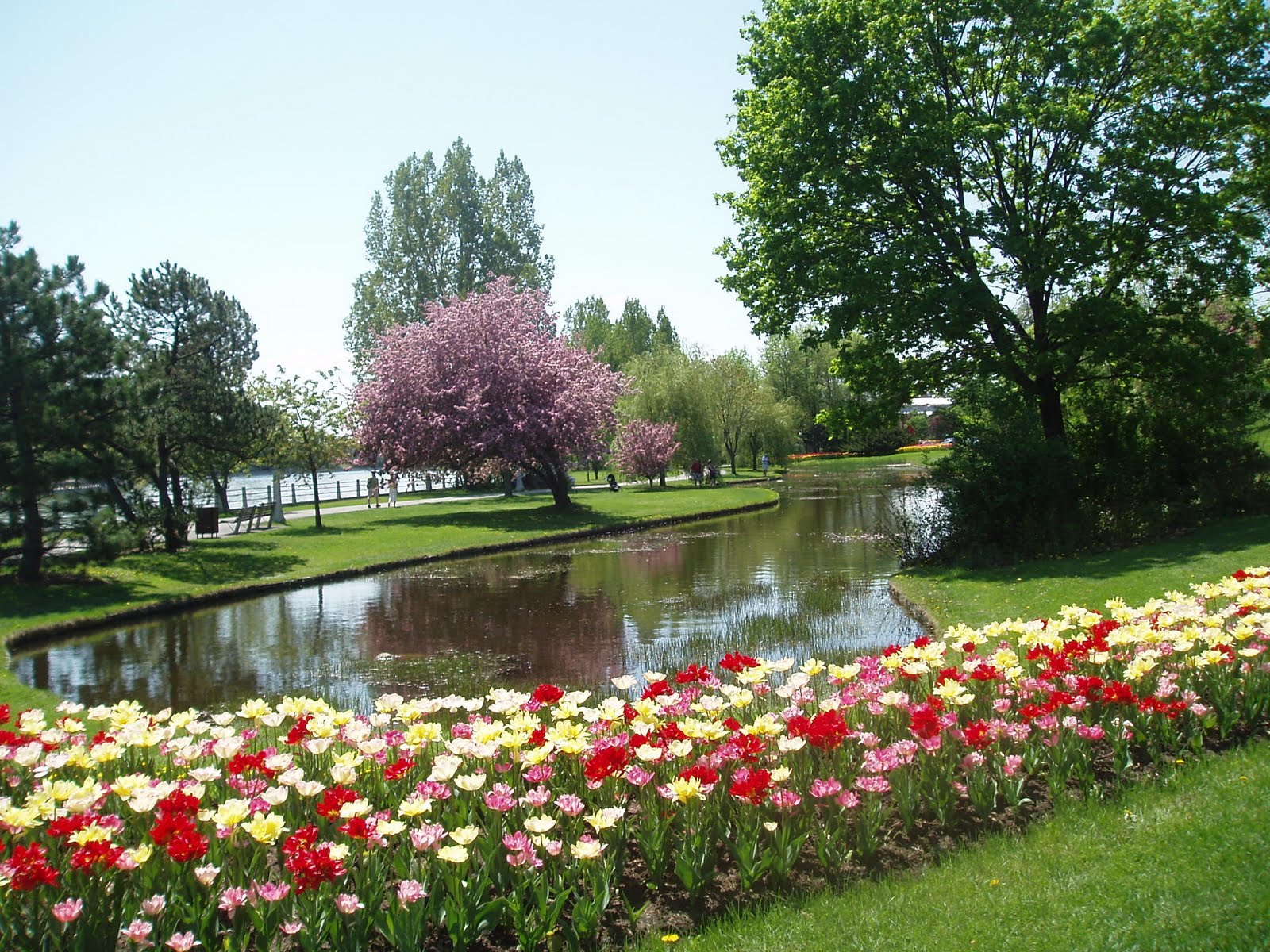


The weather gods were kind: the cool, drizzly days lasted long enough to preserve the tulips, daffodils, lilac, and cherry blossom until this holiday weekend. I took all these photos today, all within 1-300 meters of our front door. There are many much lovelier displays further afield all over Ottawa but I'd have to get the car out, negotiate traffic jams and road closures. Life is too short for that. A year ago today I drove Wendy around to see the tulips and cherry blossom at their best, on what turned out to be our final pleasure drive. After that, we drove only to and from the ALS Clinic.
Thursday, May 19, 2011
Benefits of a cool, damp spring
I've often been regarded as a bit of a weirdo, out of step with most other people, and I wear this label proudly. Many are complaining about the cool, drizzly weather we have had lately, but I'm not. My contentment with it was reinforced as I drove to my Tai Chi class this morning through a gentle misty sort of rain. This weather is preserving the tulips and cherry blossom which often have wilted and gone altogether by this date. Today the brilliant colours looked almost incandescent, seeming to light up my way along the road beside the Rideau Canal. The huge magnolia tree on the next street north from here hasn't fared quite so well -- its blossoms have wilted and many have fallen. You can't win 'em all. Otherwise I welcome this cool weather, but fear that it will be gone, and many of the tulips with it, by the end of the holiday weekend that's about to begin.
Tuesday, May 17, 2011
Memoirs again, and other matters

The photo shows Bernice Trollope, her daughter Karen Trollope Kumar and our guide at the old printery on the Niagara River Parkway.
On Friday 13 May, Christina's 25th birthday, I flew Porter Airlines, the one my daughter-in-law Desre says is tops, from Ottawa to Toronto Island Airport. Porter is as good as Desre says it is: how delightful to be pampered again on an airplane! I'd almost forgotten what it feels like. Karen Trollope Kumar met me and drove us both to the Kumar family home in Hamilton. Karen had printed some copies of her memoir, Cloud Messenger, and we spent several hours going over the complete book. I think her memoir of the years that she and Pradeep lived and worked in the Garhwal Himalayas is fascinating and very well written. However, this is a first draft, and inevitably there are a few glitches. I advised her to put the book away for a month at least, then go over it again -- hard advice to follow as I know full well. When I've followed the advice the result has always been an improvement in the quality of the finished product, and I'm sure Karen will discover this too. We didn't spend the whole weekend working on her book. She, her 89-year old mother and I drove to Niagara on the Lake and saw two plays in this year's Shaw Festival. I was sad to see the creeping expansion of NOTL into the surrounding orchards and vineyards; there are new 'developments' (sinister word!) everywhere we looked. But it's still an attractive village and the theatrical company is as good as ever. The Shaw play that we saw was "Heartbreak House" -- one of Shaw's wordy, preachy plays, rather incomprehensible in places, salvaged to some extent by a spectacular set. The other play, by Shaw's contemporary Lennox Robinson, was a very good comedy called "Drama at Inish" and carried me back to my school days when an English teacher who had worked as a stage hand at the Abbey Theatre in Dublin, introduced my classmates and me to a whole host of Anglo-Irish poets and playwrights. It was dismally wet and not very warm for which the consolation is that the profusion of flowers, especially the lovely tulips, might flourish longer than they would in the searing heat that Wendy and I have sometimes encountered at NOTL. To escape from the drizzle, we dropped in at the old William Lyon MacKenzie printing works on the Niagara River Parkway, now a small museum. It evokes memories of my favourite Uncle Lester's printery at Orooroo in rural South Australia, where Uncle Lester let me use his linotype machine when I was about 7 or 8 years old, to make a slug of my name so I could stamp it in my books -- some still on my shelves after all these years and multiple moves. The slug is still here somewhere too among a lifetime of pack-rattery. Raman, Karen and Pradeep Kumar's son, is the same age as my grandson Peter; he graduates from McMaster's general arts and sciences program this year and goes straight on to medical school. He is a very impressive young man and provides another reason besides my own grandchildren's future careers, why I'd like to live at least another ten years, so I can see what he decides to do with his life. I briefly saw Sonia Kumar too, and was happy to see how she has improved since I last saw her. She looks comfortable in her own skin; I'm sorry there wasn't a chance to chat to her at greater length. My cleaning lady Sue Ng collected the mail and newspapers while I was away. I was dismayed to find a letter from Canada Revenue Agency demanding a notarized copy of Wendy's death certificate, because I know they already have this -- obviously their left hand knoweth not what their right hand doeth. I suppose in due course all such wrinkles will get sorted out, but it's annoying, even distressing, when this sort of thing happens.
Subscribe to:
Posts (Atom)