Pages

Total Pageviews

Saturday, November 27, 2010

Fiftyfive Years of Pictures of Janet Wendy


I'm no expert as I load photos of Wendy, mostly with others, extending over the fiftyfive years that we loved each other. I haven't arranged them in strict chronological order, but starting at the bottom and working upward, there's the fuzzy photo Janet Wendy's traveling companion Louise Zuhrer took of us on the day we met, then Wendy on the day we announced our engagement, a few wedding photos, and so on up to recent times when most images got misplaced. The top one was takem at Daly's Restaurant on Christmas Day 2009 when her illness had weakened her neck muscles but left her face (and her smile!) intact. The next two date from about 1985 then follow others more recent. I'll ask a child to help me get them in order and add captions, though some are self-evident...

Thursday, November 25, 2010

A Memorial Ceremony

Perhaps this should be called a Memorial Service. It was held yesterday in a chapel that is part of St Mathias church, conducted by the lady vicar whose first name is Joan -- I don't know her family name but she is a sweet and kindly lady. She conducted a short memorial service honouring Wendy. Rebecca and Jonathan came with me. I think it was probably organized by Wendy's friend Shiela Carr and her husband Peter. There were some 20-25 women present, almost all, perhaps all, members of the Family Life group of which Wendy has been part ever since we came to live in Ottawa 41 years ago. By that time, 41 years ago, I had renounced my Christian faith -- I could not believe the basic tenets, the concept of the Trinity, rising from the dead, life everlasting, nor any of the rest of it -- and Wendy was in the process of following in my footsteps into atheism. But she remained a member of the family life group because of firm friendships with its members (and I venture to suggest, closer adherence to the values and behaviour expected of good Christians than some members of the group). It was a simple yet moving ceremony: a few readings, including the 23rd Psalm, no hymns, an opportunity for a few reminiscences, and for me to announce the Celebration of her life that we are planning for Friday February 11, 2011. After the ceremony we sat at tables for six to eat a sandwich and cake lunch, where I noticed that one variety of brownie looked and tasted very like the most popular of the cookies that Wendy used to make when our kids were young. It was the one that my father called "Compressed haggis" -- a name by which it's been known in our family ever since.

Today I was visited by Lianne Johnston from the ALS Society. She called at my request to collect leftover supplies that might well be useful to another person with ALS. I suppose this was in a way part of the process of letting-go. Last night there was another part of this process: Rebecca and I went through several boxes of winter gloves, hats, scarves, etc, selecting a few to keep, depositing most in a box to go to the Food Bank, which collects warm winter clothing as well as food items for the needy people of Ottawa. So that was Letting Go -- but the memories those warm winter gloves evoke haven't gone away, and never will. I'll have more to say about Letting Go when I've had more experience of it. One thing I won't let go, and will tell if other family members don't tell before I get a chance to say it at the Celebration on February 11, are a few anecdotes about Wendy's occasional oddities and eccentricities: the time she stormed out of our home on a freezing winter morning because each of us in turn had said we didn't want "again" or "yet again" our favourite Edinburgh winter Saturday lunch of pancakes; and the time, in our first Ottawa winter, we went blundering off into Lanark County looking for what must have been mythical snow sculptures (this was a year or two before the winter carnival was firmly established as an annual event in Ottawa). I think we will be able to muster half a dozen or more such anecdotes -- although one or two of them will require very careful use of words and expert phraseology to be suitable for use in mixed company. More of this topic anon.

Monday, November 22, 2010

A modest request

I miscalculated; it would be useful to have more copies of Wendy's death notice from the Globe & Mail or from the Ottawa Citizen. If any of my neighbours happen to read this post in the next day or two, just drop your used copy of Saturday's G&M or Citizen at my door on the 11th floor. And any department colleagues could just drop their used copy (or the relevant page) in my mailbox in the office, which I will be visiting later this week. I thank you in anticipation

Another point of view about Wendy

Here's Daughter-in-law Dorothyanne's perspective: (Ex-daughter-in-law to be precise, but she was married to David for well over 20 years, is the mother of our grandchildren and she is still my daughter-in-law whatever the technicalities say). I've left out one short paragraph but haven't corrected a small, irrelevant mistake: Wendy wasn't raised on a farm, but her sister married a farmer; and that farm might have resembled Cold Comfort Farm ever so slightly in some respects.


There was this wonderful woman, raised in the depths of New Zealand on a farm that could have stood in for Cold Comfort farm. She was tough and hardy and smart and funny and unafraid to be herself. She married an Australian, high risk for a New Zealand gal. I’ve watched Australians chase New Zealanders around a room with their conversations – Aussies are aggressive and Kiwis tend to seek compromise, and thus it was for some 50 years of marriage between these two people.

I only got to see in from the outside for a while when I was married to their son, another tough, hardy, funny, smart type, who had a perfect blend of Oz and Kiwi temperaments which made for an interesting life with him. His sister, ever so slightly older, constantly astonishes me with her wisdom and humour and I’m honoured to call her a friend; his younger brother is a character in his own right and much fun to know.

They all circled in their own orbits around this sun of a woman – she would pull them in with her love but, compared to my mother, rarely used guilt as the short leash. She made wonderful cakes, some heavy enough to support buildings, and lighter than air Pavlovas that swept across the tongue like a cool spring breeze. She worked tirelessly for those less advantaged than herself and made me ashamed of my own selfishnesses.

She and her husband supported each other through years of happy marriage – yes, lumps and bumps and a few muttered asides as occur in all happy marriages, but they rubbed along together well, even through her last challenge, ALS.

ALS is a horrible disease – it shrinks you and wastes you and for her, it was a huge challenge in that she had to let others do things for her. She fought this and strove to look after herself, walking on her own until her last week of life. One visit I made she was barely able to hold up her head, and yet she was offering me tea, and had to make it for me, hostess parfait til the end.

But, being the practical, wise, thoughtful sort of woman that she was, she’d also know that without her to pull the family together, they might just spiral outwards, get involved in their own lives, touch base infrequently. When she married, she left her family behind in New Zealand. She’d understand the need to focus on husbands, wives, friends, careers. And she’d be above using guilt to try to drag people together. Nope, she’d just be there, quietly or noisily supportive, making people want to come to her.

As we all did.

Much love to you, wherever you may be.

Wednesday, November 17, 2010

Janet Wendy's death

Janet Wendy Last, born 85 years ago in Christchurch New Zealand as Janet Margaret Wendelken, died peacefully on Monday November 15 at about 2 pm. Her death was gentle and calm: she had been slipping in and out of rather deep unconsciousness to a more wakeful state in which she could squeeze my fingers very gently and even from time to time open her eyes and look about her at her assembled family, Rebecca, David, Jonathan, Rebecca's husband Richard and David's first wife Dorothyanne and his second wife Desre. She tried to speak to me several times, I think to say 'Goodbye' which is more or less what I whispered to her. Almost everybody present, even the excellent nurse who gave her occasional medication, had tears in their eyes. I was too full of emotions and memories of our lives together to feel able to cry, and that's my loss I suppose - but I know the floodgates will burst sooner or later and I will release those pent-up signs of strong feelings.

Wendy's last few days went exactly as Louise Coulombe said they would, very quickly after the long, slow progress of the disease. About the middle of last week she said she felt too tired to be bothered getting up and dressed; by Thursday for the first time her legs were too weak for her to use the walker to get from our bedroom to the power wheelchair on the far side of our living-room, so we used the transfer wheelchair. Then when she sat in the power wheel chair, tilted far back so her eyes could focus on the TV screen where most evenings she watched an episode or two of one of her favorite BBC TV programs that we have on DVD (usually the long-running As Time Goes By) she dozed or slept, was not interested in the small domestic follies and pleasures of Lionel and Jean and the other characters whom she regards as old friends. By Saturday it was clear to me that she was dying, and we began 24/7 nursing. She remained comatose from then on, with brief spells when her eyes opened and once or twice she tried to say something but her powerless voice muscles frustrated those transient efforts. But as I sat by her bedside holding her hand there were responsive squeezes and I know she was communicating with me, as I was with her, signals of love and innumerable memories. Despite occasional misunderstandings about requests for suction, the fan, a rug over her knees or a mouth-moistening pad, she and I had over the years developed some sort of telepathic or extrasensory way to communicate important things.

All of us gathered here Monday morning: Rebecca, Richard, David, Desre, Dorothyanne, Jonathan,taking turns holding her hand, engaging intermittently in irrelevant and rather light-hearted conversations. By mid-morning her imminent death was obvious. She had Cheyne-Stokes respiration, alternating runs of shallow breaths and no breaths; her fingers were blue and ice-cold. The nurse kept her as comfortable as possible. Finally she slipped out of this life about 2 pm.

From the beginning it was a gentle, painless process. The saddest, most frustrating aspect was Wendy's loss of the power of speech. She was always such a warm-hearted lady, communicating her feelings for others so aptly, it was a cruel fate to have that power taken from her.

We have so many shared happy memories, so much to be thankful for, that the pain of losing her has been softened by these memories.

Sunday, November 14, 2010

People we've met

Wendy's journey with motor neuron disease, or ALS, brought us into contact with some remarkable and wonderful people. Her personal support workers are the ones we know best. Several times I've mentioned Sharon Morrison, and her photo has appeared on this blog. Sara Kerrigan merits more than the passing mention I gave her. At first she seemed such a kid, only 22 years old, half way through her nursing degree at Ottawa U, working part time as a PSW, aspiring to specialize in palliative care nursing. In the months she has been coming here she has matured, become more proficient, more self-confident. She has an outstanding role model in Jodi Gannon, the visiting nurse who came every day. Jodi is the epitome of everything a good nurse should be: skillful, competent, compassionate, charismatic, a splendid professional. I would love to have had her on my team. Courtney Henderson, occupational therapist is another who went the extra mile on Wendy's behalf. There were others too, nutritionists, nurses, and above all of them, Louise Coulombe, MD, palliative care specialist physician, whose wisdom and experience and calm words of comfort sustained both of us through Wendy's journey. In a separate category each and every member of the entire team at the ALS Clinic gave Wendy their undivided attention whenever we went there. As her disease progressed and her needs changed, the focus shifted from one part of the team to another, but throughout the course of her illness, every one of them seemed to us to have the same compassionate approach that makes all the difference to the patient's level of comfort and confidence. I am profoundly grateful to them all, can't find adequate words to express my gratitude.

Friday, November 12, 2010

Another way fate has been kind to us

A few days ago I attended a meeting for family members caring for a person with ALS that was organized by Heather Allen, the social worker at the ALS Clinic. Listening to the wife of a young man who is afflicted I thought, "There but for the grace of god..." When Wendy and I were in that age group, the thought didn't haunt me, but did occasionally cross my mind, that she and our (then 2) small children would have been left destitute if I had been killed or incapacitated during those immensely happy and scientifically productive years. Our only security was a puny life insurance policy; our family support networks were fragile and far away on the other side of the world. We survived on a scholarship stipend intended for a single man with no dependents, then later on a salary not far above the minimum wage, and there were no fringe benefits. In this way as in so many others, fate or chance or whatever it is that determines life's course have treated us kindly. No such calamity ever struck us when we were most vulnerable. That's another blessing to count at this sad time as Wendy's life ebbs away. Today for the first time her legs are too weak to support her and I had a hard time holding her up on my own during the middle of the day when we have no personal support worker. We are closing in on the time I'll need more help...

* * *

As a compiler and editor of dictionaries I'm always interested in words. Today, reading the Guardian Weekly, I came across a word new to me, I suppose a rather new word from computer-speak, 'petafloppies' which from the context I infer to be a word signifying the speed at which a computer can process data (or the number of bits of data a computer can process simultaneously). I like the sound of it. The prefix 'peta' is a unit used to signify a very large number, 10 to the 13th power; and 'floppy' (as in floppy disk) means flexible or capable of being changed or transformed. I couldn't find the combined word 'petafloppies' in any of my shelves of print dictionaries. But I'm sure my grandson Peter will know what it means. And now David has told me that 'floppy' is an acronym, but I've forgotten the words so he will have to add them in a comment on this blog post. The word appeared in a news item: the Chinese have a super-computer that can process data and more bits of data, than anybody else ever has. It's yet another sign that China is becoming the top nation. I hope it won't require another war to establish that reality securely.

Monday, November 8, 2010

Support networks

Today Francine ("Frankie") Nadeau, occupational therapist in the speech language pathology section of the Rehabilitation Centre/ALS Clinic came to our apartment with a mechanic/technician (Rob?) to fit a bracket on Wendy's wheelchair, so the Dynavox can sit there all the time, or as long as she wants it to anyway, instead of having its heavy weight perched on a cushion on her lap while one of us stands there to hold the weight off her. This is a great step forward and she has been making good use of the machine since this bracket was fitted. We are profoundly grateful to Frankie and Rob for coming here rather than asking us to go out to the ALS Clinic. The personal care and attention to details that everyone is providing for Wendy is heart warming. All members of the professional team who care for her are cheerfully compassionate and competent; they lift my spirits as well as hers. I can't find adequate words to express my gratitude for all that everyone is doing to make her remaining time with us as comfortable as humanly possible. Words of comfort and support arrive almost daily also from distant places, some frequent and with photos of new additions to the family, like Dodie Ziemer's and brother Peter's, others like Stephanie Blackden's email today from Scotland, with interesting news updates. And of course Rebecca and Richard visit us, and David phones or Skypes, almost every day from Kingston or Toronto, friends and neighbors drop in just about every day, as do our visiting nurse, usually Jodi or Mark on her days off. Our living room is like a garden too, with all the flowers we receive. These multiple supporting networks are a tremendous comfort to both of us during this difficult journey that Wendy is embarked upon. We never feel alone. It is very comforting that Wendy, who all her life has done so much for so many other people, has so many tangible tokens of other people's concern for her. I suppose it's a demonstration of the truth of something I said and wrote not long ago: we humans are hard-wired to care for each other.

Saturday, November 6, 2010

Miracles

It's been unusually cold in the past few days with drizzling rains and even threats of snow flurries - wintry by Adelaide standards, late autumnal by ours but bleaker than usual; and leaves still cling bravely to branches of many trees I can see from my window. Daylight saving ends today, so it will be dark an hour earlier tomorrow and we will know that winter isn't far away. Perhaps Wendy's condition is adapting to the season and she is preparing to hibernate. She is sleeping more of the time, drowsy and dozing off after each meal. Her oxygen saturation readings have been lower lately too, in the low 90s rather than the high 90s which probably explains her drowsiness. I offer to read to her from Bill Bryson's latest book, or Alexander McCall Smith's, but she isn't interested: it requires concentration and she doesn't have any to spare. So I put on a CD of one of the Dave and Morley stories from the Vinyl Cafe, the one in which Dave finds a little sprout of green leaves of a plant growing in the mess that has accumulated on the floor of his car, nurtures it, and it grows into a tree. Morley thinks it's a sumac, but it's an ailanthus, the Tree of Heaven, and when Dave and Morley carefully transplant it to a corner of their back garden it could and probably will ultimately grow to a height of 60 feet. I want to say this is one of my favorite Vinyl Cafe Dave and Morley stories but I have so many favorites the list is longer than the handful that leave me cold. Stuart McLean is indeed worthy of the accolades he's beginning to accumulate; his latest book, just out, isn't more of the stories but a haphazard collection of remarks (many from the opening moments of his weekly radio show); and some of these are wise, funny, even occasionally profound. I thought Wendy had dozed off towards the end of the story about the tiny green leaves on the floor of his car that grew into a Tree of Heaven, but she didn't, she was listening with her eyes closed. I'm happy about that, because this story is a rather lovely celebration of the miracle of life. Even though her life is approaching it end, Wendy and I can still celebrate the miracle of life, and the miracle that brought us together 55 years ago.

Wednesday, November 3, 2010

O tempora! O mores!

Some of my American friends have described me as an honorary American and at times I've thought of myself this way too. My remarks today will offend and alienate some, perhaps most or all of these friends.

In 1964-65 Wendy and I decided after a few months in the lovely little New England university city of Burlington, Vermont, that beautiful though it was and with many delightful people who became our friends, nothing would induce us to settle permanently there or indeed anywhere in the USA. Even then it was clear that the nation was headed in the wrong direction. Despite its vast wealth, squandering it on pointless foreign wars fomented by paranoid fantasies would lead ultimately to economic ruin. I don't recall ever meeting an American who recognized the war in Vietnam as the war of liberation from foreign domination that the Vietnamese and fair-minded Europeans and others perceived it to be. (The same must be said of the war in Afghanistan). I've discussed before in this blog other, more important, factors related to culture and values that led us to choose the University of Edinburgh rather than Johns Hopkins School of Hygiene and Public Health in Baltimore. The Iraq war, launched on another paranoid fantasy (or on lies) plunged the nation deeper into debt. Americans have squandered their riches, spilled much blood, wasted the natural wealth and despoiled much of the natural beauty of their country with total disregard for future generations. But it's the immature political system, its corruption by "lobbyists" and its total subservience to money that unnerves me most. The bizarre and juvenile "Tea Party" movement spent over $1 billion on a campaign based on its fantasy that lower taxes and "less" government would solve their problems; and of course they won massively because the ill-informed and poorly educated American masses believed this claptrap. But the USA's trouble is older and deeper than the little turbulence of the latest elections (parenthetically, part of the trouble with the USA is frequency of elections: planning with a time horizon of decades is an impossible dream in a nation that plays musical chairs with elected policy-makers every 2 years!). Greedy stockholders seeking instant wealth and conniving boards of directors who dismantled thriving American industries, exported jobs to countries with lax or non-existent labour and environmental laws in order to boost quarterly dividends, and corrupt incompetent banks eager for quick profits today with no thought for tomorrow, have combined to ruin the USA. Its industries have been dismantled and exported to China and elsewhere; its skilled workforce has to make do with poorly paid part-time McJobs and no benefits. Meantime legislators were bribed by lobbyists to dismantle safeguards against irresponsible home loans and several million who lost their jobs have lost their homes too. So of course they are angry, but instead of blaming the corrupt and incompetent politicians who created these fiascoes, the incumbent president and his party get the blame. An evil subtext, never spoken aloud, is the colour of this president's skin. (The far right wing Tea Party is overwhelmingly white. And it is covertly racist as well as against gays, freedom of choice for women and other progressive causes). I hope enough Canadians are savvy enough so Canadian politics can't be dragged down to the gutter level of the Tea Party.

Monday, November 1, 2010

winter is a- comin' in

The last few days have been a little rough, mainly because of broken sleep and colder weather. We used to think nothing of slipping out of bed to have a quick pee, but now it takes two of us to accomplish this solitary function: I have to transfer Wendy from a semi-horizontal to a momentarily vertical position while I dance with her a step or two from bed to commode then back again under sheet, eiderdown and blankets. She's light as a feather now, 70 pounds if that, so easy to dance with; but her shrunk shanks have very little muscle strength and it saddens me to behold when I recall her plump thighs and shapely calves of former times. And once back in bed she rapidly goes to sleep again, thanks to a bolus of her sedative tranquilizer; but I don't, perforce I must sleep lightly in case she needs me again, so no sedative-tranquilizer for me. Last night we had our first skiffs of snow, just a few flurries really but enough to cover rooftops. This morning it feels colder because it looks colder, although a glance at our indoor thermometers shows it's actually not any colder in our apartment, steady at 20-21 C - it's not quite all in the mind though because I can actually feel the icy blast of the wind as it whistles though the crack by the balcony door which still has its summer screen. It's time to put the storm door on, yet another sign that winter will soon be here. But the sun is shining, there's still plenty of colour in the trees. They will keep their leaves again this year until well after November 9, the anniversary of my arrival in Ottawa in 1969. That year there wasn't a leaf left on any tree anywhere and I remember feeling depressed at the thought of the long winter ahead, worried too that I'd made a big mistake uprooting Wendy and our three children from Edinburgh where we were so happy and life was so good in so many ways. Happily, time soon showed that coming to Ottawa was no mistake, far from it, indeed it was the best decision we ever made. This feeling is reinforced whenever I observe or reflect on the excellence of the team that cares for Wendy with such competence and compassion. What good fortune it is, to live in a city where such superb care is provided when she needs it!

Wednesday, October 27, 2010

John's first political campaign


I'm sure it won't be his last, he really seems to have the fire of politics in his blood. In the contest for the position of mayor of the city of Kingston, he ran fourth, with 377 votes, far behind the three high-profile well-known candidates but well ahead of the other two 'fringe' candidates. I am pleased and proud of this youngest of our grandchildren. He got valuable political experience, conducted a smart and almost cost-free campaign, and perhaps more important, was noticed by more experienced politicians, which could be a useful attribute in a few years if he stays with his career aim and becomes a political journalist. I hope I will stay alive and sentient long enough to see what becomes of this young man.

Saturday, October 23, 2010

Our grandson the political star

Young John Last, our grandson (age 19) is making ripples, rather than waves, in his campaign to be elected mayor of Kingston (pop 135,000) a university city about 250Km
southwest of Ottawa. Kingston is home to the venerable and prestigious Queen's University, the Royal Military College, miscellaneous light industries; tourism, farming etc also contribute to its economic base. John's campaign is mainly internet-based (he can't afford lawn signs, hire of assembly halls, etc), and hasn't got a team for door-to-door campaigning: he has no moneyed special interest backers. If I've got the right URL, you can see his picture and an article about him at
http://www.ktw.ca/ArticleDisplay.aspx?e=2780352 (I tried unsuccessfully to upload a very good photo of John that heads this article, but the file format would not upload; however you can see it- and read the article - if you copy and paste the URL above into your browser).

There are various other links and a website, http://www.runthistown.ca/
There were originally four of them involved in this but it seems to have
narrowed down now to John. It would be a hoot if he were to win, which in this time of political volatility isn't entirely impossible.It's valuable experience for his future career, no matter what the outcome.

He has lived in Kingston about half of his life. His campaign got a big boost this week when he was endorsed by the Queen's University student newspaper. Their editorial staff interviewed all the candidates, asked each of them three leading questions, said his responses were the best, most impressive of all the candidates. You can see this editorial at http://www.queensjournal.ca/story/2010-10-22/editorials/last-doesnt-lack-lustre/ where it appears with a cartoon that is quite a good likeness.

The election is on Monday October 25. We will be awaiting the outcome with keen interest

Monday, October 18, 2010

How to spot good writing

Today I did what I suggested in the last note I posted: I read aloud to Wendy the Introduction and part of Chapter 1 of Bill Bryson's new book, At Home. Out loud, his words read mellifluously, proof if proof were needed, that he writes extremely well. This experiment will continue for as long as Wendy wants it to continue. I haven't read aloud since we lived in Edinburgh in the 1960s: I had a commodious chair in which I sat with Rebecca and David beside me, each perched on a low, broad arm of the chair, and skinny little runt Jonathan beside me. Whatever happened to that chair? Why didn't we bring it to Canada with us, in the same way we brought our piano, the breakfront bookcase and several other living room chairs? I missed that chair for years; I suppose someone made an offer for it that we couldn't refuse. But I digress. I was writing about reading aloud. I treasure the memory of those reading aloud evening experiences because they were so pleasurable; and what made them so was only partly that in this way I bonded more closely to all three children. Another part of the experience was that we read some of the greatest works in the English language -- children's books to be sure, but great literature nevertheless. Reading Bill Bryson aloud is as pleasurable because he is such a fine writer.

Sunday, October 17, 2010

Serendipity, or Finding lost treasures

In each of our last two homes before we moved to our apartment at 300 Queen Elizabeth Drive, I had over 70 meters of book shelves - 76 meters at 34 Waverly Street, 72 meters at 685 Echo Drive; here I have 24 meters. So several shelves hold rows of books behind other books and many hold books untidily stacked in front of or on top of more or less neat rows of books. The long column of Hakluyt's Voyages, the Everyman Encyclopedia, and several other sets are sturdy enough, and leave enough space above them and the bottom of the shelf above, to hold a pile or a few books for which otherwise there would be no space anywhere. What's more, when we moved in here I didn't take the time and trouble I'd taken previously to organize and arrange my books. So that's why I often hunt long and fruitlessly for a book I know I still have, that I didn't pass on to one of our children or grandchildren, or dispose of to a dealer or in a garage sale. (There is also the John Last Collection of over 700 rare and antiquarian books on medicine, public health and related sciences that is safely stowed in the Roddick Room of the Royal College of Physicians and Surgeons). Hunting is fun though, even when there's only 24 meters to hunt through. I've remarked before in this blog about the unexpected delight of coming upon a lost treasure when hunting for something else altogether. This afternoon in this way I found Bill Bryson's Notes from a Small Island. I'm a great admirer of Bill Bryson, and mine is a treasured copy I bought in London many years ago, almost an identical twin of one I saw last week on the shelves in the corridor between the tower and the garage; but not quite a twin because mine is the original UK published version, the one in our condo's library was published in Canada, with the subtle changes in wording and style that publishers make presumably in the belief that readers are insular idiots. I should compare the UK and Canadian versions, but the latter quickly disappeared from the condo's little collection so the opportunity was lost. Why do I admire Bill Bryson? An American from the middle of Middle America, he's married to an Englishwoman and has lived most of his adult life in England. He has written one of the best books extant on the English language (The Mother Tongue) and several of the best, certainly the funniest, travel books of modern times. Notes from a Small Island exposes mercilessly some of the flaws and fault lines of modern Britain and British life and times, but it's written with love and affection unequalled in any other travel book. Most of his other travel books are like this, often with rich patches of laugh-out-loud rollicking wit. I read Notes from a Small Island on a train trip from London to Edinburgh and it's as well that most of the time I had the carriage to myself (it was one of those modern long carriages, not cut up into compartments) so my guffaws of unrestrained mirth didn't disturb fellow-travellers. For her birthday last week, I got Wendy several books, one of which is Bill Bryson's latest, At Home. It looks full of interesting, quirky, odd, offbeat information and ideas. It may be hard to resist the temptation of having first dibs -- or maybe this is one I could read aloud to her...

Friday, October 15, 2010

birthday celebrations


Yesterday, October 14, was Wendy's birthday, her 85th. We celebrated in a low-key way, 'we' being Rebecca, Richard, David, Jonathan, Sharon Morrison, Wendy's charismatic personal care worker, and I. Throughout the day, various friends and neighbours popped in briefly (just about everyone now is aware that brief visits are better than long ones).

Wendy got some splendid presents, practical things like large handkerchiefs and a useful device from David to help her lift herself off a chair, books by Stuart McLean and Bill Bryson among others, a new wrist watch (an el cheapo one from Zellers, not a multi-mega-buck watch by Cartier or Rolex); gloves and mittens, and a lovely fur 'scarf' that doubles as a muff, from Suzy and Elfie Juneau. The most original present is a fancy printed and bound copy of Richard's menu; having been associated for many years with the restaurant business, Richard knows where to go to have fancy menus produced. The result appears in the two pictures at the top, the cover, and the specialty dishes he has prepared. Most people can eat these with knife and fork. For Wendy's special consumption, Richard blends each of these, and freezes them in ice-block sized nuggets. Our freezer is full of rows of labeled plastic bags full of nuggets of each dish, which we thaw and heat as required. This began as an experiment that has been so highly successful that we have encouraged Richard to consider making a commercial venture of his creations. I have a hunch that this venture would be successful enough for us all to retire on the proceeds.

Tuesday, October 12, 2010

Thanksgiving Parade of Lasts - a photo album


Three perfect days: cold, frosty mornings than warm sunshine all day, lighting the brilliant Fall colours. Accompanied by Wendy's personal care worker Sharon Morrison, our three kids and I took Wendy out in her power wheelchair. Jonathan,in his role as the official family photographer, took many photos. Here is a selection, including one of him when he entrusted the camera to Sharon. I tried unsuccessfully to arrange them in rows but this elderly computer is moody, crotchety, has the sulks or for some other reason best known to itself it won't do what I tell it to do. Also, the photos aren't arranged in the order that things actually happened.

Friday, October 8, 2010

The Speed FiendTerrorizing the Neighbourhood


As a learner-driver, Wendy is confined to two speeds in her power wheelchair, for easy reference designated "snail" and "tortoise." As the names imply, these are not the highest speeds at which the chair will move. Yet to judge from the expression on her face -- reminiscent of an E H Shepherd drawing of Toad of Toad Hall at the wheel of his racing car in The Wind in the Willows -- Wendy has challenged a chipmunk to a race to the next tree, or perhaps has just run one down and is pursuing another. Anyway, it's a picture that signifies how much she was enjoying her spin in the open air on a lovely autumn day with the colours almost at their best; today I think they were a little nearer perfection, and tomorrow they may achieve their utmost brilliance.

There's no doubt her chair has been a great morale-booster, a timely, very necessary boost because life otherwise has not been fun lately. She is increasingly troubled by excessive salivation and mucus production so her suction machine is her best friend. She is using all her high-tech equipment with increasing confidence and skill, managing the Dynavox speech synthesizer, mainly to write short notes or single words, rather than lengthy speeches. The subcutaneous line through which I can administer a surreptitious dose of Medazalam to calm her when she gets agitated is another great help. I don't over-use this, perhaps twice or three times in 24 hours.

We continue to be enormously grateful and favorably impressed by the dedication, competence, charisma, and overall pleasantness of the battalion of skilled professional workers, community-based and at the ALS Clinic. All act as if Wendy is their only patient, though we know they have many others. These include quite a lot of patients with motor neurone disease, locally known as ALS. It's a commoner disease than I'd always thought until it struck so close to home. Epidemiological evidence is rather sparse and not informative, not even a plethora of intriguing clues as there are with MS and breast cancer. So we are a long way from discovering how to prevent it. Nonetheless, some time in this blog I must say a little about its epidemiology, which has some intriguing features.

Wednesday, October 6, 2010

noise-makers

Yesterday Jonathan 'personalized' Wendy's power wheelchair with noise-makers to attract my attention more effectively than the little tweeter with which it was equipped when we got it. That little tweeter sounds exactly like the warning signal a reversing truck might make on the street outside, so when I heard it I took no notice. Jonathan got two simple non-electronic noise makers, a little bicycle bell, and - at my suggestion - a little trumpet operated by a rubber bulb. These are screwed to the frame, one on each side just below the arm rests. I'm happy to report that the trumpet with the rubber bulb is a great success. It's easy for her to squeeze and it makes a very distinctive noise. It even evokes happy memories: in 1977-78 when we lived for a year in New York City we had one each of these on our bikes and could communicate with each other by coded toots -- until someone nicked our tooters. Unfortunately they were secured to the bike frame only with wing-nuts, not nut-and bolt, so were very easily undone and spirited away.

Wendy is continuing to fade away. Yesterday her weight had dropped to 77 pounds, much of the loss being further wasting away of muscle mass. She is increasingly afflicted with excessive mucus and salivary secretions, so the little portable suction machine is her best friend.

We are so pleased that Jonathan managed to persuade her to venture out into the open air yesterday. It was a perfect sunny Fall day, not a cloud in the sky, hardly a breath of wind, the trees a blaze of colour. Overnight it turned cold and today it's raining, so she made her open air expedition in the nick of time. Jonathan took lots of photos too, so as soon as I've had a chance to look at them I'll post a selection on this blog.

Friday, October 1, 2010

Wendy has a line now

For several months,Wendy has been taking benzo-diazapam by mouth and for more than two months I have been giving her an injection of Medazolam, a benzo-diazopam derivative that acts as a sedative and tranquillizer, at bed time every night. Lately I have had to give her another injection when the bed-time dose wore off, usually between 11.30 pm and about 0100; occasionally she has to have a third dose around 0300 to 0400. As you can imagine this is pretty disruptive of her sleep and mine. When Louise Coulombe called yesterday afternoon (a very busy day of visits, we had half a dozen friends drop in briefly one at a time as well as the dietician, the technician from the power wheelchair supplier, and the therapist who fitted her for the chair) and I told her about Wendy's and my disrupted sleep. She said it was time for Wendy to have a subcutaneous line and continuous small doses of Medazolam, with the option of a larger bolus as necessary, for instance to settle her for her afternoon nap. Dejardins pharmacy, which is licenced to distribute narcotics and similar supplies, arrived at 1015 last night with the boxes of supplies, and this morning, just as I was finishing off dressing Wendy's peg tube, Jodi Gannon, our visiting nurse, arrived and set everything up. So Wendy has become even more bionic! She gets most of hr nourishment from the PEG Tube which I use four times daily to give her high-energy liquid and sundry medications; but she also has -and greatly enjoys - food by mouth. At breakfast time she has jellied orange juice, mashed banana and a cup of tea; at lunch she has a thawed-out mushroom or carrot soup a la David Last, laced with whipping cream, and another cup of tear. Her supper, midway between her 4 pm and her 8 pm tube feed, is one of Richard's ever-increasing range of gourmet dishes. I will provide a complete list in a future post because I haven't time for this today.

Monday, September 27, 2010

reactions and replies

A rather grey drizzly Monday was enlivened by several letters from New Zealand, almost all with newspaper cuttings of the damage done by the magnitude 7.1 earthquake near Christchurch. One graphic description of the noise sounds almost identical to but much louder than the noise I heard when we had a 6.0 tremor here a few weeks ago. But ours was not only a rare event in these parts it was far less devastating. The Christchurch earthquake and its aftershocks collectively did damage amounting to several billion dollars, but unlike the earthquake of identical magnitude some months earlier in Haiti, it caused no deaths whatever. We can thank New Zealand's rigorous building standards for this. We'd heard all about the Christchurch earthquake before today of course, in TV reports and numerous emails, some with photos. But actual letters in envelopes bearing stamps, evoke the reality in some indefinable way, bring it home to us more vividly than the email messages. Is it just me, and my age, conferring on handwritten and typed letters with or without enclosed newspaper cuttings a greater authenticity than electronic signals?

One of these NZ letters had a photo of two recent additions to the human race, a toddler and a newborn baby; the toddler's name, I was delighted to see, is Caleb. That's a very uncommon name nowadays; it's the name of my father's uncle, who was a signalman on the Great Western Railway, operating signals and switches near Warwick; and I have on my wall a meticulously accurate pencil sketch of Kenilworth Castle, or rather of its ruins, dated 1886, by Caleb Last, who, I suppose, had no art lessons; nor did my father or my son David; but all three use exactly the same technique to draw meticulously accurate pictures. I suppose this is a genetic characteristic. I wish I shared it!

Today's emails were interesting too. One from my friend Jeff House in San Francisco echoed a plea from another friend in Chicago last week: why don't I write an Op-Ed, a panegyric singing the praises of the Canadian health care system. Why indeed! Well, entrenched opinions aren't swayed by the kinds of facts, figures and anecdotes I could muster. Minds are made up, and aren't going to be swayed by facts or by eloquence greater than mine. Thanks for the thoughts, but I'll count our blessings and sit this one out.

Friday, September 24, 2010

All power to the chair!

After a timid start there's been no holding Wendy back these past few days as she gets more accustomed to driving her power wheel chair. All the family felt frustrated when we had such perfect weather last weekend but we simply couldn't persuade her to go outside. Early in the week, however, Rebecca and Richard backed me in tempting her to venture out the back door in the corridor between our tower block and the garage, then the next day Courtney Henderson, who fitted her for the chair and made last-minute fine-tuning adjustments, persuaded her to go out the ramp from the garage to the street. Once she has got used to driving out of doors there will be no holding her. But she loves the chair most of all because she can tilt it to the position that she finds the most comfortable -- as you can see in the photos in the post before this one. Now she is spending most of her waking hours in it.

Her chair is brand new, custom-built to her exact measurements, and is the latest and best example of the excellent service we have been getting from our health and medical care system. Diffidently, I raised with a couple of members of the team caring for her the question of priorities in allocating scarce and expensive equipment that I've discussed in earlier posts on this blog, and was emphatically told that setting priorities plays no part whatever in the process. We waited as long as we did simply because there's a great deal of work involved, and not enough skilled chair-builders in the business.

Another thing that happened this week is that I had a birthday, celebrated in a pretty low key manner this year but that's as it should be; there is nothing special about the transition from 83 to 84 years. Richard provided delicious salmon and all the trimmings to go with it, which made a pleasant change from my usual steak and two vegetables; and Rebecca produced a splendid little cake, the last remains of which still repose in the frig for me to savour over the weekend.

Saturday, September 18, 2010

Comfortably ensconced


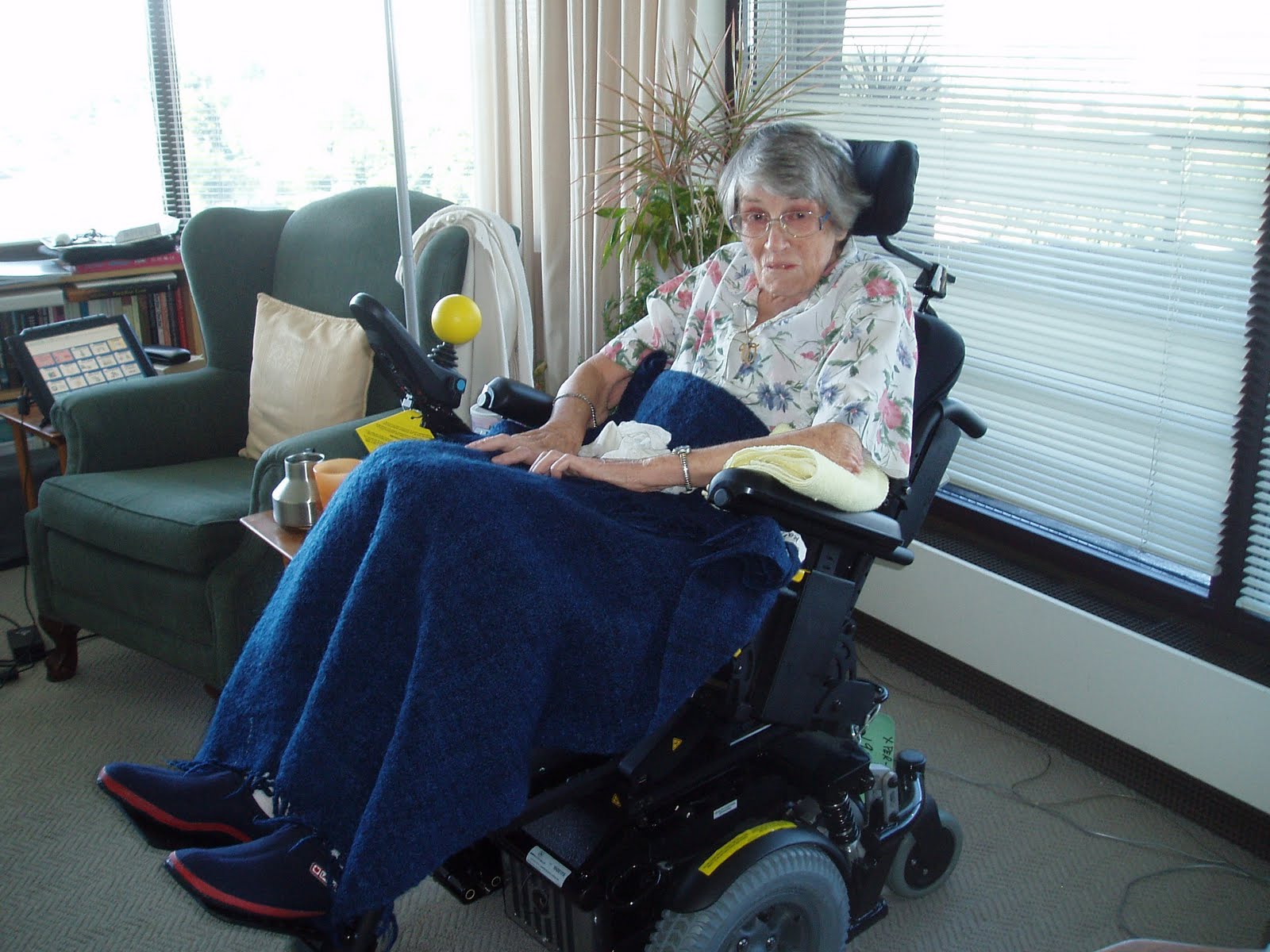
Here are a couple of photos taken today of Wendy in her new wheelchair. She is still learning how to use it, but is making excellent progress. One of its advantages is that she can control the amount of tilt to give herself the most comfortable position to recline. Once she becomes proficient driving it, the controls can be adjusted so she can move about while in this reclining position, but for now as a learner driver for safety reasons, she has to be upright, or very nearly upright before the chair can move.

In the background of these photos you can see her speech synthesizer's touch screen, set here on symbols. Her keyboards, either alphabetical order or QWERTY keyboard, are on the nest screens - very large letters, too large for touch typing, which is a good thing because her weakened fingers are too 'clumsy' as she puts it, to be able to touch type now.

Finally the power chair has arrived

Now we have every item of high-tech equipment and specialized device that can be deployed to make Wendy's life a little easier. This week we went to the workshop where major items of equipment and devices are assembled. Her power chair had some final fine-tuning adjustments and she had a test-drive in a spacious room where several other large pieces of equipment and devices scattered about the room presented tricky obstacles that she had to steer around. Two days later it was delivered, and she has since had a few test=drives in our apartment -- leaving visible traces of her passing in the form of several abrasions and scars on furniture, walls and doors... The power wheelchair is a snug fit and she sits higher in the room, towering over me in the next chair. there is an elegant perspex tray that slides over the arm rests and her speech synthesizer can sit on this. Above all, it is very comfortable, and can be tilted back so she reclines in a semi-recumbent position Which is all very fine, but she feels trapped when she is in the chair, especially when the tray is in place. She can't get out unaided, whereas she can get in and out of the arm chair unaided, or rather just with the arms of her walker for leverage. Of course as her legs get weaker she will find the power wheel chair essential but for now she is in an in-between state with legs that are weaker but still work reasonably well. I think she and I may both be wondering whether she really needs the power wheel chair; at present she doesn't but she soon will, so it is as well to get used to it and to learn how to handle it before it becomes her only way to get about. Today we are having one of those perfect late summer or early autumn days, a day of bright sunshine with a cloudless blue sky, the first traces of autumn colours, no wind, temperature in the low 20s. So today I will encourage her to get outside into the fresh air.

We continue to get letters, cards and emails from family members and friends who are scattered far and near in all corners of the world. This morning when I turned on the computer the first email to pop up on the screen was from Dodie Ziemer in Melbourne, a dear friend I have known since she and her husband Harald arrived in Adelaide as migrants from Germany on Christmas Day 1955. Wendy met them a few months later when she and I were courting. Dodie and Harald are in good shape, staying in touch by Skype phone with their son Markus, daughter-in-law and twin grand-daughters who are living in Santiago, Chile, for three years. One of the changes in the world in my lifetime has been this new freedom to move easily all over the world and for family members and friends to stay closely connected despite sometimes vast distances of physical separation. Alas, Skype no longer works well for Wendy; she and those with whom we speak by Skype can see each other, mostly David and Desre who Skype-phoned from Toronto last evening, but Wendy's voice fails under those circumstances. At least we can see each other and she can smile her lovely smile, can make gestures; but speech is nearly impossible and the synthesizer is too slow as yet. She needs more practice, but says she doesn't feel motivated or inspired to get this practice. I'll continue to encourage her and with time and practice her skill will increase.

Wednesday, September 15, 2010

Life-changing events

In the 1950s the group medical practice in which I became a junior partner had a monthly financial meeting. Our accountant presented the latest balance sheet, the earnings and expenses of each partner. At the meeting in about October 1958 my partners rejoiced as the accountant recited the numbers. I could not share their glee. I saw in my mind's eye the sad face of a woman whose only son I had helplessly watched as he died of overwhelming viral toxaemia during the Asian influenza pandemic that had brought us so much work in the previous months, made so much money for all of us. On the morning before our meeting, this grieving mother had insisted on paying me for my fruitless visits to her son. He had been my friend, an occasional playing partner at golf, which made our encounter emotionally stressful. That had been a moment of truth. I realized in an instant that I did not want to get rich on the proceeds of other people's misfortune, sickness or suffering. I loved my work as a family doctor, but could not share the delight my partners expressed that evening. In that moment of truth I realized that I would have to find another way to follow my profession...and, as it transpired in due course, to lead a small part of it briefly. So that monthly business meeting in the early summer of 1958 was a life-changing event. A second life-changing event followed 2 or 3 months later. As the influenza epidemic waned, I fell ill myself with a life-threatening virus pneumonia; and during my slow convalescence I had time to think about ways to make the best use of the life I had been spared to live. That was when I decided to leave the family practice I loved, and make a career in helping as best I could to find ways to keep people as healthy as possible for as long as possible.

Friday, September 10, 2010

Priorities

In the 1960s when we lived in Edinburgh, my Canadian-American friend Kerr White sent Marie McCormick, a very bright medical student from Johns Hopkins University medical school, to spend a summer term elective period with me. Marie later became a distinguished pediatrician. The main task he gave her for her summer elective was to find out what criteria were used in Scotland to set priorities for the use of scarce and costly renal dialysis services. It was an epidemiological approach to an ethical problem, priority-setting in the allocation of very scarce and very costly services The question of setting priorities for renal dialysis and Marie's youthful enthusiasm led me to become associated for a while with a select committee of the Scottish National Health Services that had the heavy responsibility of deciding which patients in renal failure would get access to renal dialysis and the chance to live a little longer, and who on the contrary would not get access to dialysis and therefore would be allowed to die untreated. Put like this, it sounds cold-hearted, inhumane, the opposite of what good medical practice is supposed to be. On the contrary, it is the very highest quality medical care, to use reason rather than happenstance, wealth, emotion to decide how best to allocate extremely costly equipment and a skilled team of very highly specialized physicians and the technical experts responsible for running and maintaining the equipment, performing tests and titrating biochemical variables. I can't remember all the details but I do remember that in the early and middle 1960s the existing renal dialysis services in Scotland could meet the needs of only about one in every nine or ten of the theoretically eligible patients. As best we could determine at the time the situation was much the same in other wealthy nations, except the USA, where the deciding factor was (and still is) wealth: those who could afford to pay got dialysis, even if they suffered from a terminal condition like diabetic renal failure. In Scotland then, and in other enlightened nations then and since, decisions about allocation of scarce resources and the expertise of highly specialized professional staff were based as far as feasible on reproducible scientific evidence. It is a variation on the theme of triage, the system used to decide whom to treat first (and whom to allow to die quietly) in a major disaster with mass casualties.

I remember and think about Marie McCormick's work on renal dialysis in Scotland in the 1960s when I see the range of sophisticated equipment and devices, and reflect on our good fortune to have such a plentiful supply of skilled expert professionals caring for Wendy. Is there much priority-setting, or is access to the top quality care we have had, determined by my 'rank' or my knowledge of the system? I don't think it's either really; I think we are just fortunate to live in a city that is fairly well supplied with excellent professional people in all the branches of the Canadian health care system, and a reasonable supply of all the specialized devices and equipment that we have needed. Once again, I'm thankful for the Canadian health care system and all the services and skilled staff it employs.

Monday, September 6, 2010

More toys

Toys isn't the right word, I know: these are pieces of equipment. One very useful gadget that I don't think I've mentioned before is the suction machine that Wendy uses when she is troubled by the overwhelming flow of mucus and saliva that from time to time stream from her nose and mouth almost in a torrent. This distressing symptom is common in advanced stages of motor neurone disease (ALS). Some sort of suction is far superior to a handkerchief which is soaked in a few moments, or a box of tissues that might all get used in an hour or two. She has had this for a week or two now. Yesterday (Sunday) Louise Coulombe finally cleared her backlog of urgent house calls and came to see Wendy. We have argued, Wendy and I have argued, that is, about the efficacy of the BIPAP ventilator. I tell Wendy that when she sleeps while she is using the face mask, she seems constantly to be distressed, judging by the noises she makes and her facial expression; moreover, it doesn't fit well, most of the air escapes around the sides of the face mask so each intake is accompanied by loud fart-like noises, which she can't hear because she is so deaf. On the other hand she sleeps quietly and peacefully without the ventilator. So yesterday, Louise said she needs a proper hospital bed in which she can be propped up; and this should eliminate the feeling of suffocation she gets when she lies flat. Sitting up, she is not breathless, and her oxygen saturation level is 97-98%; and she can get about our apartment quite briskly with the aid of her walker, so her respiratory reserve is still quite considerable. Louise asked for the hospital bed to be delivered tomorrow afternoon. Tomorrow morning we have an appointment with the speech language pathologist, to collect the speech synthesizer, so by tomorrow evening two costly and complicated item of equipment will be added to those we already have. This week we might also get the power wheel chair that we have waited for now for several months. The advantage of this over the walker she uses now is that she will be able to see where she is going, rather than only the floor beneath her feet, because it is to be fitted with a reclining back. It's as well that we have a spacious apartment!

Friday, September 3, 2010

Another Labour Day weekend

This blog post carries on a 'tradition' that lasted over 40 years. For many years I wrote a family letter during the Labour Day weekend, that was a sort of 'status report', because this weekend marked the end of the allegedly relaxed summer and the beginning of another academic year with new groups of students, new courses, and cooler weather. This year we have the last of these with emphasis - it's been another hot week with temperatures in the 30s and high humidity, and then right on schedule, just as the weather forecaster said it would, a front came through around 6 pm on Friday with thunder, lightning, high winds and heavy rain; and the temperature on our balcony dropped nearly 10 C in 20 minutes or so, from the low 30s to 22 C. Already it almost feels like an autumn evening. The holiday weekend will be much cooler, but at least some of it will be sunny, and it will be much more pleasant than the oppressive heat and humidity we've had all this week.

This year has been very different from any other in our experience. No interesting travels to exotic destinations, just a shut-in time for Wendy with a slow but relentless decline in health and vitality; she sleeps a lot, has no energy, has lost a great deal of weight as her muscles waste away and she has become less and less able to do things for herself. But on the positive side, she has no pain whatever, and her mind is as sharp as ever - even if she has some difficulty telling what day of the week it is. For her, every day is much the same as every other day. Lately her speech has become increasingly difficult to understand, and she has had increasing difficulty articulating her words, because she is losing the nerve supply to the muscles she uses to speak. So I was very pleased indeed to get a phone call today from Margo Butler, the speech language pathologist at the ALS Clinic, to tell us that the speech synthesizing device earmarked for her has arrived. We have an appointment to get accustomed to it, complete the paperwork, etc, first thing on Tuesday morning, after the holiday weekend. This speech synthesizer is a complex electronic device that would cost somewhere between $25K and $30K if we had to buy it. The way the Ontario Health Insurance Plan works is that we get it on loan from an equipment pool for an annual rental fee for as long as we need it. If we program it appropriately, I think Wendy could even use it to send and receive email, but we will find out on Tuesday whether that would be possible with the machine Wendy is getting. Stay tuned for further bulletins on this.

Monday, August 30, 2010

That girl

That girl is Lisbeth Salander. Over 40 million copies have been sold worldwide of three fat books, each over 600 pages long, describing her achievements and misadventures. She is described as a tiny, waif-like thing, tattooed, pieced, sometimes wearing 'goth' makeup and clothes. She possesses uncanny computing skills that she uses to hack into the most protected computers in Sweden and tax-free havens everywhere; she fights and defeats great hulking men several times her size, using a unique combination of martial arts and cunning. She has less than a handful of true friends and allies, and a large and diverse array of enemies seeking to kill her or lock her away forever in an asylum for the criminally insane. These enemies include recognized criminals, biker gangs, corrupt police and secret service agents, lawyers, financiers, among others. But she is a superwoman who vanquishes thugs, ruthless killers, assorted criminals and a sinister secret neo-Nazi network of black-hearted villains embedded in the Swedish secret police and intelligence services. She survives mayhem that would lay low the he-man heroes of comic book legends: in the climax of the second book she is shot three times (one bullet penetrates her brain) and survives being buried alive, because she is a comic book heroine and the female of the species is stronger, more intelligent, more, more every kind of good superlative, than the male. I devoured the first book of the trilogy as a fast read that took a few hours to skim its more than 600 pages, and skimmed the other two volumes in an hour or so apiece. No doubt I missed a lot of gory detail and tedium between the blood-and-thunder episodes. If I still were flying back and forth across the Atlantic, these three fat books would have kept me amused long enough to ease the boredom of a flight each way. As it is, I can only envy the author, or rather his estate, for dreaming up this unlikeliest of heroines and amassing a huge fortune from the sale of astronomical numbers of copies in goodness knows how many languages, not to mention movies in Swedish with American spin offs to follow. But dragon tattoos, playing with fire, and kicking hornets' nests aren't enough to make for longterm survival; the world will soon pass on to better books.

Sunday, August 29, 2010

Summer scenes

Looking out our picture windows on this lovely morning I saw among the exuberant green leaves of late summer the first orange and golden leaves of autumn, and realized that this summer is passing me by. This morning I decided not to allow it to pass entirely without some experience of it, so while Sharon Morrison, Wendy's personal care worker, was still here I went out for a walk along the path by the Canal. Much of Ottawa's population seemed to be doing the same, the path almost needed a traffic patrol; it would certainly have benefited from some method of separating speeding cyclists from mums and dads with babies in strollers, dawdling elderly folk like me, winter sports lovers with devices resembling skis with little wheels fore and aft, propelled by ski poles fitted with ends like midget toilet plungers, the occasional skate boarder (is skate-boarding waning? It seems so locally) and of course many, many people on roller blades,keeping their skills honed for the ice that they hope will cover the Canal in a few months from now. It required more sure-footed dexterity than I possess these days to avoid colliding with the wheeled varieties of outdoors-lovers on the wide and recently resurfaced pathway, so I retreated like many others to the grass beside the pond, where I had to watch my feet to avoid the large and rather sticky deposits left by the Canada geese that have adopted these lawns as their favourite pasture. This is the pond where carp and catfish spawn in springtime but all those large fish are now long gone, many of them down the gullets of Chinese fishermen for whom this pond is a favourite place in spring and early summer. Today the pond was chock-full, like the path alongside it, not with people but with adolescent ducks learning the up-tails-all skills of stripping the waterweed from the bottom. It's a better place to learn that skill than the canal or Patterson's inlet beside our condominium because the water is less than half a meter deep with a flat, sand or gravel bottom from which the waterweed is easily stripped. But it was hot already at 1030-1100 this morning, so I cut short my stroll in the fresh air and retreated to the air-conditioned comfort of our apartment. I hope I will have some opportunities to experience more of this splendid summer before it all ends.

Saturday, August 28, 2010

Wendy's Wall Hanging


We celebrated our thirtieth wedding anniversary at a splendid sea food restaurant in Sydney, and I have photographs to prove it. But Wendy also made a wall hanging that marked some milestones of our first 30 years together. This looked absolutely splendid on the exposed bricks of our large kitchen in the row house at 34 Waverley Street in Ottawa. She never meant it to become a permanent part of the decorative art on our walls but when we moved in 1990 from that tall, narrow home to a cottage on Echo Drive, we took the wall hanging with us, and from there it came to our condo apartment. Our reason for clinging to it has very little to do with its artistic merit and a lot to do with memories evoked by the scraps of material she cobbled together to create the images on this old length of faded green fabric. They are all that remains of clothes she made that our kids had outgrown, or that she made for herself or me, and we had discarded. Every piece of material reminds us of our past in happy ways. And the images, or pictures? From the bottom up and right to left, these are a kangaroo (John) and a Kiwi (Janet Wendy); a beach in Adelaide with two stick figures (one heavily pregnant); Sydney Harbour; Trafalgar Square in London; Sydney again, with a cock-eyed Opera House; a sugaring-off hut and ski slope in Vermont; Edinburgh castle; New York, complete with the twin towers of the World Trade Center; and Ottawa, with the Peace Tower, Chateau Laurier, the Rideau Canal at sunset. I fondly think that final top left-hand image shows the influence of French impressionist art we had been admiring in Musee D'Orsay not long before the burst of creativity that produced this wall hanging. It richly merits its place just inside our apartment door, and in the book of Selected Works of Janet Wendy Last.

Thursday, August 26, 2010

More helpful equipment

It's been a busy day. Jodi Gannon, Wendy's visiting nurse, assembled the suction machine that was delivered a day or two ago, so from now on we can use it, as dentists do, to clear excess saliva and mucus secretions that occasionally build up in Wendy's mouth and at the back of her throat and cause distressing feelings of choking. Dorothyanne and Peter were here at the same time as Jodi so once again I was deprived of an opportunity to chat at leisure to Peter and find out more about his travels with Sylvie in Cambodia and Vietnam. There was time between moments getting instructed by Jodi about the suction machine for Peter to tell us that he and Sylvie will edit the thousands of pictures they took, add a commentary and get the whole thing made into a book of their travels, perhaps something like the book we made of Selected Works of Janet Wendy Last. Just as Jodi left, our expert on aids to getting about, occupational therapist Courtney Henderson arrived, soon followed by Shelly from the equipment supplier, with the good news that Wendy's power wheel chair will be ready next week. It seems that we won't much longer have to feel like Vladimir and Estragon, Waiting for Godot. The chair will be fitted with a tray table that can hold her speech synthesizer. The combination will add greatly to Wendy's mobility and capability to communicate.

Tuesday, August 24, 2010

More supporting stuff

If I believed in god, I'd give thanks to her for providing us with the Canadian health care system and its services. As we enter each phase of Wendy's journey with motor neurone disease (ALS) we discover that it's been anticipated by the team of supporting health care professionals, and there is a specialist professional and suitable and appropriate equipment to deal with it. This week began with a visit from the nutritionist/dietician - who explained to me the fine distinction between these two callings - and continued with the arrival of several more boxes of equipment and supplies. Last week I mentioned to Louise Coulombe, our palliative care physician, that Wendy is increasingly troubled by mucous secretions, and asked tentatively whether some sort of suction like the dentists use, might help. The boxes that arrived today from Ontario Medical Supply included an electric suction machine and all the supplies of saline etc to use with it. It looks terrifying complex in disconnected parts in its box and I dare not try to assemble it. I'll leave that job to Louise or to Jodi Gannon, our visiting nurse. Our living room and our bedroom look more and more like a hospital or clinic, and there is no doubt more to come. Wendy is hanging in there, tackling each new challenge as it arises, most of the time cheerfully and bravely - though she has complained about the discomfort of the face mask she wears when using the BIPAP ventilator. I give her a small subcutaneous injection of tranquilizer to take the edge off the discomfort, and tomorrow I will visit the supplier to see what sorts of alternative face masks are available. The one she got originally was quite comfortable to begin with, but as her facial muscles have wasted away a little bit, it doesn't fit neatly any more, so I'll try to find one that does fit. She continues to lose flesh, her arms and legs are painfully thin and the bones of her spine stick our like so many teeth. Her voice is going too, so we hope the speech synthesizer I mentioned in any earlier post will materialize soon. In case it doesn't, Jonathan is going to make some flash cards with common and important words and phrases on them. The list I already have will be a good start towards this, and in fact may contain everything Jonathan needs. I give her four square meals a day through the PEG tube, and as well she eats breakfast, lunch and dinner - almost all in liquid form, though she does have avocado and banana, mashed up but otherwise indubitably solid.

Friday, August 20, 2010

Wendy's photo is in a medical journal

For some years, the International Society for Environmental Epidemiology has been sponsoring a series they call 'Voices' in which prominent epidemiologists are interviewed in front of a video camera. The interviews are preserved in perpetuity in the Society's archives. In addition, an edited transcript is published in the Society's journal, which is called Epidemiology. I was interviewed for this project in May 2007. My interview lasted about an hour and a half, which may help to explain why it has taken so long for the edited (and much truncated) transcript of the interview to find its way into print. I was asked to supply two photographs, one dating from early in my career, the other a current or very recent photo. For the latter, I chose the photo of Wendy and me that was taken at our golden wedding anniversary banquet, expecting that it would be cropped to show me only. To my surprise, the editor of the journal left the photo intact, so I am very happy to report that an excellent photo of Wendy Last has appeared in the September 2010 issue of this prestigious scientific journal. You can see it, and the edited transcript of the interview, at:

http://journals.lww.com/epidem/Fulltext/2010/09000/A_Conversation_With_John_Last.32.aspx#

I think it's absolutely splendid that Wendy's photo, a very good photo too, will be preserved in print and electronic archives, in such places as the National Library of Medicine in Washington, DC, the Royal Society in London, England, and several thousand other medical and scientific libraries all over the world. Wendy richly merits this distinction! (The same photo appears in full colour in the blog post of July 28).

Thursday, August 19, 2010

machines that speak

Yesterday Janet Wendy and I had a useful session with Margo Butler, the speech language pathologist, and 'Frankie' Nadeau, one of the occupational therapists who specializes in user-friendly equipment at the ALS Clinic. The purpose of our meeting was to learn more about the speech synthesizer, a very fancy electronic device that can speak for her now that the muscles she uses to speak are no longer consistently receiving effective signals from nerve endings that have atrophied. That's the underlying problem with motor neuron disease (ALS): the nerve endings that supply muscles atrophy, or die, so the muscles no longer receive signals, and stop working. This happens both to voluntary muscles like those in the fingers, hands, and voice-box, and to 'automatic' muscles like the diaphragm and the muscles between her ribs that she uses to breathe. That's why a ventilator at night while she sleeps is a great help, because it gives the breathing muscles a chance to rest. It's her voice-box muscle failure that is making it impossible for her to speak intelligibly for an increasing part of the time. Eventually her voice muscles will fail altogether. So soon she will have a device like the one that the theoretical physicist Stephen Hawking uses, but a nice female voice rather than one that sounds like a Dalak or a spaceman from another planet. She and I liked the machine she tested very much and hope it can be delivered really soon; but it comes with a stand that has a very large footprint. It will fit easily enough in our spacious living room amid all the clutter of walkers, equipment tray tables, wheelchairs etc.; but I fear it's going to be hard to avoid tripping over it. However, that's a small price to pay if it works as it's supposed to. The speech synthesizer can be programmed with commonly used words and phrases, and we spent some time creating a personalized list to add to the ones already included. It will be fun to play with this, and we hope we don't have to wait too long for it. I'm beginning to sense that because Janet Wendy is in her mid-80s, she is quite rightly lower on the priority list than someone half her age who needs the same sort of equipment. I think that's the reason we have waited so long, so far in vain, for a power wheel chair. It may be the same story with the voice synthesizer, but I hope it isn't. We will know if we don't receive the equipment within3-4 weeks that she has been bumped down low on the priority list.